$ cat posts/the-weekend-i-never-had.md
The weekend I never had
This week I canceled two services I was subscribed to. I usually have annual subscriptions to services like Dropbox or Microsoft 365. That last one I signed up for several years ago while my kids were in school, and the truth is I kept it out of inertia.
These days you don’t just feel like canceling these services because of how expensive they’ve gotten, but also because you no longer need them. In my case, everything these services gave me I now replace with Claude. I’m tempted to say that the only software-as-a-service subscription I need is Claude.
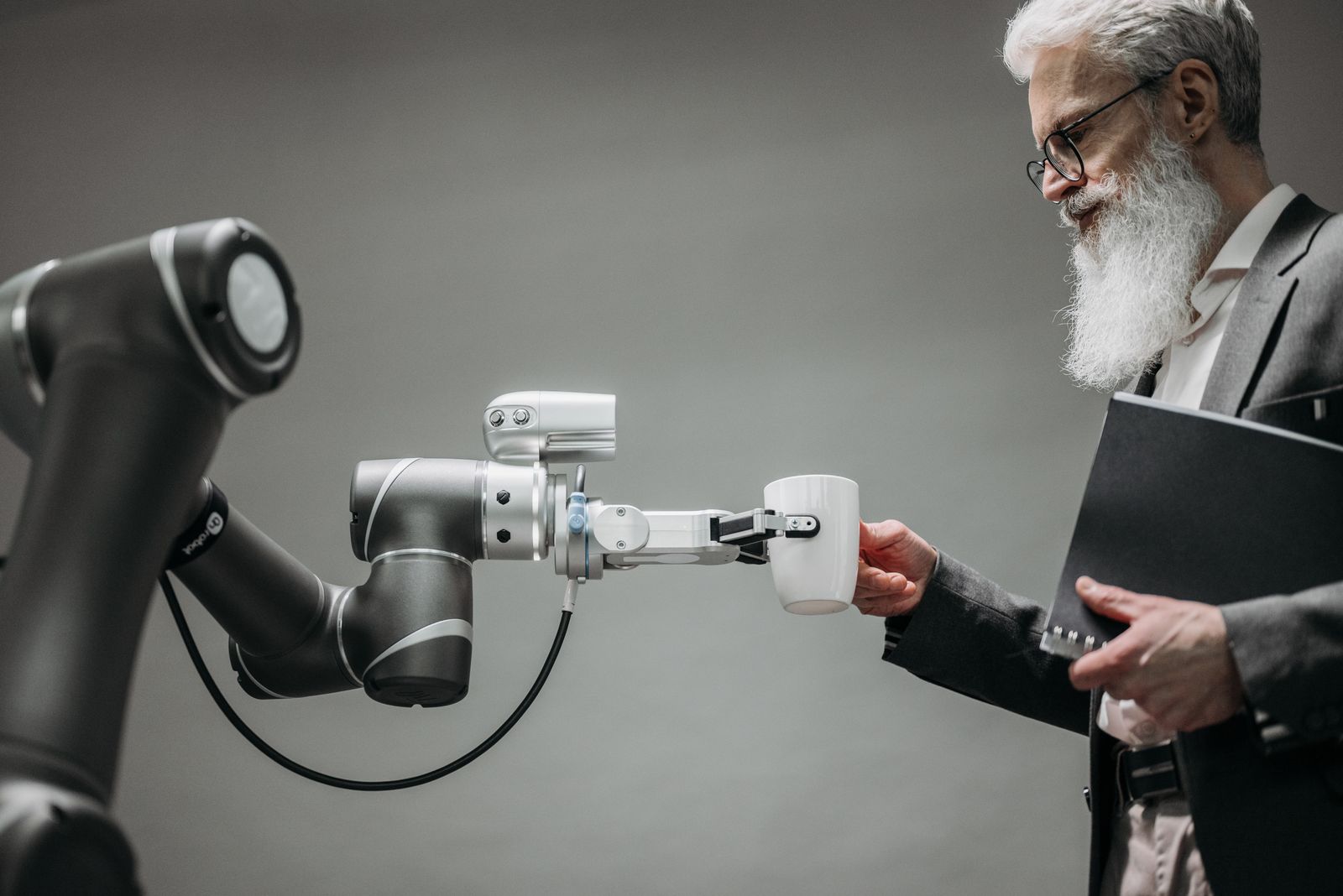
The future I didn’t see coming in 2005. (Photo by Pavel Danilyuk, from Pexels)
There’s an exercise a lot of people do with Claude: they download their bank and credit card statements, hand them to the model, and discover (we discover) that we’re spending a fortune on subscriptions we barely use, or flat-out stopped using.
If you’ve been living under a rock and haven’t done it, I encourage you to do it now. And if you don’t know how, then I have the solution for you: an invitation. But you’ll have to wait a bit (if you’re impatient, click here (in Spanish)).
What we’ve learned is that these software-as-a-service (SaaS) companies were treating us like the proverbial frog in boiling water. They slowly raised the price without us noticing. And it wasn’t until we started to feel it, after making an active effort, that we said enough was enough.
Something else that’s happening is that we software developers have always thought: “I could replace this with an app of my own, working a few weekends.” But we never have those free weekends.
Programming takes time. It means designing, writing the code, testing, validating with the end user (in this case, yourself), deploying to some infra (or creating an installer so you can use it on your personal computer).
AI has let us shorten that time: something that took several weekends spread over several years can turn, for real this time, into a weekend project.
Twenty-one years ago I couldn’t have suspected that. I didn’t believe I’d get to see the rise of AI in my lifetime. In 2005 I started this blog to share my ideas, to explore and learn about the nature of software. I had decided that building (or developing) software was what I’d devote my life to, and by that year I had already been programming for 18 or 19 years.
I no longer remember very well when I started programming, whether it was 1985 or 1986. On a little Sinclair ZX-81. That same year I took part in a project to build an interactive tourism interface. We displayed a map of our region of the country (the Second Region, or the Antofagasta Region as it’s called today). We drew it by hand on a sheet of graph paper and then wrote a long program where we fed it the points so it would plot them one by one (later I simplified it to use a vector drawing mechanism).
By 1987 or 1988 I was already getting paid for my work, and it helped me pay for my studies. I used Turbo Pascal, and with it I built systems for my first client, the owner of a hardware store. Several years later I consulted for the hardware store organization founded by that same gentleman, so they could build a modernized clone of the system he had been using since back then.
I was studying and working, and I joined a group of university classmates as a partner in their software development company. Curiously, the first job with them involved writing a user manual. I found a book on how to write a user manual in the university library, and I wrote a top-notch manual. I combined my two passions, writing and programming.
The rest of what happened I told in a series of posts titled “The End of Agile”, in case you’re interested in knowing some of my history as a programmer. Maybe that’s worth putting in a book.
In 2014 I published a book with a selection of articles from this blog. I’ll probably publish another one in the next few years. Right now I’m busy with several things, and the time it takes to publish a book properly, one that isn’t written by AI, is considerable. It’s several months, believe me. Publishing the first one ate up my time: working with an editor, correcting, iterating. As complex as building software the traditional way.
Could I cut the time to publication with AI? Maybe so, but would it be the same?
Either way, right now I’m devoted to my job, and in my free time I’m devoted to teaching and consulting.
Something worries me, and I’ve said so on LinkedIn and elsewhere. People are using AI recklessly. Out of that comes slop, code that breaks in production, or lawyers who get sanctioned for citing case law that doesn’t exist.
The people who build software aren’t clear on how to use it. In the other professions, even less so.
I’ve decided to help with that, because I’ve been using AI for practically two years now, but I also have training in Artificial Intelligence. Accidentally on purpose, when I was doing my master’s, I took courses on machine learning and neural networks, which prepared me to use it even before Transformers came along. At Uber that knowledge was already useful in my work. And later, when ChatGPT and Claude appeared, I was already using them.
I’ve always been critical of how AI is used, because there are two extreme positions I keep objecting to. First, I’m clear that we’re at a very early stage in the development of this technology, however advanced it may look. Second, at this stage we still can’t say it’s ready to replace us, much less to rule over us.
There’s a lot of sensationalism, fed by the AI labs, which have gone wild doing “Doom Marketing”. We have to separate the wheat from the chaff, and that’s hard.
The typical line, the one AI would give you, goes like this: “AI isn’t going to replace you; the professional who knows how to direct it will.”
That idea carries a fair amount of weight. At least for now. And I say “for now” because I’ve learned to be cautious. I’m not going to say it’ll be years before AI can produce an AGI, or superintelligence. I have no idea, and it’s best not to play fortune teller, because I’ve blown several predictions in the past. You never know when a company will show up with a disruptive breakthrough that makes everything we’re using obsolete (and pops the current bubble while it’s at it).
I digress. That idea, that you have to learn to direct AI, is what keeps me busy in my free time. Helping companies and individuals with my experience taming generative AI. Here I’ll tell you about two initiatives.

The machine has already learned to pour the glass. Now it’s your turn to learn to direct it. (Photo by Pavel Danilyuk, from Pexels)
The first is one I’m doing with the support of ChileTec, the Chilean tech companies’ association. Toward the end of August I’ll teach a course centered on what we now call AI First Engineering. A set of techniques for learning to master AI and bring it into the software development cycle, something I’ve been teaching at universities for a while and will now offer to a broader technical audience. Here’s the course link (in Spanish). On August 11 I’ll give a free talk about the course, describing what we’ll cover.
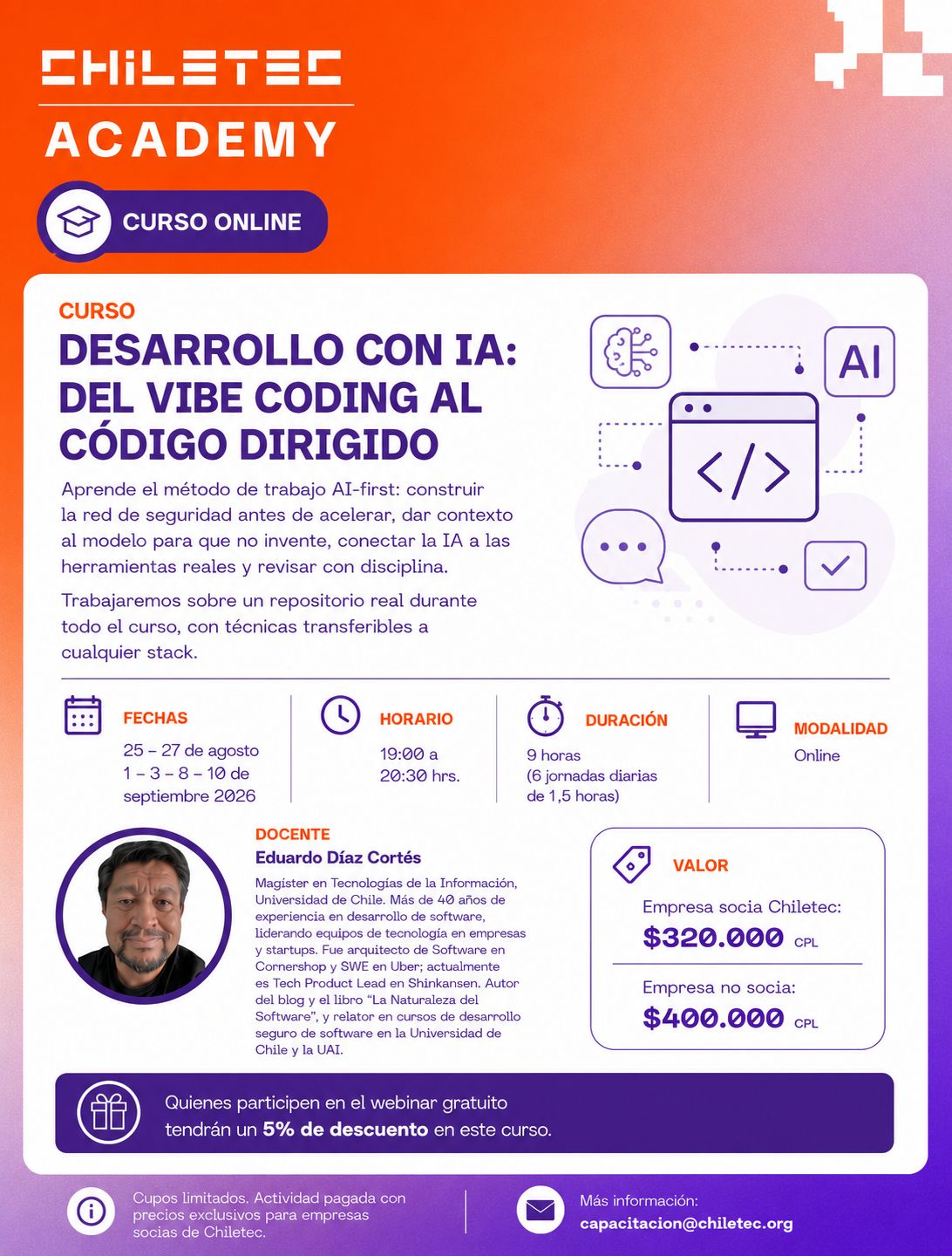
“Desarrollo con IA: del vibe coding al código dirigido” (AI development: from vibe coding to directed code), a ChileTec Academy course. Online, from August 25 to September 10, 2026, 19:00 to 20:30.
The second is a personal initiative: a remote, intensive, six-hour course, split into four sessions, Tuesdays and Thursdays (19:00 to 20:30 Chile time).
Live course (in Spanish) · Starts martes 11 de agosto
IA aplicada al trabajo profesional con Claude
Los fundamentos para trabajar con agentes de IA, demostrados con el ecosistema Claude de Anthropic. No se requiere programar.
- Martes y jueves, 19:00 a 20:30
- 4 sesiones en vivo por Zoom
- 20 cupos
If you’re not in Chile but you’re interested in taking part, sign up and I’ll contact you by email and we’ll work out the details.
This is my way of celebrating this blog turning twenty-one. In Chile that used to be the age of majority. It’s a nice age, the age of having become a young adult stepping into the experience of life on your own. I hope to have 21 more years to keep giving you what I’ve learned in these 40 years of programming.
Twenty-one years later this blog is still here because there are people who read it. If what I write has been useful to you over that time, consider supporting it on Patreon: that’s where I publish extra content, and those who join take part in choosing the topics I cover here.
Comments
comments powered by Disqus