$ cat posts/the-end-of-agile-vii.md
The end of agile (VII)
Part 7 - Jam bands
Table of contents
(To listen to this post’s soundtrack click here)
When all the little ants are marching
Red and black antennae waving
They all do it the same
They all do it the same way
— Dave Mathews Band
The first song by the Dave Mathews Band that I remember hearing is a live version of “Ants Marching”. I liked it so much that I used it in the soundtrack of a family video I made of our summer vacation in 2004.
That year we went to La Serena, and I bought the video camera right there. It has beautiful, funny moments of my older kids playing with Francisca, who had just turned two.
I don’t remember exactly whether it was in late 2003 or early 2004 that my friend Marco got in touch with an idea. Those meetings were joined by Gustavo, an Argentine colleague who worked with Marco. When I had the crisis I told you about in part 6, I worked on an electronic invoicing project for the company where they worked. I respected Gus because it was clear to me that he was a brilliant and very meticulous programmer.
Marco told me he had been approached by a successful businessman, whom I knew as well, since we had explored some business together when we worked at Énfasis. His company represented the Handkey brand, which sold a device like this one:
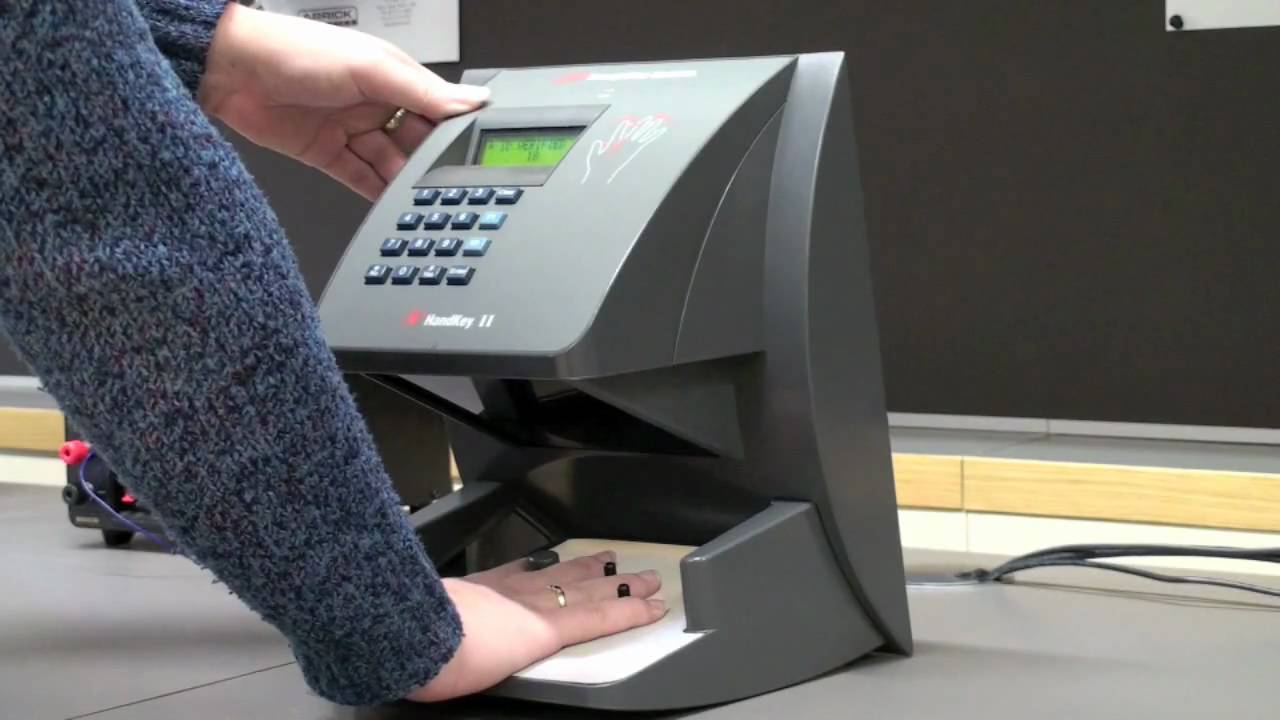
Handkey II
This gadget measures the geometry of the hand, which is very useful for identifying people within a limited population. That’s why the device started being used in some sports clubs and gyms in the capital. This businessman’s problem was that he couldn’t scale the business for lack of suitable software.
But Marco had a broader idea: why not develop platform software that would make it possible to implement identity services for people using biometrics? [That’s how we worked up a business plan that we presented to this gentleman, with the aim of creating a venture focused on solutions that used biometrics.
Our value proposition was more or less this: “whenever you need to identify someone, anywhere in your business processes, we give you the technology to answer three questions: Who, Where and When”.
That’s how Biokey Technologies was born. We deliberately chose an English name because we pictured it as a startup that could go abroad. We got a little pretentious and took titles in English: Gus was the Chief Technology Officer, Marco the Chief Marketing Officer and I was the Chief Operating Officer. [We set up in the offices of our main investor’s company, and started operating out of a showroom. When they needed that room we cleared out and set up in the kitchen or went to work at some nearby café.
The first months were intense design. Lots of whiteboard, arguments, and Marco filling ashtrays with his cigarette butts. We studied and made important architectural decisions.
When you work on software architecture you first have to consider the context in which your solutions will operate. You also have to define certain goals the architecture must satisfy. To meet those objectives you define the business principles and then the technical principles that will guide your architecture decisions. [I’ll sum this up in this diagram:]{style=“letter-spacing: 0.01rem;”}
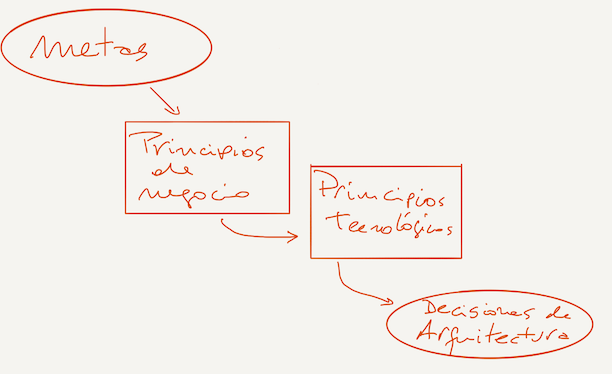
The process for making decisions in a software architecture
This diagram is very important because it is the working guide of the good software architect. If you want more detail I suggest reading the work of Rozanski and Woods [1].
Well, as I said before, our business proposition was to offer a way to help our customers answer those three simple questions: Who? Where? and When?
So we decided we would build a network of distributed biometric devices, of every kind and flavor. Biometrics would help us answer the question of who. The network structure would let us answer the where. The when was trivial: you just had to record the timestamp of each transaction.
Since all three of us had prior experience in cryptography, and in electronic documents and signature media, we could guarantee the integrity and reliability of the answers to these three questions.
Those were the principles that guided our architecture.
But once you have these principles there are practical matters to decide. In particular, the specific technology you should use. This is where we surprised everyone who knew us. We decided to use Microsoft’s .Net platform.
When we started presenting our solutions to potential customers, people who knew our technology background were puzzled that we were using .Net and not Java, all the more since we, or at least I, were known as Java fans.
One of the reasons for this decision was entirely practical: most biometric devices ran on Windows, and besides, we would have to deploy them on Windows computers. There was another, strategic reason: we wanted to form an alliance with Microsoft, which we did achieve, by the way. The third, the most important, was that both Gus and I felt like learning C#. “If it’s not fun, why do it?”

Jam Bands
Yeah
One, two, princes kneel before you
That's what I said, now
Princes, Princes who adore you
Just go ahead, now
— Spin Doctors
The term jam bands applies to those groups whose live shows generate a strong fan culture. It’s a phenomenon that started with the Grateful Dead in the 60s, and its exponents include excellent bands like Phish, The Allman Brothers Band, Blues Traveler, Ozric Tentacles, Spin Doctors and of course, my favorite, Dave Mathews Band.
It’s a very broad term that covers a range of musical styles, but what they have in common is that it brings together bands with great musicians in their ranks, capable of putting on a great live show, not so much through virtuosity as through the feeling they put into every performance.
Well, in those years, working at Biokey, I felt like I was playing in the rhythm section of a jam band. Gus and I split the work. He took care mainly of the frontend and I took the backend.
In the first months we wrote a lot of code. The goal was to show a first version of our technology at an important mining trade show.
Memories blur over the years, but I believe it was right when we were incorporating the company that I had an accident at home and fell getting out of the shower, fracturing the neck of my left humerus (that’s the shoulder, kids). That kept me out of action for at least three months. I felt frustrated, but even so I helped the guys organize the first tasks and worked on the design.
Despite the rough start, we kept moving forward. We built proofs of concept. Once I had recovered we started the real jam session. We wrote code and assembled our platform while Marco looked for alliances and prospected for business.
However, I think we fell into one of the mistakes that Roberto Camhi, in this recent article, calls deadly sins. Our failure was in the timing. Our concepts were somewhat ahead of the maturity of the Chilean market in the use of biometrics in 2004.
It may sound arrogant, but I believe no significant company working in biometrics in Chile has a proposal as clearly structured, conceptually and architecturally, as the one we developed. But this, unfortunately, confirms that technical excellence isn’t everything when it comes to succeeding in business.
In hindsight I think one of our main advantages was that we invested a lot of time in research. Maybe our investor didn’t like that, but we were convinced it was one of the things that set our proposal apart.
I’ll give you an example of what we did at BioKey Technologies. Our platform offered a security model based on the work of Ratha, Connell and Bolle, which is detailed in this paper
\[2\]. In that article these researchers explain that there are eight points of attack on a biometric system. Well, our proposal explained these eight vulnerabilities and proposed solutions and mitigations for each one. That was the technical rigor we applied at Biokey, and as I said, I don’t see much of it today in the Chilean industry that works in this field.

The model of Ratha, Connell and Bolle.
What Would You Say
Knock knock on the door. Who's it for?
There's nobody in here
Look in the mirror, my friend
I don't understand at best
And cannot speak for all the rest
— Dave Mathews Band
Since in the first months we weren’t getting sales of our products, we took on some projects that brought in the income we needed. Since much of the technology was already built, we could divert part of our attention to solving some of the industry’s problems, and that way these customers might also buy our solutions later on.
It so happened that Microsoft saw us as .Net experts, so they recommended us to an important company based in Valparaiso to improve the performance of its new web operations platform. We did the same for a cable company. The number of architectural aberrations we had to look at in those days would be enough to write another series. The transition from client-server applications to web applications was something Chilean engineers were struggling with. Microsoft didn’t help much with Visual Studio and its first versions of the .Net Framework. Many programmers thought it was right to apply Visual Basic’s event-response paradigm, and the two-tier model, which Microsoft’s tools more or less imposed. That changed with time, when Microsoft finally implemented MVC, but it was perhaps a bit late. In my opinion the damage was already done. We used C#, but in a different way from what Microsoft promoted. Since we came from Java, we structured our architecture very differently from the way the Visual Studio IDE forced on you.
Accident
Driving along this highway
All these cars and upon the sidewalk
People in every direction
— Dave Mathews Band
In the second half of 2005 anxiety was eating me alive. I was starting to feel disappointed with the venture. The idea had never been to end up, once again, in a company doing project work. I had signed up to build products and a platform. On top of that, I had to resolve some old conflicts with my mother and my siblings, which led to tense situations. Remember, too, that I was dragging along a financial mess from the previous years.
We had set ourselves an initial salary level in line with the original plan. It was a good income, but it was below what all of us partners had been used to. We accepted it because it was a way of motivating ourselves: if the business was good, if we managed to sell our products, then success would mean better salaries.
But that wasn’t happening, and I’ll explain later what mistake we made. What happened to me at that time was that anxiety was pushing me into depression. I remember my friend Marco took me to the hospital a couple of times, because I thought I was having a heart attack. They were actually panic attacks. I had to start seeing a psychiatrist and begin treatment. I was diagnosed with depression.
To make things worse, in January 2006 I had a serious car accident. The Grim Reaper’s scythe went by close enough to graze my hair. I went almost a year without driving after that. The only way forward I found was writing. In August 2005 I started writing this blog, and at first it was a form of escape. Then writing started to help me, little by little. I think the main thing I learned from that time was that I had to stop keeping so much to myself. In Ants Marching Dave Mathews writes:
But we never say a thing
And these crimes between us grow deeper
I learned that there were things I was keeping to myself too, in all my relationships, with my family, my friends, and at the company. So I had to learn to say them.
A pocket full of kryptonite
Come on downtown and stay with me tonight
I got a pocket full of kryptonite
— Spin Doctors
But even so we kept researching and developing technology. We developed our own implementation of the WSQ format, which we certified with the FBI. We won an innovation award for this work from the AIE. We also signed an agreement with Chilean universities in 2007 to develop algorithms that would make it easier to use biometric solutions in Chile.
We carried out several projects in that period. But anxiety started eating at us too. One of the mistakes we made has also been identified by Roberto Camhi. It’s what he calls “product focus”. We had such a robust solution that we kept insisting that was what we should focus on. But selling a solution, rather than solving the customer’s problem, is the reason many startups fail.
We started to pivot, to develop much simpler attendance tracking or identity control solutions. And also to take on specific projects. That’s when the arguments among the partners started. At one point I felt we had four different visions of how to run the company, and that would eventually end up splitting it. Finally, in July 2007, I had a heated argument with my partners.
I had published a comment on this very blog about a public policy that involved a strategic business partner. It seemed wrong to me and I said so openly. That was reckless of me, it’s true. But it meant an ethical conflict for me. I had to decide between continuing to support that business alliance, or defending my freedom to think and express my opinions. The hardest part of that moment was the arguments with my friend Marco. Several months had to pass before Marco and I reconciled and cleared up our motivations at the time, both legitimate, by the way. But that is a story that will continue in the next part.
In mid-2007 I was unemployed again. But I made use of my network of contacts and told them openly that I was looking for work. I got several calls, and had some very interesting conversations. I was back on the market, and the market seemed interested in my services. That’s how I got the call from Ubaldo, but I’ll tell that in part eight.
Notes
\[1\]Software Systems Architecture, Nick Rozanski, Eóin Woods [https://amzn.to/2Xc8F4i
\[2\]“Enhancing security and privacy in biometrics based authentication”, [N. K. Ratha, J. H. Connell, R. M. Bolle]https://www.researchgate.net/profile/Jonathan_Connell/publication/220353130_Enhancing_Security_and_Privacy_in_Biometrics-Based_Authentication_Systems/links/555a010508ae6fd2d8281b10/Enhancing-Security-and-Privacy-in-Biometrics-Based-Authentication-Systems.pdf
The first part of this series is here: https://www.lnds.net/blog/lnds/2019/03/17/el-fin-de-la-agilidad
The eighth part of this series is here: https://www.lnds.net/blog/lnds/2019/04/21/el-fin-de-la-agilidad
Comments
comments powered by Disqus