$ cat posts/the-end-of-agile-v.md
The end of agile (V)
Part 5: Garage rock revival
Table of contents
(To listen to this post’s soundtrack, click this link)
I’m going to Wichita
Far from this opera for evermore
I’m gonna work the straw
Make the sweat drip out of every pore
— The White Stripes
When I was in school I was in a band that played Latin rock. We played parties and events in Chuquicamata and Calama, the mining towns of northern Chile. Several years later every member of the group was in Santiago, so we got together for a few months to rehearse, in a garage or a little storage room, I don’t quite remember, at the house of our second guitarist’s father.
The idea was to end up playing in some pub in the capital. But the idea went nowhere. We split up and for years we didn’t get back together, until August 2000 came around and I suggested we improvise something for my wedding. It was our worst performance ever, but in the end we got through a couple of Miguel Mateos songs, played White Stripes style, with just a guitar and drums. That saved the night.
CEO
The months went by, and 2001 arrived, with the internet bubble and everyone’s craze to start something on the web. Around then a brother-in-law of mine, who advised Conicyt, Chile’s national science agency, told me they were planning to invite some “young veterans of the internet” to a meeting to explore activities to organize together. He asked me for some names, and I told him I was interested in taking part too.
That’s how one day in 2001 we found ourselves in the office of Eric Goles, winner of the National Prize for Exact Sciences, academic and at the time the director of Conicyt. I remember one wall had a beautiful large-format painting hanging on it. A modern painting that showed the Machine and the face of Alan Turing, and of course a half-eaten apple, all in a modern, well-executed composition. It was signed by a well-known artist. Goles told us how he had commissioned the piece and then started telling us the story of Turing, a somewhat unnecessary gesture, because almost everyone in that office that day was a former student of his, and besides, we knew Turing’s story perfectly well. But that’s how he was, so you had to be patient. (Around that time Eric Goles had a popular science show on television, so I suppose he felt called to be the Chilean Carl Sagan, what do I know).
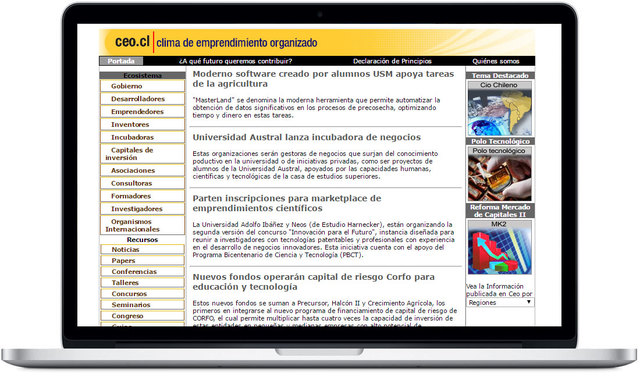
Image from the CEO.cl website, a historical record of those years that is worth a visit
So over the months this group kept up the habit of getting together for lunch every so often, lunches to which we invited entrepreneurs, officials, and people interested in building a climate of entrepreneurship in Chile. We became independent of the state agency and held these activities at the offices of the company of one of the group’s members.
Out of those lunches came CEO: Clima de Emprendimiento Organizado (Organized Entrepreneurship Climate). Deep down we all felt something significant would come out of these meetings, but the great achievement was keeping those gatherings going for several years.
Time passed, September 11, 2001 shook us all, and with that event began, in my opinion, the era we live in, with its wars on terrorism, fake news, distrust and lack of patience.
Post-punk revival
I say don’t you know
You say you don’t know
I say, take me out!
— Franz Ferdinand
The Post Punk Revival, or Garage Rock Revival, was a movement that started in the late nineties and ran through the early 2000s. They drew on grunge, new wave, blues and punk. An interesting mix, with bands like the White Stripes, Franz Ferdinand, Elastica or Arctic Monkeys.
[I don’t think it’s a coincidence that the White Stripes chose to use the colors red and white and to invent an origin story that tied them to the American heartland. Or that Franz Ferdinand took the name of the Archduke of Austria, whose assassination led to the First World War. This musical style, with its lyrics and aesthetics, reflected the start of our contemporary era, with its invasions of the Middle East and its search for weapons of mass destruction that never existed.]{style=“letter-spacing: 0.01rem;”}

Franz Ferdinand performing live
November 2001
Hate to say I told you so, alright
Come on
I do believe I told you so
– The Hives
Perhaps one of the happiest moments of my life was the birth of my daughter Francisca, in late November 2001. Holding her in my arms was a moment of total joy that is hard to beat.
But this lovely personal story could have turned into a drama worthy of Charles Dickens. After the birth there were unexpected complications and Kika had to stay in the hospital for several days. They were hard times, full of uncertainty. For a month my duty was to my wife and my daughter, above everything else, and I was at the hospital that whole time without going to work.
I remember that the Isapre, the private health insurer I had at the time, sent an account executive to see me, and she told me there was nothing we could do anymore because I hadn’t requested the catastrophic coverage in time. Can you understand that?
[At that moment, when I was worried because my wife was spending the night in the ICU. Moments when I asked them to hand me the baby so I could feed her and hold her while tears ran from my eyes, because I was desperate and didn’t know what might happen. Right then the system was asking me to fill out a form, to activate a damn catastrophic insurance policy? Can’t that be automatic? Or if you request it after the fact, once things have calmed down a bit, can’t they honor it?
Those are the bugs our representatives leave in our legislation and that end up hurting people, feeding this climate of distrust in everything and everyone that defines our time.
Leaving Las Vegas
I’m standing in the middle of the desert
Waiting for my ship to come in
— Sherryl Crow
We got home, with the baby and with my wife recovering from the ordeal. For months she had to keep up with treatments and support. But she got better fast. The baby was starting to grow and to receive the love of her older siblings.
Still, I wasn’t at ease. I was in debt and not very happy with my salary either. And the mood of the time was entrepreneurship. I had watched many friends take the leap. A colleague, a deputy manager, left the Chamber to set up his own venture.
That’s how I got an interesting offer from one of the CEO participants. I would be in charge of building the technology area of his startup. The offer was for almost 30% more than I was making at the time. I talked to my boss. I still wasn’t convinced I wanted to leave for good, because it meant a risk, so I was hoping they’d make me a counteroffer. After all, I had been quite successful and had contributed a lot in my job.
My boss reacted and did what he was supposed to do. I felt he didn’t want to let me go, and I’ll always be grateful to him for that. But it didn’t go well for him. Apparently I wasn’t that valuable to the rest of the organization. The counteroffer was ridiculous. Jorge presented it to me with some disappointment and embarrassment, I think.
That’s how I began my exit from the Santiago Chamber of Commerce. But at the time I didn’t feel sad. On the contrary, I was angry. My exit was pretty abrupt: within a few days I was at another company preparing the ground to launch a new startup.
Toxic environments
Due to lack of interest
Tomorrow is cancelled
– Kaiser Chiefs
Sometimes a leak of toxic material starts poisoning a river, or a lagoon. The leak may be small, but it’s steady.
That happens in organizations. There are toxic leaks we don’t plug in time. This toxicity shows up between people and in their relationships. Not everyone in a company has to like each other, but, in my opinion, it’s the duty of those who run organizations to keep these toxic leaks from happening.

Watch out for the toxic elements that spill into the river of an organization’s creativity and effort.
I felt that back then. I knew some people in the organization where I had worked until then didn’t like me. It gets complicated when the people who don’t like you are people with power. I don’t know whether it was conscious or unconscious, but that was becoming unbearable for me too.
You have to learn how to handle yourself inside organizations. To know their dynamics, their politics. Every human organization is political. A lot of young people don’t get that. They think it’s all about technical merit, but that is often the least important thing in building a career.
Every organization has factions, with their own interests. That’s normal, even healthy. I’ve always been suspicious of any group of people where everything is cordial and nobody disagrees.
What matters, and the key to leadership in my opinion, is that despite these differences everyone is aligned behind the company’s mission and vision. When personal interests, or those of the factions, stray from the path that was laid out, that’s when institutions begin to decay. That’s when people decide to walk away and look for other horizons.
And so in 2002 I was heading into the darkest period of my professional life, but I didn’t know it. I had the support of my wife, a beautiful baby and my kids. Without them I don’t know how I would have survived what came next, but that’s something I’ll tell you about in the next part.
Notes:
Sherryl Crow doesn’t belong to the Garage Rock Revival movement, but her song Leaving Las Vegas has just the right verse, so apologies to the purists.
The first part of this “unauthorized autobiography” is here: https://www.lnds.net/blog/lnds/2019/03/17/el-fin-de-la-agilidad.
Part two: https://www.lnds.net/blog/lnds/2019/03/18/el-fin-de-la-agilidad.
Part three: https://www.lnds.net/blog/lnds/2019/03/19/el-fin-de-la-agilidad.
Part four: https://www.lnds.net/blog/lnds/2019/03/23/el-fin-de-la-agilidad.
Part six: https://www.lnds.net/blog/lnds/2019/04/06/el-fin-de-la-agilidad
Comments
comments powered by Disqus