$ cat posts/process-loss.md
Process loss
When we work in a group we are always influencing one another, for better or for worse. Together we can achieve things that seemed impossible; other times we fail miserably. Either way, every group exhibits what students of social behavior call “process loss”.
This concept is similar to the consequences of the laws of thermodynamics. That is, just as it’s impossible to have one hundred percent efficiency in a physical system, the same goes for a group of people: the group’s performance is always less than the sum of the individual performances.
Working in a group carries a series of costs, which can come from coordination problems or from loss of motivation.

The figure1 shows this effect. The group’s actual productivity is less than the sum of the individual contributions, always.
If working in a team is inefficient, why do we do it?
The most obvious reason is that the tasks we take on as a group are often too big for one individual. It’s the way we have of dealing with the complexity of today’s projects.
The important thing is to remember that as we take on complex projects, and form groups and hierarchies to tackle them, we have to pay a price, and that price is “process loss”.
Some causes
Apart from the losses inherent to coordination within a team, another source of reduced productivity is loss of motivation.
One of the phenomena observed in teamwork is what is known as social loafing2. This phenomenon was first observed in a series of experiments carried out by Max Ringelmann, who discovered the effect that bears his name.
The “Ringelmann effect”, also known as “free rider behavior” or the “free-rider problem”, is a concept that names the tendency for performance in a group to drop as the size of the group increases.
Ringelmann ran a series of experiments with groups playing tug of war. Effort was measured both for individuals and for groups of two, three and so on up to eight people per team.
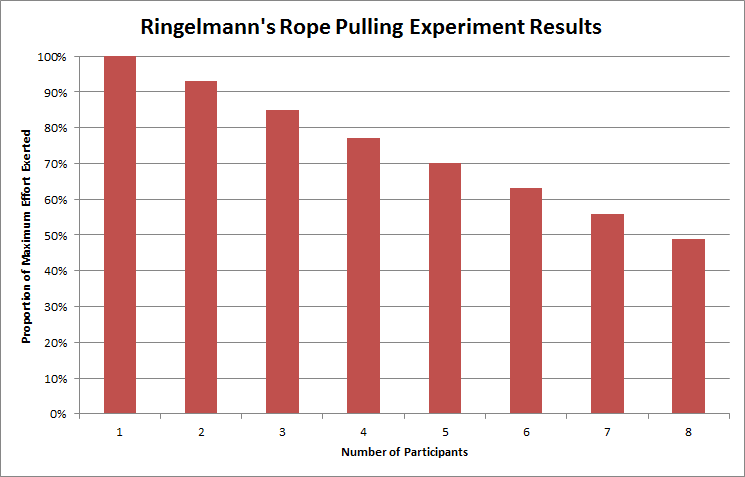
Results of Ringelmann’s experiments
When the group reached eight people, individuals were exerting less than half the effort they would exert on their own.

We’ve all noticed the Ringelmann effect at some point
Ringelmann was the first to identify the effects of process loss; according to him there are two kinds of problems3:
Loss of motivation: the reduction of individual effort exerted when people work in groups compared to when they work alone. According to Ringelmann, group members tend to rely on their co-workers to provide the effort needed for a common task.
Coordination problems: When individuals come together in groups to perform a task, their performance depends on their individual resources and the various interpersonal processes at work within the group. Even if the group members have the skills and knowledge needed to complete an assigned task, they may fail to coordinate their efforts in a productive way.
In 1993, Karau and Williams4 conducted a meta-analysis of different studies on this phenomenon and made some interesting findings, such as, for example, that among women from Eastern cultures the social loafing effect was reduced. After analyzing a number of results, these authors proposed what they called the collective effort model:
Expectancy X Instrumentality X Valence of Outcome = Motivational Force
In this model, Expectancy is the degree to which high levels of effort are expected to lead to similarly high levels of performance. Instrumentality is the degree to which high-quality performance is perceived as instrumental in obtaining an outcome. Valence of Outcome is the degree to which the outcome is perceived as desirable.
However, the authors acknowledge that although individual and group performance is strongly related to many of the valued outcomes, there are some outcomes that don’t depend on performance.
For example, when working on intrinsically meaningful tasks, or when working with highly respected colleagues, exerting high levels of effort can lead to greater self-satisfaction, approval from the group, or other important outcomes, even when that high effort has little or no impact on tangible performance results.
So there are ways to reduce the lack of motivation, and it depends on the makeup of the team and its intrinsic motivations.
How to reduce process loss
According to Dan J. Rothwell, there are three elements for reducing the loss due to lack of motivation: Collaboration, Content and Choice (the 3 Cs).
Collaboration is a way of getting everyone involved by assigning each member special, meaningful work. It’s the way the members of the group share knowledge and the tasks that absolutely must be completed. If you have two people sitting idle because they weren’t given specific jobs, what you have to do is give them tasks that make them feel essential to the group, because that way they won’t want the team’s performance to drop, since they have specific obligations to fulfill.
Content identifies the importance of the specific tasks within the group. If the members of the group see their role as necessary for completing a worthwhile task, they are more likely to fulfill it. People need to feel that meeting their obligations will be valued by the group.
Choice is giving the members of the group the opportunity to pick the task they want to carry out. Assigning roles in a group causes complaints and frustration. Giving group members the freedom to choose their role makes social loafing less significant, and motivates the members of the group to work as a team.
This is one strategy; there are other proposals, and which one to pick depends on each group and of course on the leader. But the important thing is to understand that this effect exists; detecting it in time and coming up with strategies to lessen its impact is one of the duties of a good team leader.
Personally I think that if you align reducing process loss with the self-satisfaction of the team members, you’ll get the best results. What do you think?
Adapted from an image in the book “Your Code as a Crime Scene”, Adam Tornhill, chapter 11, page 123. ↩︎
Social Loafing https://en.wikipedia.org/wiki/Social_loafing ↩︎
Ringelmann effect on Wikipedia: https://es.wikipedia.org/wiki/Efecto\_Ringelmann ↩︎
Social Loafing: A Meta-Analytic Review and Theoretical Integration, Steven Karau & Kipling D. Williams: http://www.communicationcache.com/uploads/1/0/8/8/10887248/social\_loafing-\_a\_meta-analytic\_review\_and\_theoretical\_integration.pdf ↩︎
Comments
comments powered by Disqus