$ cat posts/to-the-bone.md
To the Bone
(The Chain, part 2)
Table of contents
“Once we’ve made sense of our world,
we wanna go fuck up everybody else’s
because his or her truth doesn’t match mine.
But this is the problem.
Truth is individual calculation.
Which means because we all have different perspectives,
there isn't one singular truth, is there?”
– Steven Wilson in “To the bone”
For Steven Wilson, the meaning of many of the songs on his fifth album, “To The Bone”, has to do with truth, conceived as something that can be manipulated and filtered to mean whatever suits us best, whether you are a politician, a terrorist or simply someone trying to convince themselves that their relationship is fine, even though it isn’t.
We could say that if it exists, truth must be something we all agree on, that is, nobody should question a truth, but it’s not that easy. Truth is not defined by consensus, or is it?
Even in the logical, bistable world of computers, consensus is not an easy thing to define. And that is what we are going to talk about this time.
The space shuttle computers
When I was a teenager I read a piece about the space shuttles which said that these spacecraft had a set of four computers working redundantly, which gave the whole system fault tolerance. If one computer malfunctioned, the other three detected the situation and disconnected the failed computer. The mechanism by which these computers detected this situation was something that intrigued me and that took me several years to learn and understand in detail.

Launch of Discovery’s STS-124 mission; during this mission a Byzantine fault occurred among its four computers
At the time the space shuttles were designed, the theory of redundant systems barely existed. It is said that NASA made it a priority to solve the synchronization problem among these computers. In particular, the hardest part was determining, effectively, when one of the computers should take control and deactivate the others in the event of a failure.
One of the keys when planning redundancy is determining how many computers are needed to reach a certain level of safety. One solution is to go with five computers. If one fails, operations continue normally. When two computers fail we are in what is called a “fail-safe” situation, since the other three prevent the dreaded situation of dual computer systems (one is failing, but which one?)1. Despite these considerations, NASA used four computers and not five.
The general problem is how to handle the situation in which failed components give conflicting information to different parts of the system. In 1981 a group of researchers from Stanford tackled this problem in a famous paper with a curious title: “The Byzantine Generals Problem”2.
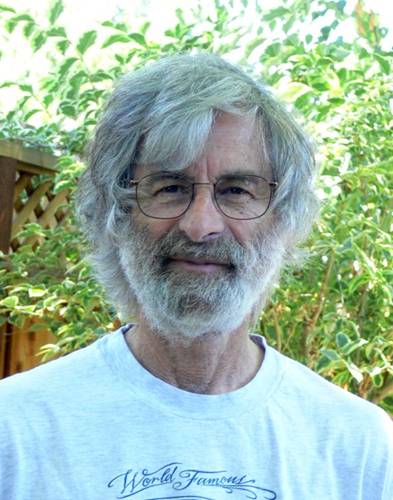
Leslie Lamport, Turing Award winner, author of LaTeX and lead coauthor of the Byzantine generals paper
The Byzantine Generals Problem
“We’re drilling through their stone
Ho-oh, down through every fairy story”
Leslie Lamport and his colleagues, the authors of that paper, expressed the problem through a thought experiment:
“A group of generals of the Byzantine army camped with their troops around an enemy city. Communicating only by messenger, the generals must agree upon a common battle plan. However, one or more of them may be traitors who will try to confuse the others. The problem is to find an algorithm to ensure that the loyal generals will reach agreement.”
Together with Robert Shostak and Marshall Pease, Lamport showed the conditions that must hold to solve this problem. In particular, using simple oral messages, the problem can only be solved if more than two-thirds of the generals are loyal.
To tidy things up a bit, we will assume there are n generals, one of them is the commander, and the other n-1 generals are his lieutenants. That way, one way of stating this problem is the following:
A commanding general must send an order to his n-1 lieutenant generals such that:
- IC1: All loyal lieutenants obey the same order.
- IC2: If the commanding general is loyal, then every loyal lieutenant obeys the order he sends.
Conditions IC1 and IC2 are called the interactive consistency conditions.
Let’s see how this could work.
We know there are n generals, one commander and n-1 lieutenants, so the commander sends a message to each lieutenant, and in turn each lieutenant shares his orders with every colleague. Given this, each general must review n-1 messages and act based on the messages he has received. For example, if the majority says attack, then he attacks; if the majority says retreat, then he retreats.
Let’s look at an example. In the following figure you can see the case where there are three generals and one of them is a traitor (it can be the commander or one of the lieutenants). In this configuration one of the lieutenants receives two contradictory orders, and therefore cannot make a decision. The traitor has managed to paralyze the army.

The case of three generals and one traitor, taken from the original paper
The way to solve the problem is to use infallible messages, that is, texts that cannot be altered by the messengers. For this, we must define three conditions that have to hold:
A1. Every message that is sent is delivered correctly (that is, it cannot be altered).
A2. The receiver of a message knows who sent it.
A3. The absence of a message can be detected.
If these hold, Lamport and his colleagues show that it is possible to solve the problem with n = 3m+1 generals. Given this condition, the authors show a first algorithm that guarantees a solution if there are at most m traitor generals (in practical terms, there must be four or more generals for a solution to exist).
Let’s translate this to the reality of the space shuttle, where there were four computers, and a fifth as a backup. In this context a “betrayal” translates into a failing computer (for example, one delivering incoherent information). What we want is to determine which computer to shut down in this situation. The first solution proposed by Lamport only lets us pin down the failure of one computer at most.
To improve on this, Lamport offers another alternative, an algorithm in which the messages are signed. In this case, the three-generals case can be solved. The algorithms proposed in the paper require receiving messages from all the generals, or defining a default strategy for when a message is lost. The paper refers to the fact that when it comes to computers, it is essential that they operate the same way, are synchronized and, as far as possible, share information efficiently. In the case of the space shuttle, the processors share the data bus, and over the course of this space program modifications were made to deal with various “Byzantine faults” that came up3.
The Discovery’s Byzantine fault
During the shuttle Discovery’s STS-124 mission, in 2008, a fault occurred that could have ended in disaster. During fueling, a 3-1 disagreement arose among the ship’s computers, that is, the results from one of the computers did not match what the other three reported. Three seconds later there was a 2-1-1 split, that is, only two computers agreed, and the other two showed discrepancies. This forced the launch countdown to be stopped.
While the situation was being reviewed it reached a 1-1-1-1 split, the worst possible state: no computer agreed with the other three. However, there was nothing wrong with the computers. The failure was in other components of the system, called MDMs, Multiplexer/DeMultiplexers. The MDMs are a kind of remote router that channels all the ship’s I/O signals to the computers. The cause of the problem was a physical crack in a diode inside one of the MDMs. The figure below shows the photograph of the cracked diode (affectionately nicknamed “the Byzantine assassin”).

The photograph of the Byzantine Assassin
Byzantine faults
“But behind the closed doors
The bees were buzzing
Inciting me to war
You’re penitent maybe
But it’s really not your fault you fail to see”
We say fault tolerance is Byzantine when there is imperfect information for determining whether a component is failing. This happens mainly in distributed systems.
In a “Byzantine fault”, a component (for example, a server) can inconsistently appear as working or failed to the failure detection systems, that is, it presents different symptoms to different observers. In this case it is hard for the other components of the network to declare it failed and disconnect it from the network, because first a consensus must be reached to decide whether the component is considered failed.
In the case of the STS-124 fault there was no failure in any computer, but during the crisis it was impossible to establish that.
This kind of fault doesn’t only happen in distributed systems; there is an example that comes from biology.
Byzantine bees
When bees must choose a new home for their queens, they send out scouts to look for a suitable place. Scientists have found that bees reach a consensus to decide the new location for the hive. In various experiments, it was established that when offered two equally attractive alternatives, the bees cannot decide, the swarm splits and all the bees die.
Consensus
So pariah you'll begin again
Take comfort from me
And I will take comfort from you
Now we are going to discuss how to avoid the fatal fate of the bees, but first we have to recall a concept we discussed a while ago.
The CAP theorem
When we talk about distributed systems we would like to guarantee three things:
- CONSISTENCY: we would like all nodes to have a consistent view of the system.
- AVAILABILITY: every request gets served.
- PARTITION TOLERANCE: the system works even if messages are lost.
These three guarantees are called CAP, after their initials (Consistency, Availability, Partition Tolerance). I have talked about this topic before in this article.
The important thing to remember here is that there is a result telling us that we cannot have all three guarantees at the same time in a distributed system; at most we can guarantee two.
We can have these combinations:
- CA: which guarantees correct answers only while the connection works well; this is the case in centralized systems.
- CP: which guarantees correct answers even if there are failures in the connection, but the answer may not be there (weak availability).
- AP: “the best” answer is always provided even in the presence of connection failures (in this case consistency is eventual).

The CAP theorem and the kinds of combinations available on which we can run our distributed systems
Byzantine faults and partition tolerance
When a Byzantine fault occurs, we are facing a scenario in which a machine responds incorrectly. To correct a Byzantine fault in which f machines are failing, we will need 2f+1 replicated machines.
To decide which machine to shut down in a Byzantine fault we must find consensus. There are several possible kinds of consensus:
- Strong consensus: all the machines, or nodes, must agree in their answers.
- Majority consensus: there must be agreement among the majority.
- Plurality consensus: when a plurality agrees, not necessarily the majority.
- Quorum consensus: it is defined that n nodes must agree.
- Disabled consensus: we don’t care about consensus, we care about the first answer we get from any node.
When we have strong consensus the system is CP; when we have disabled consensus we are looking at an AP system. And there is a gradient from CP to AP as we relax the level of consensus.
Consistency
“A sea we can sail
Then sink like a stone
Down to the truth
Down to the bone”
We have now defined criteria for declaring consensus. It is evident that strong consensus cannot be reached in the face of Byzantine faults, so at the operational level we must define a desired level of consensus (for example, majority, or quorum) and of consistency.
If we want strong consistency (CP) we are going to sacrifice the availability of the system and will need a higher degree of replication. If we go for high availability we have to sacrifice consistency and we don’t need as much replication.
To reach consistency we need mechanisms for distributing messages among the nodes. There are several alternatives; one interesting way to do it is gossip protocols.
To illustrate this we are going to look at the case of Dynamo, a distributed data system created by Amazon.
Dynamo4 is a distributed database where the replication factor can be chosen for each table. To reach consensus it uses a gossip-style protocol. It uses quorums: there are multiple nodes for reads (R) and writes (W). On each operation at least R or W nodes must confirm the operation. A higher R or W gives more consistency, sacrificing availability.
A gossip protocol is a way of spreading messages across the network the same way rumors work, or the way epidemics spread.
The idea is very simple. Let’s see how rumors spread in an office. For example, Alicia decides to spread a rumor, so she heads to the coffee area on her floor, finds Benito and tells him the gossip. Both go back to their desks, and at some point Benito runs into Carlos, or Alicia runs into Daniela, and they pass the rumor on, and so it keeps propagating through random encounters.
A gossip protocol is one that satisfies the following conditions:
- The core of the protocol involves periodic interactions between pairs.
- The information exchanged during these interactions is of a fixed, bounded size.
- When the participants, or agents, interact, the state of one agent changes to reflect the state of the other.
- Reliable communication must not be assumed.
- The frequency of the interactions is low compared to latencies, so that the protocol costs are negligible.
- There is some degree of randomness in peer selection. Peers are selected from the set of all nodes or from a small set of neighbors.
- Due to the replication there is an implicit redundancy in the delivered information.
Gossip protocols are very efficient, especially because the structures of massive distributed systems can be complex and huge, and this is a very effective way to disseminate information quickly at a reasonable cost.
Detecting inconsistencies
“Hold on, down and deeper, down we’re going
Way down through the floor
Oh, don’t you wanna see what's at the core?”
Since data in Dynamo is distributed, it can happen that two nodes hold data that is inconsistent with each other. Dynamo has a mechanism to detect this inconsistency and report it, although the reconciliation process, that is, the decision about which value should be considered valid, is something that must be decided by the application using Dynamo as storage.
To detect inconsistencies Dynamo uses a data structure known as a Merkle tree.
This data structure makes it possible to detect inconsistencies quickly and minimize the amount of data to transfer. A Merkle tree is a tree that stores the values of a hash function applied to individual keys. The parent nodes higher up in the tree hold the hash value of their respective children. The main advantage of the Merkle tree is that each branch can be verified independently, without a node having to download the entire tree or the whole data set. For example, if the hash values of the roots of two trees are equal, then the values of the leaf nodes in the tree are equal and the nodes don’t need to be synchronized. If not, this implies that the values of some replicas are different. In that case, the nodes can exchange the hash values of the children and the process continues until it reaches the leaves of the tree. At that point the servers can detect the keys that are out of sync.
Dynamo uses Merkle trees as follows: each node maintains a separate Merkle tree for each key range covered by the node. This lets nodes compare whether their keys are up to date. In this scheme, two nodes exchange the roots of the trees corresponding to the keys they hold in common. And so, successively, traversing the tree in the way just described, the nodes determine whether there are differences and the appropriate synchronization actions are carried out. The downside of this is that many keys change when a node joins or leaves the system, which requires these trees to be recalculated.
The following three figures5 show how all of this is used to maintain consistency in Dynamo:

Merkle trees used in Dynamo
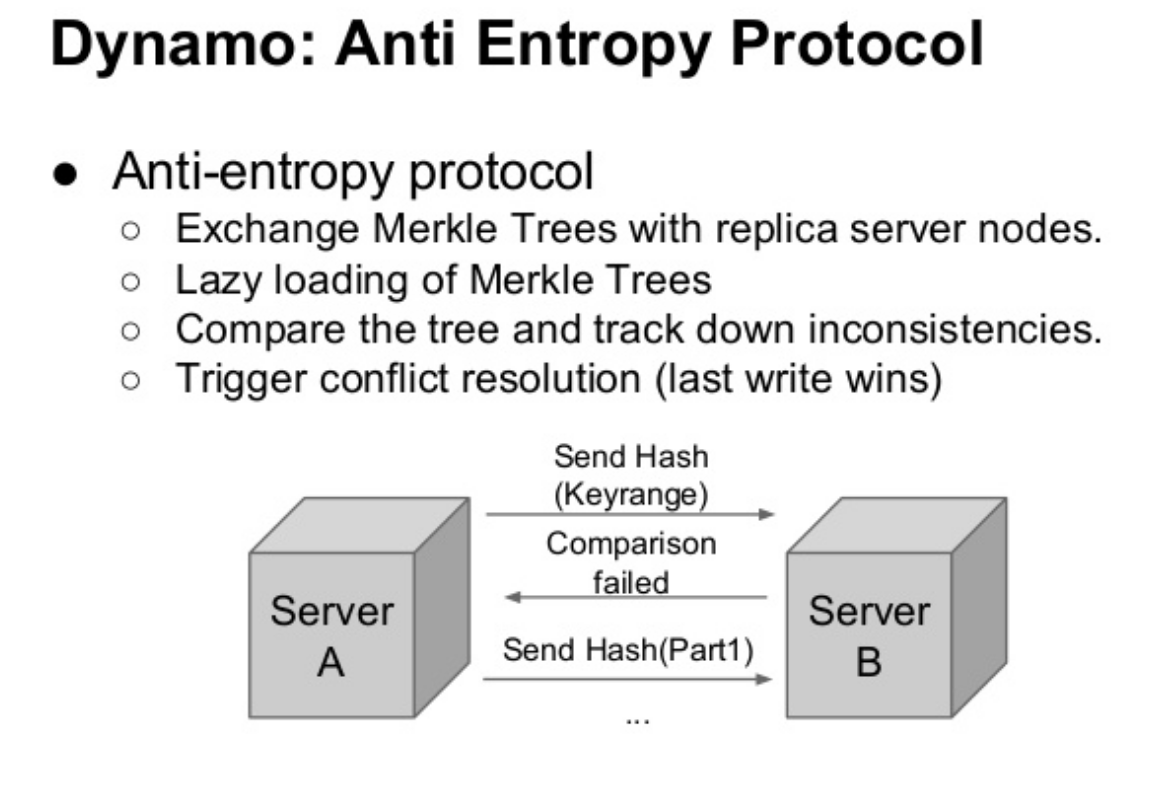
Dynamo’s anti-entropy protocol: the servers exchange their Merkle trees, compare the roots first and then check for inconsistencies by navigating the branches of the tree.

The gossip protocol ensures that eventually all nodes share the same view of the system, or that a failure or inconsistency is detected.
Truth is individual calculation
In distributed systems there is no central source of authority. The state of the system depends on resolving the inconsistencies that can arise. In particular, in the presence of Byzantine faults, it becomes necessary to define mechanisms for managing them and identifying those situations. We have seen how a distributed system like Dynamo tackles this problem of reaching consensus given the possibility of Byzantine faults. As you can see, it is something fairly complex that has required developing some rather ingenious techniques to solve.
The most important thing I want to get across in this post is the idea that in distributed systems consensus is the fruit of the individual calculation of each node, or as Steven Wilson says:
Truth is individual calculation. Which means because we all have
different perspectives, there isn’t one singular truth, is there
Notes:
The English epigraphs are taken from the following songs on Steven Wilson’s album “To The Bone”: “To The Bone”, “Pariah” and “People who eat darkness”.
Computers in Spaceflight: The NASA Experience https://history.nasa.gov/computers/Ch4-4.html ↩︎
The Byzantine Generals Problem, http://bnrg.cs.berkeley.edu/~adj/cs16x/hand-outs/Original_Byzantine.pdf ↩︎
https://c3.nasa.gov/dashlink/projects/79/wiki/test_stories_split/ ↩︎
Dynamo: Amazon’s Highly Available Key-value Store https://www.allthingsdistributed.com/files/amazon-dynamo-sosp2007.pdf ↩︎
https://www.slideshare.net/yellow7/cassandra-backgroundandarchitecture](https://www.allthingsdistributed.com/files/amazon-dynamo-sosp2007.pdf) ↩︎
Comments
comments powered by Disqus