$ cat posts/the-chain.md
The Chain
Table of contents
“Chain, keep us together
Running in the shadows
Chain, keep us together
Running in the shadows
The Chain has the distinction of being the only Fleetwood Mac song credited to all the members active during the recording of an album, and the reason for this is a curious one.
In 1977 the band had its best-known and most successful lineup. It went like this: Mick Fleetwood on drums, John McVie on bass, Christine McVie on vocals and keyboards, the great Stevie Nicks on vocals, of course, and Lindsey Buckingham on guitars and vocals.

Fleetwood Mac in 1977
To record its eleventh album the band headed to California, to work at the famous Record Plant studio, in Sausalito.
That period was one of the roughest moments inside the group. Stevie Nicks has always said that Fleetwood Mac’s best work came out when the band was in its worst shape.

The Chain came out of the concatenation of a pile of rejected material. The final section of the song, which starts with a bass progression, was created by Mick Fleetwood and John McVie, who recorded it separately. Meanwhile Stevie Nicks had written the lyrics and thought they could fit that melody, so she worked with Christine McVie on putting together the first part of the song. To complete the track, Buckingham recycled the intro of a piece he had developed with Nicks as a duo in 1973. The bridge was pulled by the sound engineers, Ken Caillat and Richard Dashut, from another discarded recording; they removed the piano McVie had put on it and cut the tapes with razor blades to then splice them together and give the song its final shape.
That is why The Chain is credited to every member of the group.1
Chains
“Listen to the wind blow
Watch the sun rise
Run in the shadows
Damn your love, damn your lies”
A chain is a set of links, or rings, joined together. It is a useful tool, for pulling, holding, or even transmitting motion to machines. It is also a symbol, with multiple meanings, such as oppression, unity, or even opulence.
In physics and mathematics, the catenary is the shape a chain takes when hanging from its two ends. The precise form of the equation that describes this geometric shape was obtained in response to a challenge posed by Jakob Bernoulli, who summoned the best mathematicians of the seventeenth century. The result was obtained through the collective work of Gottfried Leibniz, Christiaan Huygens and Johann Bernoulli.
The shape of the catenary allowed the Catalan architect Antoni Gaudí to create structures that better distribute the stress they are subjected to.

Catenaries in Gaudí’s La Pedrera
In computing, chains show up in many areas and contexts, of course, and that is what we are going to talk about a bit.
Immutable chaining
“And if you don’t love me now
You will never love me again
I can still hear you saying
We would never break the chain”
“Method chaining” is a technique used in many object-oriented programming languages.
In object-oriented programming we use method chaining to run a series of operations on an object.
Let’s look at an example in Scala: 2
    class Person {
      private var name: String = null
      private var age: Int = 0

      def setName(newName: String) = { this.name = newName; this; }
      def setAge(newAge: Int) = { this.age = newAge; this; )
      def introduce { println( s"Hello, my name is $name and I am $age years old." ) }
    }

    object App {
      def main(args: Array[String]) {

        // Output: Hello, my name is Peter and I am 21 years old.
        new Person().setName("Peter").setAge(21).introduce
      }
    }
What we have done here is create an object of type Person, to which we apply a sequence of methods that alter its state and generate an output. That chain of methods lets you write more compact code. This technique is very useful for developing domain-specific languages (DSL)3.
But a functional programmer would find this an abomination, because on every call we are altering the state of the object and that is a mortal sin in this paradigm, where the concept of immutability is essential.
What does this immutability thing mean?
What we want is for data structures not to change their value throughout the process. For example, if we have a record that holds a person’s name, the value written there must not change, ever.
But people do change their names, right?
They do, although we could ask ourselves whether the person who at twenty-five changes his name to Jorge is the same person who was given the name Pedro at birth.
But philosophy aside, we have to deal with change. The answer that guarantees immutability is that we must create a new record with the new value and forget about the previous value (or leave it lying around, for historians to look at later).
So let’s see what the code would look like with an immutable data structure:
    case class Person(private val name: String = null, private val age: Int = 0 ) {
      def setName(newName: String) = Person( newName, this.age )
      def setAge(newAge: Int) = Person( this.name, newAge )
      def introduce { println( s"Hello, my name is $name and I am $age years old." ) }
    }

    object App {
      def main(args: Array[String]) {
        // Output: Hello, my name is Peter and I am 21 years old.
        Person().setName("Peter").setAge(21).introduce
      }
    }
Notice that each method generates a new Person object. In this particular case the previous object is lost and gets freed automatically by the language’s Garbage Collector. As programmers we don’t care about it anymore (although I suppose it would be nice to tell the systems engineer in charge of running our software in production to allocate enough memory and tune the virtual machine’s parameters; a little courtesy never hurts).
Chain of responsibility
“Thunder only happens when it’s raining
Players only love when they are playing”\
Chain of responsibility is a software design pattern that aims to solve two problems:\
- Avoid coupling between the sender of a request and its receiver.\
- It should be possible for more than one receiver to handle a request. \[4\]

What this pattern says is that a request is processed by a series, or chain, of receivers, which are unknown a priori to the sender.
This is very useful in user interfaces, for example. When you touch an object on the screen, a “view” is expected to exist that is able to process that event. This view may not know what to do with the event, so it hands it off to a parent view, and so the event climbs up the chain until it finds an object that knows how to process the event.
The important thing here is that we can distribute the processing responsibility along the chain.
Message chain
“Break the silence
Damn the dark, damn the light”
Not everything about chains is good. For example, there is a problem, something we call a code smell4, named the Message Chain.
Martin Fowler describes it in his book “Refactoring: Improving the Design of Existing Code”, in the following way:
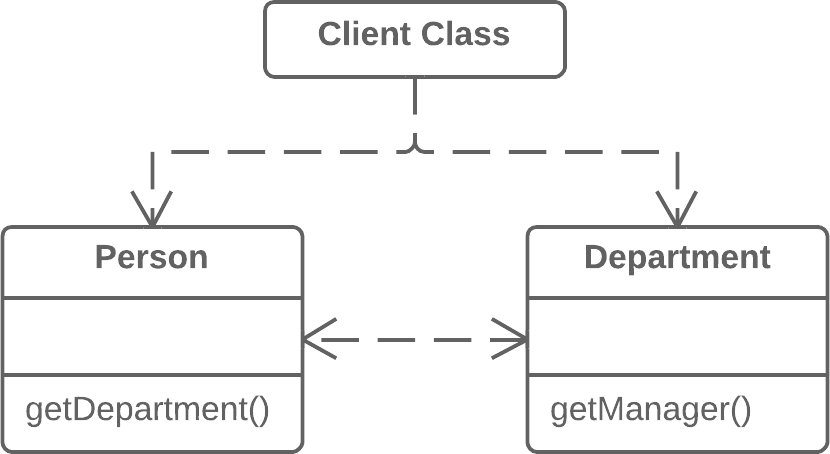
A message chain scenario
Suppose that from a client object we want to get a person’s manager. To do that, the code we have to write is the following:
manager = person.getDepartment().getManager()
It could be worse; there are situations where you can end up with a long chain of messages just to get a value:
f = client.getA().getB().getC().getD().getF()
This is different from method chaining, because in that case we are operating on methods of the same class.
In message chaining we are navigating a class hierarchy to get to the method we need.
The Law of Demeter
“I know there’s nothing to say
Someone has taken my place”
Message chaining is a form of coupling, and one way to avoid this problem is to respect the Law of Demeter, or Principle of Least Knowledge, which says the following:
Given a method m of an object O, it may only invoke the methods of the following kinds of objects:
- The object O itself.
- The parameters of m.
- Any object created or instantiated within m.
- The objects that are components of O.
- A global variable, accessible by O, in the scope of m.
So what we should do to fix the previous example is the following:
manager = person.getManager()
This involves a refactoring known as “Hide Delegate”:

Reorganizing the Person class to allow Hide Delegate
Middle man
“Tell me why
Everything turned around
Packing up
Shacking up’s all you wanna do”
It turns out that if we apply the Law of Demeter indiscriminately we can get ourselves into a mess.
Suppose we now add to the Person class the methods getDivision(), getDirector(), getCountry(), getDivisionManager(), etc, to access different objects within the hierarchy.
The Person class becomes an object everything else depends on, and it in turn ends up depending on many more classes. It becomes a middle man. Everything has to go through this class, which is not good either.
This symptom, or code smell, is called MiddleMan.
What is the solution to this problem?
The bad news is that the solution to this code smell is called Message Chain, the famous message chain we were trying to run away from a moment ago. :D
Middle men vs. chains
Don't stop thinking about tomorrow
Don't stop, it'll soon be here
It'll be here better than before
Yesterday's gone, yesterday's gone
This can be somewhat distressing. On one hand we are told that method chaining is an interesting pattern to use, and so is the chain of responsibility, but on the other hand the message chain, which looks like method chaining, violates the Law of Demeter. And in the effort to respect the Law of Demeter we can fall into the MiddleMan trap, for which the only way out is to violate the Law of Demeter by introducing the message chain. It’s enough to drive you crazy!
That is software design: a series of decisions among requirements that sometimes conflict.
But also, doesn’t it seem to you that we have stumbled onto something more fundamental here?
We have, because this dichotomy between centralizing and decentralizing, placing the responsibility at a central point versus distributing it along a chain, is something that shows up in different contexts, not just technological ones.
Think of another chain, very famous these days. I mean the Block Chain. It is a technology that lets you distribute trust, or to be more precise, consensus, across a whole network that works collectively, using an immutable chain to do it.
Blockchain is an interesting solution that we will start studying in the following articles. Some questions I intend to answer are: what is blockchain good for? Is blockchain the right solution for certain problems, or is it sometimes better to use a MiddleMan?
Although this article seems to be about programming, it actually isn’t. It is about solution design, about constraints and, of course, rock and roll.
In this text I have tried to introduce some basic concepts that are needed to understand what’s coming, so I invite you to stay tuned for the second article in this series, which I have called “The Chain”, where we will take a little detour to talk about consensus.
Notes:
The quotes are from the songs “The Chain”, “Dreams”, “Second Hand News” and “Don´t Stop”, from the album “Rumours” by Fleetwood Mac, the band that will keep us company on this adventure.
There are more anecdotes about The Chain at Songfacts. ↩︎
Examples taken and adapted from Wikipedia: https://en.wikipedia.org/wiki/Method_chaining ↩︎
You can read about applying DSLs with method chaining in this article on InfoQ https://www.infoq.com/articles/internal-dsls-java ↩︎
A code smell is any symptom in the source code of a program that indicates there is a potential problem: https://en.wikipedia.org/wiki/Code_smell ↩︎
Comments
comments powered by Disqus