$ cat posts/51.md
51
“Once we´ve made sense of our world
We wanna go fuck up everybody else’s
Because his or her truth doesn’t match mine
But this is the problem
Truth is individual calculation
Which means because we all have different perspectives
There isn’t just singular truth, is there?”
-- To the Bone, Steven Wilson
What is truth?
Several years ago I attended some philosophy talks where the speaker (Ricardo Espinoza Lolas) talked about the four truths that we Westerners accept.
The four truths
The truth that comes from the Greeks is the first one.
The Greeks didn’t say truth, because the Greeks spoke Greek, but it is not just that the word was different. For the Greeks truth was not a synonym, it was also a verb.
In Greek, truth would be αλήθεια (Alétheia), which literally means what has been uncovered, what is no longer hidden.
So the Greeks “truthed”, because aletheia implies the act of drawing back the veil that hides the truth from us, and so it was the Greek’s duty to “truth”. For the Greeks, seeking the truth was almost a duty.
The second notion of truth we have is the Roman veritas, from which our word truth comes in Spanish (verdad). For the Romans Truth was a goddess.
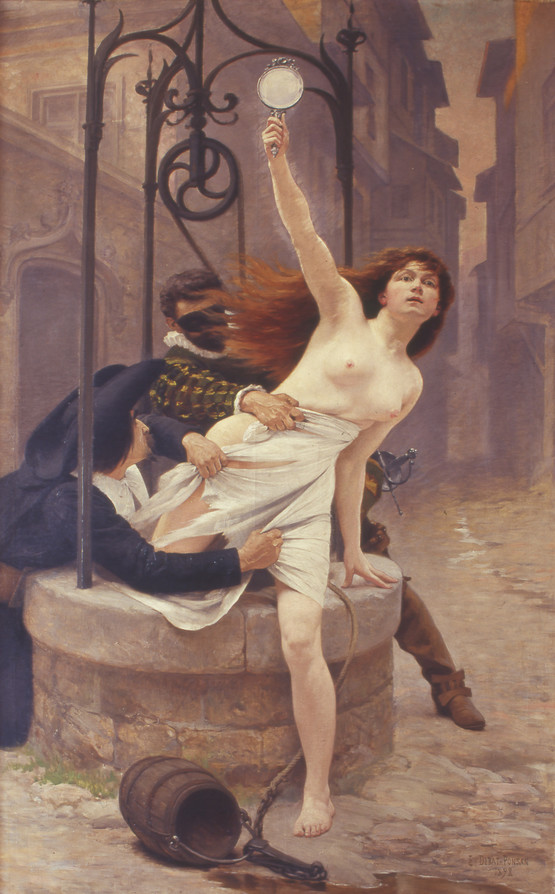
Truth coming out of the well, a painting by Édouard Debat-Ponsan (1898); the characters who don’t want truth to escape from the well are a clergyman and a masked nobleman.
Truth was depicted as a woman, daughter of Saturn (or Cronus, that is, time), and she was the mother of another goddess known as Virtue. Truth lived hidden in a well, because of her elusive nature.
For the Romans truth was sincerity. But how do you check the sincerity of a person’s words?
Being a people attached to law and order, for the Romans truth was something that had to be certified. Truth was sanctioned by authority, that of the Senate and the Roman People, represented in the emblem SPQR (Senātus Populusque Rōmānus) .
So truth is something that requires a certification, a seal. We have inherited a lot of that in our habit of not trusting anything that doesn’t carry a seal verifying where it comes from. When we demand certification as validation that something is certain, as a kind of guarantee that things are what they say they are, we are using Roman truth.
The third notion of truth comes from the Semitic and Arab peoples. It is the overwhelming truth before which there is no option but to fall prostrate. It is Revealed Truth.
Just pronouncing it requires an aspiration, a running out of breath, in the Hebrew האמת, or the حقيقة (hqyq). In Hebrew you would say: אמת אלוהים אמת, the Truth of God.
Truth in the Near East is the revelation of God. I Am is the way the god of Moses defines himself.
There is nothing left but to let yourself be swept away by revelation, fall prostrate and accept that the truth is what is in scripture, in the Talmud or in the writings of the Prophet.
The fourth notion of truth, according to the account of the philosopher I’m telling you about, was the truth of the other. This notion of truth appears with Christianity.
The truth is in your neighbor, as well as in yourself. The idea that the truth is in God, or in Jesus himself, is a holdover from Hebraic, or Judaic, truth.
But Christianity is born more with the apostles and the followers of Jesus, so it is that syncretism among these revolutionary Jews, interacting with Romans and Greeks, who also take old ideas from Zoroaster and from Dionysus, that shapes this idea that the truth is in my neighbor. It is piety, solidarity, love of one’s neighbor.
In Matthew 22 they ask Jesus which is the greatest commandment, and he answers that the most important one is to love God, just as the Pharisees testing him expected, but he adds, and this is the crucial part: “A second is equally important: ‘Love your neighbor as yourself.’”
The author of that text shows the amalgam of concepts that leads Christian truth away from the Hebrew notion of falling prostrate before the truth of a single God. Christianity rescues from the well this truth that Zoroaster gave us, that you must love the other as yourself. If the truth is God, and if Jesus says that loving God is as important as loving your neighbor, then the truth must also be in your neighbor, right?
And these are the four notions of truth that professor talked about in Valparaíso.
And that is my gift to you on my birthday, a notion, or four notions, that made me think and opened up my head and my way of thinking.
I’ll leave you with a song, as usual, To The Bone, by Steven Wilson, which contains the epigraph of this post:
Comments
comments powered by Disqus