$ cat posts/mamma-mia-here-i-go-again.md
Mamma Mia, here I go again
9 challenges in 9 languages (4 of 9), part 8
Table of contents
Sweden, the land of Volvo, Electrolux, H&M, Ericsson, Bluetooth and, of course, ABBA.
In the seventies, ABBA was the best-selling band on the planet. Legend has it that ABBA accounted for a sizable chunk of Sweden’s GDP, which is highly unlikely, because Sweden was already a very prosperous country back then.
Agnetha, Björn, Benny and Anni-Frid shot to world fame in 1974, after winning the Eurovision Song Contest with the smash hit Waterloo. In this video you can watch their Eurovision performance, in a very glam style, which was all the rage at the time:
ABBA at Eurovision 1974The beauty of Agnetha and Frida is what I remember most about this group from my childhood, because my father was an ABBA fan, so we listened to their songs almost all the time. As a teenager I tried to get away from that kind of music, but it was too late. Despite my resistance, the ABBA virus invaded my musical DNA and left its mark forever.
Until 2008, when my family and I watched the movie “Mamma Mia!”, those melodies had been kept out of our house. But they came back and caught us, like a guilty pleasure. I must confess I have become my father, and every now and then I enjoy listening to the old ABBA songs.
But this post is not here to tell the story of the quartet, which is well known. No, this is the story of another Swedish product, and mainly of an Englishman who helped create it. A man born the same year as Agnetha Fältskog, who at seventeen, while the beautiful singer was entering her country’s music charts, decided to learn to program, and along the way picked up a passion for this craft that he never gave up. And although it took him a while to get the recognition he deserved, his story must be told on this blog, since he is one of my personal heroes.
Waterloo
At Waterloo Napoleon did surrender
Oh yeah, and I have met my destiny in quite a similar way
Joe Armstrong was born in England, in 1950. While Agnetha Fältskog was hitting the charts in her country, with a hit after just one year in the business, our hero was wrestling with punched cards and FORTRAN to learn how to program his school’s computer.
When he got to university, however, he decided to study physics and pursue a PhD in that subject, and not in computer science, curiously.
Armstrong tells that at university he took several courses that required programming, but that he developed a special knack for debugging programs, so he helped other people fix the bugs in their code. The fee was quoted in beers: there were two-beer problems, three-beer problems, or more. Often his job consisted of simplifying his “clients’” code. One of the things that struck him most was that people coded in the most complicated way possible, and that was the cause of many of their bugs.
His thesis supervisor had told him on several occasions: “you shouldn’t be doing a PhD in physics, you love computers,” but Armstrong refused. “I have to finish what I’m doing,” he insisted. In the long run it turned out his professor was absolutely right.
But in the middle of his studies Armstrong suffered the first of the many setbacks of his career. He had to drop out of his PhD for financial reasons. His dreams of studying high-energy physics were left behind. He needed money, to make a living and maybe save something to resume his career later.
Super Trouper
I was sick and tired of everything
When I called you last night from Glasgow
Around that time, visiting his university’s library, he came across some huge volumes titled “Machine Intelligence”, which came from the department of the same name at the University of Edinburgh, edited by Donald Michie and Jean Hayes Michie.
Armstrong wrote a letter to Michie, who was one of the pioneers of Artificial Intelligence in the United Kingdom, explaining his programming experience and asking about the possibility of applying for a job as a programmer in his department.

Donald Michie, AI pioneer in England
The letter must have been very convincing, because Michie called him: “I’ll be in London next Tuesday, can we meet? I’m taking a train to Edinburgh, can you come to the station?”1.
Armstrong went to the station and met Michie, who said “Hmmm! Well, we can’t do the interview here, so let’s find a pub!” And in a pub near the train station they had their job interview. A few days later a letter from Michie arrived: “there’s a job as a research assistant, here in Edinburgh, why don’t you apply?”1.
There is something interesting at this point in the story: Donald Michie was a personal friend of Alan Turing and they worked together at Bletchley Park during World War II, so Armstrong had the rare opportunity to use one of Turing’s desks and to be surrounded by several of his original papers. In 1975 Michie was the chairman of the Turing Trust, an archive of Turing’s work, and he later founded the Turing Institute, an artificial intelligence lab, in Glasgow.
However, funding for the AI group in Edinburgh began to dry up, and Armstrong had to look for work again. That is how he found a job as a physicist programmer at EISCAT, an international scientific organization founded in 1975 and headquartered in Sweden.
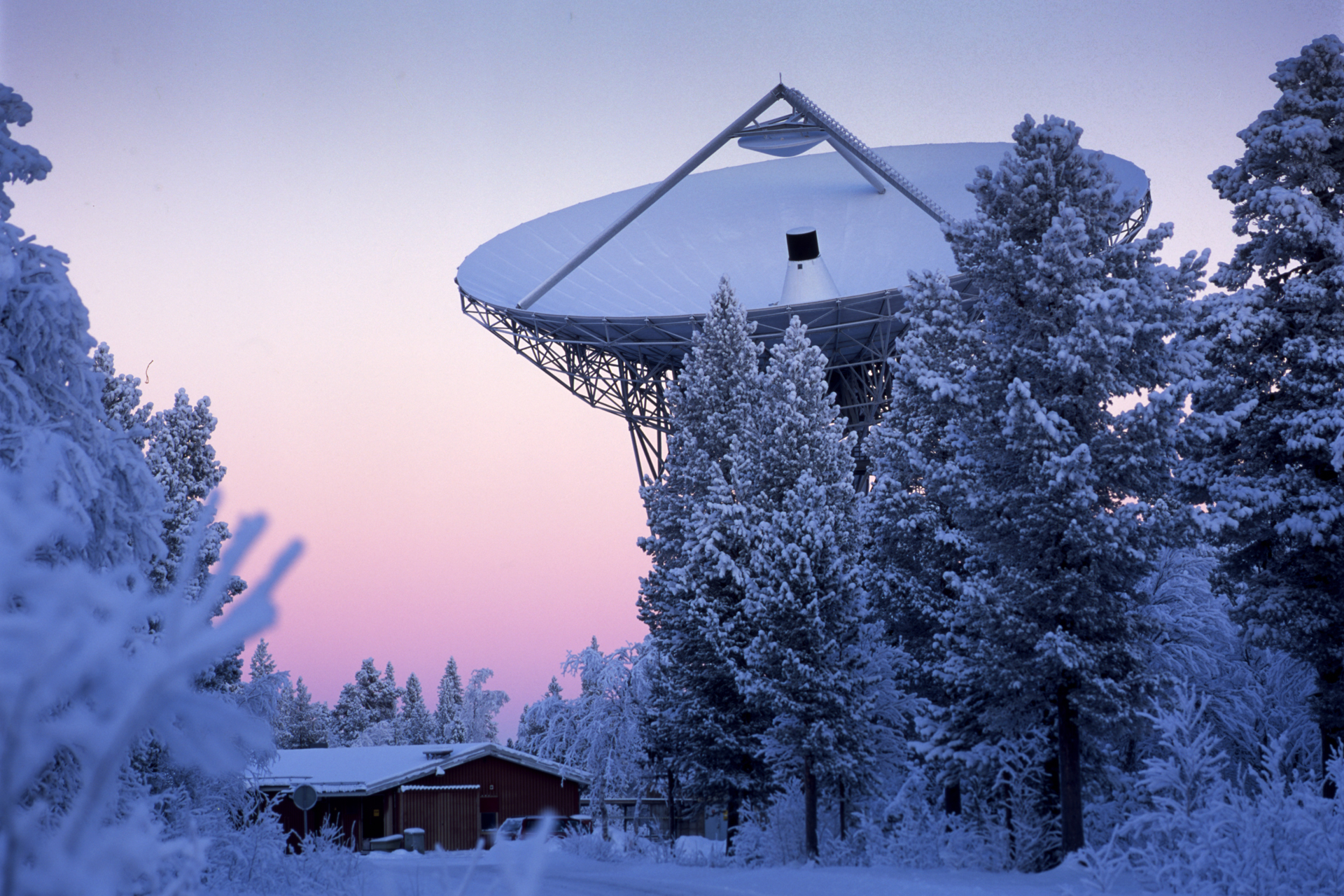
EISCAT headquarters in Kiruna, Sweden
Eventually, Armstrong joined the Swedish Space Corporation, as a developer of the operating system for the first Swedish satellite, Viking.
Around 1984, he moved to Ericsson’s research lab.
Take a chance on me
Take a chance on me
If you need me, let me know, gonna be around
At first Armstrong worked on creating a small language based on Prolog. The lab’s job was to build software that Ericsson’s engineers could eventually use. Together with Robert Virding he teamed up with a group of Ericsson employees who wanted a new language for programming telephony applications. It was a knowledge exchange: Virding and Armstrong would teach them about programming and in return would learn about telephony.
The product of those months of exchange turned into a two-year project, whose fruit would be the Erlang programming language and OTP (Open Telecom Platform).
While Armstrong wrote the compiler in Prolog, Virding designed and programmed the libraries and framework. When the time came to write the virtual machine for the language, Armstrong faced the C language for the first time. Reviewing his work, Mike Williams, another colleague at the lab, told him it was the worst C he had seen in his life, so he decided to take over the virtual machine personally. Armstrong was freed up to finish the design of the language and its compiler. That is how they began the bootstrap process, in which the compiler could be written entirely in Erlang, freeing itself from its past in Prolog.1
The name Erlang refers to the Danish mathematician Agner Krarup Erlang, author of queueing theory and of much of the original theory of telephone networks (such as the Erlang traffic formula). Erlang also works as an acronym for Ericsson Language, although the open source community that supports it today tries not to tie it to Ericsson.

Erlang’s greatest achievement is the AXD301 system. In 1995 the successor to the packet switching system for telephone networks, called AXE-N, had collapsed completely under the new demands and was replaced by the AXD series, developed entirely in Erlang2.
The AXD301, with more than two million lines of code, is a system that achieved 99.9999999% reliability.
You read that right, 99.9999999% (that is nine nines), which means that this system has 0.03 seconds of downtime in the whole year. This figure was measured at British Telecom over a period of eight months. What the figure expresses is the uptime of the service as a whole, not of its parts.
How did they pull this off? Thanks to two essential features: not sharing state and having a sophisticated error recovery model.
Erlang is a functional language that lets you build highly distributed systems, and that incorporates the actor model to implement concurrency and distribution. It comes with OTP, Open Telecom Platform, a complete framework that includes libraries, modules and standards, and is the foundation of most of the systems built with this language. Erlang is practically inseparable from this framework.
The Winner Takes It All
I don’t want to talk
About the things we’ve gone through
I’ve played all my cards
And that’s what you’ve done too
Nothing more to say
No more ace to play
Despite Erlang’s proven success, Ericsson’s executives made a strange decision and in 1998 decided to impose a restriction and ban the use of Erlang for developing internal products. The argument given was that they preferred not to develop in proprietary languages. The ban made Armstrong and other engineers leave Ericsson. The implementation was released as open source at the end of that same year.
Eventually, in 2003, the ban was lifted and Armstrong was rehired by Ericsson3. Even though Ericsson has not established any official policy regarding the language, this is the reason the program’s open source community prefers to ignore the reference to Ericsson in the language’s name.
Before returning to Ericsson, Armstrong documented his work on the development of Erlang in a doctoral thesis he submitted to the Royal Institute of Technology in Stockholm.
His thesis, titled “Making reliable distributed systems in the presence of software errors”2, is available online http://erlang.org/download/armstrong\_thesis\_2003.pdf.
So, at fifty-three, Joe Armstrong finally got his PhD, not in physics as he had hoped as a young man, but in information technology, where he made a great contribution.
This is a great inspiration, at least to me. Maybe unconsciously I decided to emulate him when I went back to university at fifty.
As Armstrong’s life shows us, nothing is final in life, and not everything follows the path we expect. Sometimes the road to recognition has strange twists and turns.
Dancing Queens
Looking out for a place to go
Where they play the right music
Getting in the swing
You come to look for a king
Anybody could be that guy
The tech world heard about Erlang again in February 2014, after Facebook’s acquisition of WhatsApp. Founded in 2009 by Brian Acton and Jan Koum, the app revolutionized the world of instant messaging.

WhatsApp became the epitome of the unicorn startup. It was the queen of the messaging app world in December 2013. With more than 400 million users, it was obvious the tech giants were after the company. The sale to Facebook for more than nineteen billion dollars left everyone stunned. A company with barely 50 employees was getting one of the highest valuations in the history of technology.
When they looked into the technology behind this product, the press and many tech enthusiasts found out that Erlang existed. For an application like this one, a system with high scalability, concurrency and distribution, Erlang’s design characteristics are more than adequate4.
Voulez Vous
And here we go again, we know the start, we know the end
Masters of the scene
To me, Joe Armstrong is one of those people whose life I find inspiring. Among the things I most identify with is what he says in the interview with Seibel in his book Coders At Work1.
“The really good programmers spend a lot of time programming. I haven’t seen very good programmers who don’t spend a lot of time programming. If I don’t program for two or three days, I need to do it. And you get better at it—you get quicker at it. The side effect of writing all this other stuff is that when you get to doing ordinary problems, you can do them very quickly.”
“I have learned new programming languages, but not with the goal of becoming a better programmer. With the goal of becoming a better language designer, maybe.”
“I like figuring out how things work. And a good test of that is to implement them yourself. To me programming isn’t about typing code into a machine. Programming is about understanding.”

Joe Armstrong, programmer and creator of Erlang
Huffman coding in Erlang
Erlang lets you write very concise code, and for this exercise, which is part of my series on those strange new languages, Huffman compression, I needed barely 70 effective lines of code, which shows how expressive this language is.
This is the essence of the program:
    -module (huffman).
    -compile({no_auto_import,[size/1]}).
    -export ([main/0, main/1]).
    -import(filename, [absname/1]).
    -define(USAGE, "uso: huffman [c|d] archivo_entrada archivo_salida\n").


        main() -> io:format(?USAGE).
    main([Opt,Entrada,Salida]) when Opt =:= 'c' -> comprimir(Entrada, Salida);
    main([Opt,Entrada,Salida]) when Opt =:= 'd' -> descomprimir(Entrada, Salida);
    main([_]) -> io:format(?USAGE).

    comprimir(Entrada, Salida) ->
       {ok, Binary} = file:read_file(Entrada),
     Bytes = binary_to_list(Binary),
     {Dump, Tree} = encode(Bytes),
       DTree = tree_as_bits(Tree),
     PS = (8 - ((bit_size(DTree) + bit_size(Dump)) rem 8)) rem 8,
        PDump = <<DTree:(bit_size(DTree))/bitstring, Dump:(bit_size(Dump))/bitstring, 0:PS>>,
       ok = file:write_file(Salida, PDump).

    descomprimir(Entrada, Salida) ->
        {ok, Binary} = file:read_file(Entrada),
     {Tree, Code} = read_tree(Binary),
       Dump = decode(Code, Tree),
      ok = file:write_file(Salida, Dump).
Being a language created to solve telecommunications problems, its support for building protocols is superior to many languages. In particular, binary data manipulation is one of Erlang’s interesting features, and one I leaned on heavily to solve this problem.
Erlang has a data structure that corresponds to a string of bits. This makes it possible to generate the bit stream needed for Huffman compression. Let’s see how.
First, once we have the Huffman code tree, we must store it as a sequence of bits. To build that sequence we use this code:
    tree_as_bits({L,R}) ->
       BL = tree_as_bits(L),
       BR = tree_as_bits(R),
       <<0:1, BL/bitstring, BR/bitstring>>;
    tree_as_bits(Symbol) ->
     <<1:1, Symbol>>.
Remember that our tree can have internal nodes (which have two children) or leaves, which only hold the symbol.
Given that, the pattern {L,R} represents a node, in which case L is the left branch and R the right branch. What this does is recursively create the binary representation for L and R, leaving them in BL and BR, respectively, and then return the bitstring <<0:1, BL/bitstring, BR/bitstring>>. With this we say that a sequence of bits is returned, where the first bit is 0 (the :1 indicates it is a string 1 bit wide), followed by the bitstrings BL and BR.
In the second case, Symbol is the leaf that holds only the symbol we want to store (one byte), so we return <<1:1, Symbol>>, that is, a bit set to 1, followed by the 8 bits that represent the symbol.
The reverse is also solved recursively, like this:
    read_tree(<<1:1, Rest/bitstring>>) -> read_leaf(Rest);
    read_tree(<<0:1, Rest/bitstring>>) -> read_node(Rest).

    read_leaf(<<Sym:8, Rest/bitstring>>) -> {{Sym,-1}, Rest}.

    read_node(Bits) ->
      {L, Rest1} = read_tree(Bits),
      {R, Rest2} = read_tree(Rest1),
      {{L,R}, Rest2}.
In this case we are reading a sequence of bits. If we find a 1 then we read a leaf (read_leaf) from the rest of the bits (Rest). If we find a 0, we read a node from the rest of the bits (Rest).
The read_leaf function reads the symbol from the first 8 bits of the bitstring and returns the symbol as a node with a frequency value of -1 {Sym, -1} along with the rest of the bits. Remember that for decompression we don’t care about the frequency of the symbols, but we need to keep this shape so that our decoding code recognizes when it is reading the symbol.
The read_node function is recursive: it reads the left node first and then the right one and returns a compound node plus the rest of the bits.
One last, very relevant aspect that I ran into was the following. In the compressed file we store the tree as a sequence of bits, and then a sequence of bits that represents the compressed information.
So the decoding function must read this sequence of bits, walking it guided by the tree. That is, if there is a 1 it walks the right tree until it reaches a leaf, if there is a zero it walks the left tree until it reaches the leaf. Once you reach the leaf, the symbol it holds is the decoded symbol. Now, my first version used bitstring to do this, but that turned out to be extremely slow. This is because bitstrings are a fairly complex data structure and the recursive nature of the algorithm requires a lighter data structure to work with.
That is why the final version of the decoder ended up like this:
    % decode a binary using Tree
    decode(Code, Tree) ->
     L = [X || <<X:1>> <= Code],
      decode(L, Tree, Tree, []).

    decode([], _, _, Result) ->
     lists:reverse(Result);
    decode([1|Rest], {_, R={_,_}}, Tree, Result) ->
        decode(Rest, R, Tree, Result);
    decode([0|Rest], {L={_,_}, _}, Tree, Result) ->
        decode(Rest, L, Tree, Result);
    decode(L, {Sym, -1},  Tree, Result) ->
        decode(L, Tree, Tree, [Sym|Result]).
The decode/2 function (which takes the bits and the tree) transforms the bitstring into a list of 0 or 1 values. This list is what gets passed to the decode/4 function (which takes a list of 0s and 1s, the node to visit, the whole tree and a list that holds the decoded symbols).
The full code is, as always, in my GitHub repository, at this address: https://github.com/lnds/9d9l/tree/master/desafio4/erlang
So let’s end this post with one of ABBA’s greatest hits and maybe one of the best pop songs of all time, Dancing Queen:
Notes
Coders at work: Reflections on the Craft of Programming. By Peter Seibel. ↩︎ ↩︎ ↩︎ ↩︎
Armstrong’s 2003 thesis, “Making reliable distributed systems in the presence of software errors”: http://erlang.org/download/armstrong_thesis_2003.pdf ↩︎ ↩︎
Inside Erlang, the Rare Programming Language behind WhatsApp’s success ↩︎
Comments
comments powered by Disqus