$ cat posts/walking-with-dromedaries.md
Walking with dromedaries
Reflections on Conway's law
“A dromedary is a horse designed by a committee”
– ancient Mentat aphorism, predating the Butlerian Jihad
“There’s never enough time to do something right, but there’s always enough time to do it over”
– Anonymous, quoted by Melvin Conway
My most memorable encounter with Conway’s Law, and the moment its depth really sank in, was a couple of years ago, when an architecture decision was shaped by the organization of the datacenter where we host our applications. You heard that right: we had to modify the deployment architecture of our system because of how the datacenter’s services were organized.
“You can’t have a database on the same server as the application, because... databases are administered by the DBAs, the application tiers by the system operators”.
[But... “Databases are administered by the DBAs, the application tiers by the system operators”.
Anyway, we’ll leave the discussion about “best practices” for another day.
Conway’s Law
Conway’s Law is an observation by the programmer, hacker, and PhD in Computer Science Melvin Conway, which says (quoting from his paper):
“Organizations which design systems (in the broad sense used here) are constrained to produce designs which are copies of the communication structures of these organizations”.
When Melvin Conway submitted his paper “How Do Committees Invent?” to the prestigious Harvard Business Review, it was rejected on the grounds that he had not proved his thesis. After that rejection he sent it to Datamation. The article is from 1968, and it’s a quite reasonable and well-argued observation, in my opinion.
For Conway, designing a system is the intellectual activity that tries to create a whole out of diverse parts. Whether it’s creating a weapon system, recommending how to meet a social challenge, or programming a computer. For the author these activities are essentially the same.
Normally the organization in charge of devising this system sets out to produce a document containing a coherently structured body of information. This is what’s called the system design. The recipient of this document is a “sponsor”, who wants some activity carried out, guided by the system design. For example, a public official who commissions legislation to prevent the recurrence of a recent disaster, and to that end appoints a team to explain the catastrophe and propose preventive solutions. It could also be a businessman who needs to market a new product and appoints a planning team to specify how it should be introduced into the market.
The organization that designs may or may not be involved in building the system. This affects design decisions, because knowing that you’ll be involved in the construction leads you to make different decisions than if you know that burden falls on someone else’s shoulders.
The activity of designing requires making decisions continuously, and these are also decisions the designer makes about his own future. Here the incentives present in the environment can work against the sponsor’s intentions.
One of Conway’s key observations is that the mere choice of the team implies basic design decisions about the final system. In other words, the design of a system is a reflection of the group of people who are going to design it.
Once the organization of the design team is chosen, we can delegate activities to the subgroups within that organization. With each delegation what we do is narrow the possible design alternatives, according to the capabilities of the subgroups or people chosen.
Along with delegation come coordination problems. The need to coordinate lowers the productivity of the smaller groups, but it’s the only way the separate task groups can consolidate their efforts into a unified system design.
For Conway the life cycle of a system design goes like this:
- Drawing of the system’s boundaries according to certain ground rules
- Choice of a preliminary system concept
- Organization of the design activity and delegation of tasks according to that concept
- Coordination among the delegated tasks.
- Consolidation of the subdesigns into a single design.
The design activity may not follow this sequence. For example, you might reorganize after discovering a new design concept that is obviously superior. Of course reorganizing isn’t pleasant, and it’s often expensive too.
What is certain is that this process is always repeating itself. After all, as Conway observes, “there’s never enough time to do something right, but there’s always enough time to do it over”.
Any system of consequence is structured from smaller subsystems, which are interconnected. The description of the system starts with the description of its connections to the outside world and then goes into each subsystem and how they are interconnected, dropping down a level each time, reducing the scope until we reach the simplest parts, which can be understood without further subdivision.
The same can be said of a theory, which can also be subdivided into subtheories and explained in a similar way.
A system or theory can be represented as a graph. Each node is a subsystem that communicates with other subsystems through the branches or edges. We call these edges interfaces.
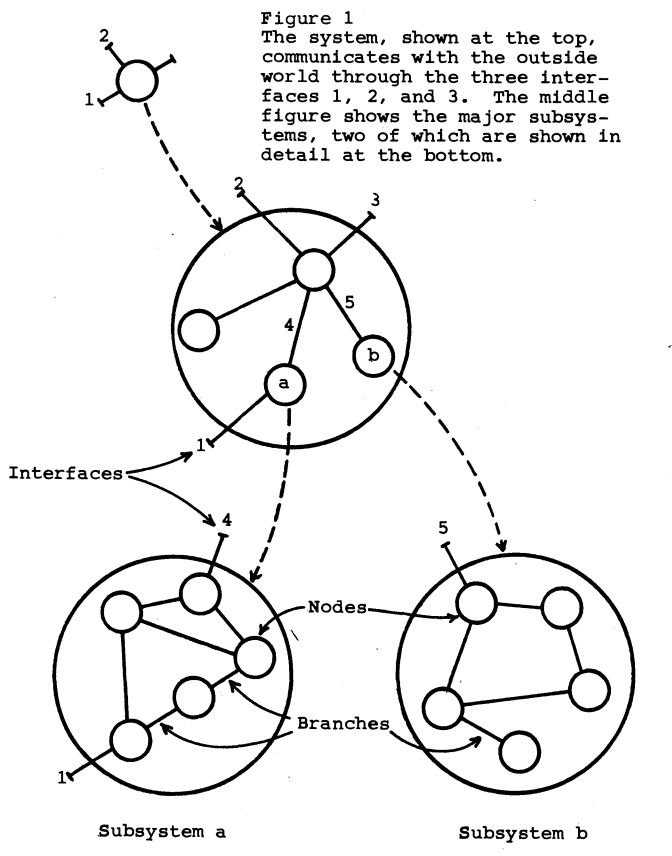
An example of a linear graph used to represent a system, presented by Conway in his original article: “How Do Committees Invent?”
The interesting part, and it’s what Conway sets out to demonstrate in his article, is that in the graph you can replace the word system with the word committee, subsystem with subcommittee and interfaces with coordinators, and in doing so replicate the organizational structure that designed the system.
Consider the case of interfaces. Take two nodes X and Y of a system. They may be connected to each other by an edge. If there is an edge, then two design groups X and Y (not necessarily distinct) must have negotiated and reached an agreement on the interface specification to allow communication between the two corresponding nodes. If there is no branch between nodes X and Y, it means there was nothing to negotiate between the two design groups. It’s that simple.
The structure of the system, then, reflects the structure of the organization that designs it. In mathematical terms, there is a homomorphism between the graph of a system’s design and the graph of the organizational structure that designed it.
The classic example Conway gives is this one:
A contract research organization had eight people who were to produce a COBOL and an ALGOL compiler. After some initial estimates of difficulty and time, five people were assigned to the COBOL job and three to the ALGOL job. The resulting COBOL compiler ran in five phases, the ALGOL compiler ran in three.
In other words, if you have a three-tier system it’s because you have your team split in three: one team for the front-end, another for the business tier and another for the data tier. An application divided this way will be deployed in three separate pieces.
A monolithic application is usually the product of the initial work of a single developer, which is then “handed over” to a larger team, which quickly starts dividing it into modules so it can deal with its evolution.
Conway reminds us that the structure of a large system tends to disintegrate during development, qualitatively more so than with small systems.
To understand this you have to understand why large systems disintegrate, and that has to do directly with the homomorphism we’ve identified.
Systems disintegrate in three steps:
- First, the realization by the initial designers that the system will be large, together with certain pressures in their organization, makes irresistible the temptation to assign too many people to the design effort.
- Second, application of the conventional wisdom of management to a large design organization causes its communication structure to disintegrate.
- Third, the homomorphism ensures that the structure of the system will reflect the disintegration that has occurred in the design organization.
You’ve surely experienced this many times. Design teams slowly disintegrate while the design still isn’t completely finished, because their members are needed for other work. That disintegration is reflected in the structure the system has taken on, and the ones who suffer it are those developing or maintaining the system.
When a system is large, odds are we’ll ask for a bigger team. After all, we want to delegate the effort in order to attack the apparent complexity of the system, which has already reached the limits of our comprehension. We have a deadline to meet, so we want to subdivide the work further to get it done. But the initial designer is caught at a crossroads: wrestle with the complex design or fragment his knowledge of it through delegation. And the manager forces delegation, because he can’t keep idle resources.
Another example is when a difficult design task has to be subcontracted and there are two options: a small, new contractor with an approach that looks interesting at a cost below budget, or a more conventional, established organization with a more “realistic” price.
The manager knows that if the smaller contractor fails he’ll be accused of wasting resources, but if the more “established” contractor fails it will be evidence that the problem really is very hard.
The problem is that accounting criteria, which guide conventional management practice, tell us that when we talk about human effort it must be measured by the cost of the hours put in.
The fallacy behind this calculation is that it sets up a linear property which says that two people working for a year or a hundred people working for a week are resources of equal value.
We know that two people and a hundred people cannot have the same organizational structure, and Conway’s homomorphism tells us they won’t design similar systems, so the efforts aren’t even comparable. Experience tells us that if we choose well, and if they survive the experience, two people will give us a better system.
If it were a matter of peeling potatoes, putting up walls, or bringing in the wheat harvest, we could use linearity and assume that bringing in more people helps cut the time. But for designing complex systems, that isn’t true. And yet people insist on using this linear criterion in planning and designing our systems.
Conway also warns us that once the manager’s prestige and power are tied to his budget, he will tend to expand his organization. “Once the organization exists, of course, it will be used. Probably the greatest single common factor behind many poorly designed systems now in existence has been the availability of a design organization in need of work”.
The second phase of the disintegration process begins as soon as delegation starts. We know that the number of possible communication paths in an organization is proportional to the square of the number of people in it. Even in small organizations it’s necessary to restrict the degree of communication between people so that we get anywhere (something that doesn’t happen much, given our tendency to hold expanded meetings to make any decision at all).
So, to restrict these communication channels, normal management practice leads to setting up hierarchical structures, where communication flows from the top down and vice versa. The graph becomes a tree, and the system starts to take on a similar hierarchical structure (another thing that also tends to fail when, in organizations, decisions get stuck at the upper levels and communication doesn’t make it down to the implementers at the lower levels).
Conclusions
Conway tells us that organizations which design systems will produce systems that resemble their own communication structures. This has important implications for the management of system design.
The obvious conclusion is that flexibility of organization is important to effective design, because we know the first design is never the best possible,
In 1968 Conway recommends that we reward those managers who keep their organizations lean and flexible. That the management of design should not be based on the idea that adding more people adds more productivity. For him this philosophy is key to making the design of technology a dependable undertaking.
We’re coming up on fifty years since Conway’s article was published and we’re still caught in the same traps this author identified. We keep getting dromedaries, when what we wanted were horses.
Comments
comments powered by Disqus