$ cat posts/pour-some-syntactic-sugar-on-me.md
Pour some syntactic sugar on me
9 challenges in 9 languages (4 of 9), part 1
Table of contents
December 31, 1984 was a date that changed forever the life of Rick Allen, the drummer of Def Leppard. In a car accident, the “Thunder God”, as his fans call him, lost his left arm.
For a brilliant young drummer the amputation meant the end of his career, but encouraged by his bandmates and with the help of Jeff Rich (the drummer of Status Quo), Allen worked on designing an electronic kit, and with it he made his debut in 1986 at the Monsters of Rock festival at Castle Donington.
Rick uses four pedals for his left foot, to replace his missing limb, with which he triggers the sound of the hi-hat, bass drum, snare and a tom.
But it turned out that after Allen’s accident the band entered its most successful period. Hysteria, Def Leppard’s fourth studio album, hit number one on the Billboard 200 and the UK Album Charts in 1987. The story is told very well in the movie “Hysteria, the Def Leppard Story”.
Rick Allen’s decision to use technology and change the way he played the drums, in order to keep his career going, is something worth studying in detail. Not all of us face decisions as vital as the one this musician faced, but in the world of technology sudden change is a constant.
One lesson we can take from Allen’s case is that technology can be a great help in overcoming our physical limitations.

Rick Allen, drummer of Def Leppard
Kotlin
Programming languages are one of the technologies we invented to overcome the limitation imposed by giving instructions to a Turing Machine. What we’re after is being able to express ourselves as closely as possible to the way we think, and not in the sequential way imposed on us by the Von Neumann model, for example.
That’s why there are so many programming languages: each one is trying to overcome some limitation.
Java is one of the most popular languages right now, one of those with the greatest penetration and presence in the software development market, according to various indexes, such as the RedMonk ranking , or the TIOBE index.
But all of us who have programmed in Java know it’s not a comfortable language. It has some design decisions that still cause major headaches (as we’ll see in an example later in this article).
The Java Virtual Machine was created to support the Java language. Gosling’s idea was to port this machine to different environments, mainly devices with limited resources. But Java is almost everywhere, and massively distributed across millions of Android devices.
When Microsoft invented .Net it decided to take, in a way, the opposite path from Sun’s: its CLR is a virtual machine designed to work with several languages, and when it hit the market it included Visual Basic and C#.
Over time, people using Java decided to build other languages that would take advantage of the JVM, while trying to overcome Java’s limitations.
Kotlin is one of those attempts. A language that has been in development for six years now, and is at version 1.1.
I’m not going to write an ode to Kotlin; Steve Yegge already did that elsewhere.
It’s an interesting language, one to keep an eye on. I think it’s going to gain traction after the push Google gave it by officially recognizing it as an official language for Android.
This article is an introduction to the fourth challenge in my series on these “strange new languages”, so let’s get to that, and then we’ll come back to Kotlin.
Syntactic sugar
Pour your sugar on me
I can't get enough
– Def Leppard
Syntactic Sugar causes cancer of semicolons
– Alan Perlis
In programming languages we talk about syntactic sugar to refer to syntax designed to make things easier to read, or to understand.
The idea of challenge four is to explore that syntactic sugar, along with other design decisions, that give each of the languages some advantage, and that explain why there’s such a variety of them. It also lets us understand what their authors were thinking when they created them.
This time, I’ll solve the problem one language at a time and document the solution for each language in its own post. So this fourth challenge will have nine parts (or maybe 10 or 11).
The fourth challenge
This time we’ll build a program that compresses information. For this we’ll use a classic algorithm called Huffman Coding.
At least in theory, Huffman Coding is the compression that guarantees each symbol is represented with the optimal number of bits, according to Shannon’s information theory (which we’ve talked about before).
In Huffman Encoding what we do is count the frequency of the symbols in the text we want to compress, and based on that we build a representation table that minimizes the number of bits for each one. That way the most frequent symbols require fewer bits than the symbols that show up fewer times in the text.
There’s a more detailed description of Huffman coding on Wikipedia; I’ll leave it here for you to study if you’re interested: Huffman Coding. What matters now is how we implement this in different languages. So we’ll be looking at that throughout these articles.
Back to Kotlin
To build a solution to this challenge we need to build some very interesting data structures, like a Priority Queue and a Trie. The latter lets us see where a language like Kotlin has advantages over Java and helps us make fewer mistakes, and write less code.
To explain it I’m going to take a detour and propose another exercise. Suppose we have a binary tree. In each node of this tree we store a number, and we want to compute the sum of these numbers and the maximum and minimum values of the tree.
So our goal is to build a structure that satisfies the following:
Tree is a binary tree structure.
A node always has two children, and a numeric value.
A leaf only has a numeric value.
Tree.sum(): returns the sum of the values in the nodes and the leaves.
Tree.max(): returns the maximum value among the nodes and the leaves.
Tree.min(): returns the minimum value among the nodes and the leaves.
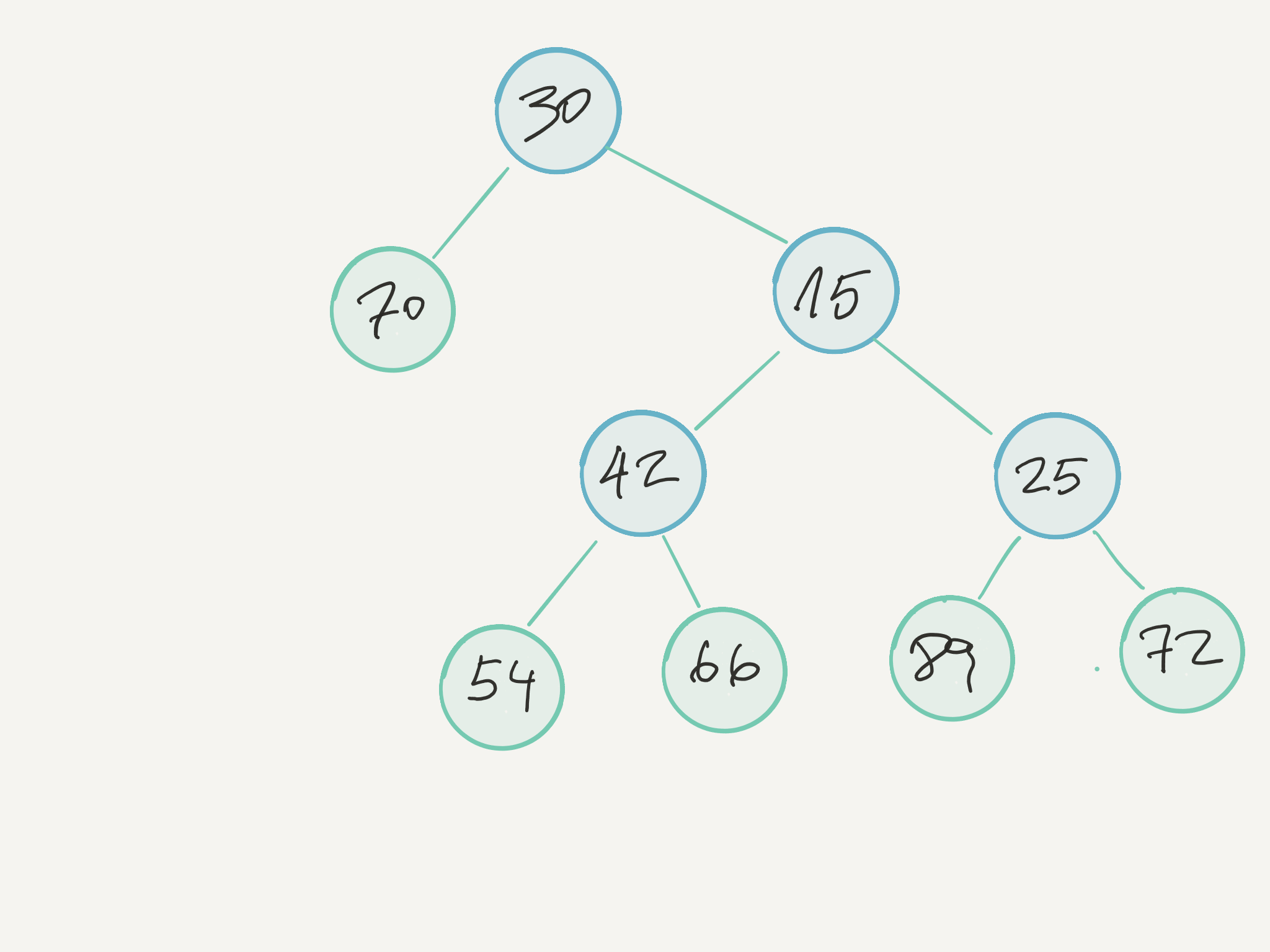
A binary tree with numbers in its nodes and leaves
A solution in Java looks like this:
    public class Tree {
        int value;
        Tree left;
        Tree right;
        public Tree(int value) { this(value, null, null); }

        public Tree(int value, Tree left, Tree right) {
             this.value = value;
             this.left = left;
             this.right = right;
        }

        public int sum() {
            return this.value + this.left.sum() + this.right.sum();
        }

        public int max() {
            return Math.max(this.value, Math.max(this.left.max(), this.right.max()));
        }

        public int min() {
            return Math.min(this.value, Math.min(this.left.min(), this.right.max()));
        }
    }
And we can create the tree in the figure like this:
     Tree arbol = new Tree(30, new Tree(70), new Tree(15, new Tree(42, new Tree(54),
                  new Tree(66)), new Tree(25, new Tree(89), new Tree(72))));
     System.out.println(arbol.sum()); // 463
     System.out.println(arbol.max()); // 89
     System.out.println(arbol.min()); // 15
There are several problems with this implementation. For example, what happens with this code?
Tree arbol = new Tree(30, new Tree(70), null);
Oops, an NPE! So we have to patch our code like this:
    public int sum() {
        if (this.left == null && this.right == null) {
            return this.value;
        }
        else if (this.left == null) {
       return this.value + this.right.sum();
        }
        else {
        return this.value + this.left.sum() + this.right.sum();
        }
    }
And the same for max and min. But are we sure that code is right?
Consider this solution in Kotlin:
    interface Tree {
         fun sum() : Int
         fun min() : Int
         fun max() : Int
     }

    class Node(val value:Int, val left:Tree, val right:Tree) : Tree {
           override fun sum() : Int = value + left.sum() + right.sum()
         override fun max() : Int = Math.max(value, Math.max(left.max(), right.max()))
           override fun min() : Int = Math.min(value, Math.min(left.min(), right.min()))
    }

    class Leaf(val value:Int) : Tree {
          override fun sum() : Int = value
            override fun min() : Int = value
            override fun max() : Int = value
    }
With this we can create and use our tree like so:
    val arbol = Node(30, Leaf(70),
                Node(15, Node(42, Leaf(54), Leaf(66)), Node(25, Leaf(89), Leaf(72))))
    println (arbol.sum())
    println (arbol.max())
    println (arbol.min())
Not only is the code more compact, but in Kotlin it’s impossible for us to slip a null into a tree.
In Kotlin, uninitialized variables are forbidden by default.
But sometimes you do need to put nulls in your structures, and in that case Kotlin introduces syntactic salt, that is, syntax that makes it harder to write dangerous things, or bad practices.
If we wanted our nodes to accept nulls, we’d have to declare them like this:
class Node(val value:Int, val left:Tree?, val right:Tree?) : Tree
And we’d have to handle all the edge cases, ugh!
So Kotlin has that advantage built in and you should make the most of it.
Tony Hoare regrets having invented null to the point of calling it his “billion-dollar mistake”. It’s one of the biggest sources of errors in our Java code. Kotlin in its normal mode prevents that. If you want to use nulls you have to be very clear about what you’re doing, and the language’s syntax reminds you at every turn.
A subtle bug
But there’s a design decision in Kotlin that shows up as a subtle bug, one that gave me trouble when I implemented the first solution to the challenge.
The bug becomes obvious in this code:
    fun main(args:Array<String>) {
        var list = ArrayList<Int>()
        list.add(0)
        list.add(0)
        list.remove(list.size-1) o remove(int index)
        list.forEachIndexed { i, v ->
        println("list(" + i +") = "+v)
        }
    }
You’d expect it to print just one element, but it prints two!
Why does this happen?
Because in Kotlin Int translates to Java’s Integer type, but Java treats that as a class distinct from the native type int.
Unfortunately, the ArrayList class has the remove method overloaded, like this:
    void remove(int index);
    void remove(Object o);
When you pass an Int in Kotlin the compiler uses the version that takes an object.
So the call list.remove(list.size-1) gets translated as list.remove(new Integer(1)), and since the number 1 isn’t in the list, nothing gets removed from it, which is not what the programmer intended.
The solution is to use the removeAt() method, but in other situations this bug can happen without us noticing. The Kotlin compiler should do better here, with some kind of warning.
Unlike Scala, Kotlin builds its collections by extending the ones available in Java. In Scala the collections are different, and the way to interoperate with Java is somewhat more complicated, so this subtle error doesn’t come up.
Huffman Coding in Kotlin
Kotlin’s advantage in this exercise shows in the implementation of the encoding algorithm.
In essence, the algorithm for building the Huffman coding tree is this:
Create a leaf node for each symbol, assigning a weight based on its frequency of occurrence, and insert it into the list sorted in ascending order.
While there is more than one node in the list:
2.1. Remove the two nodes with the lowest probability from the list.
2.2. Create a new internal node that links to those two nodes, assigning it as weight the sum of the weights of the child nodes.
2.3. Insert the new node into the list (in the place where it belongs according to its weight).
- The node that remains is the root node of the tree.
To implement this in Kotlin, the tree is represented like this:
    abstract class HuffTree(val frequency : Int)

    class HuffLeaf(frequency: Int, val symbol: Char) : HuffTree(frequency) {
        fun symbolIndex() : Int = ...
    }

    class HuffNode(val left: HuffTree, val right: HuffTree)
            : HuffTree(left.frequency+right.frequency)
And building the tree looks like this:
    fun buildTree(freqs : IntArray) : HuffTree {
        // we implement the sorted list as a Heap
        val heap = HuffHeap()

        // Create a leaf for each symbol with its frequency
        freqs.forEachIndexed { sym, freq ->
              if (freq > 0) {
                  heap.insert(HuffLeaf(freq, sym.toChar()))
               }
        }
        // while there is more than one node in the list
        while (heap.size() > 1) {
            val a = heap.extract()
      val b = heap.extract()
      heap.insert(HuffNode(a, b))
        }
        return heap.extract()
    }
While this comes out very elegant, the Heap implementation requires us to use an array that may contain nulls, and this is where the syntactic salt we mentioned earlier shows up:
    class HuffHeap {
         var heap = arrayOfNulls<HuffTree>(maxSymbols+1)
           var last = 0
            fun insert(tree:HuffTree) {
             if (full()) {
                   throw ArrayIndexOutOfBoundsException()
              }
               last++
              heap[last] = tree
               var j = last
                while (j > 1){
                   if (heap[j]!!.frequency < heap[j/2]!!.frequency) {
                       val tmp = heap[j]!!
                     heap[j] = heap[j / 2]!!
                     heap[j / 2] = tmp
                   }
                   j /= 2
              }
           }
           ....
By declaring heap as arrayOfNulls, we get an array of type Array<HuffTree?>.
This means each element of the array can hold a reference to a HuffTree, and that reference can be null.
Which is why we have to write heap[j\]!!.frequency to get at the
frequency of an element in the Heap.
By construction, and if the Heap ADT is implemented correctly, there’s no way
for heap[j] to be null, so the !! syntax tells us it’s safe
to use that value and that it isn’t null.
Another advantage of Kotlin, and this one really is syntactic sugar, is that after checking for a type we can get rid of Java’s cumbersome type casts. You can see this in the buildCodes() function
    fun buildCodes(tree : HuffTree, codes: Array<String>, prefix : StringBuffer) {
            when (tree) {
               is HuffLeaf -> codes[tree.symbolIndex()] = prefix.toString()
             is HuffNode -> { ... }
            }
        }
Here we use the when control structure, which is a kind of switch, only more powerful. In this case we check the type of tree. Notice that if we know tree is a HuffLeaf we can call the symbolIndex() method, which only exists in that class.
This happens in Swift too, but the truth is Swift seems to have taken this feature from Kotlin.
The complete code is in my GitHub repository. I did two implementations, one more object-oriented than the other.
The difference in approach is expressed in these two code fragments that implement the same function:
    // decompress function, version 1
       fun  decompress(inputFile: String, outputFile: String) {
            val input = BitInputStream(BufferedInputStream(FileInputStream(inputFile)))
         val output = BitOutputStream(BufferedOutputStream(FileOutputStream(outputFile)))
            val huffTree = readTree(input)
          val length = input.readInt()
            for (i in 0..length-1) {
                var node = huffTree
             while (node is HuffNode) {
                  val bit = input.readBoolean()
                   node = if (bit) node.right else node.left
               }
               if (node is HuffLeaf)
                   output.write(node.symbol)
           }
           output.close()
      }

    // decompress function, version 2
     private fun  decompress(inputFile: String, outputFile: String) {
            val input = BitInputStream(BufferedInputStream(FileInputStream(inputFile)))
         val output = BitOutputStream(BufferedOutputStream(FileOutputStream(outputFile)))
            val huffTree = readTree(input)
          val length = input.readInt()
            (0..length-1).forEach { output.write(huffTree.readChar(input)) }
            output.close()
      }
In version 2 the HuffTree class behaves the way the object-oriented paradigm dictates, and each class that implements it knows how to behave according to the context it operates in. This is what’s known as polymorphism.
The big difference is that HuffTree is declared like this:
    abstract class HuffTree(val frequency : Int) {
            abstract fun writeTo(output: BitOutputStream)
           abstract fun dumpCodes(codes: Array<String>, prefix : StringBuffer)
           abstract fun readChar(input: BitInputStream) : Char
     }
And to understand decompress you have to keep in mind that in HuffNode the readChar function is implemented like this
      // implementation in HuffNode
       override fun readChar(input: BitInputStream) : Char {
            val bit = input.readBoolean()
            return if (bit) right.readChar(input) else left.readChar(input)
        }
Whereas in HuffLeaf...
        override fun readChar(input: BitInputStream) : Char {
            return this.symbol
        }
All of this to show you that while Kotlin has the is operator, and when, and gets rid of casts, there are better ways to build this, or else your code turns into one enormous sequence of ifs or whens doing implicit type casts.
Conclusion
Kotlin is a very practical language. It lets you write fairly compact, expressive code. Many of its constructs also let you write safer code. Scala has similar things, but they require more verbosity (I’m thinking of Options to avoid nulls), but that’s something we’ll discuss in the second article of this series.
It has constructs that save you type casts and let you run statements according to the type of data you receive, but this can lead to bad programming habits. Whenever possible, use the object-oriented paradigm properly, and that means using polymorphism.
Kotlin is a modern language, fun, easy to learn. With the right dose of syntactic salt and sugar you can build almost anything. But just as with the salt and sugar in our food, abuse can cause serious health problems, so use it in moderation.
All the code that goes with this article is on Github: https://github.com/lnds/9d9l/tree/master/desafio4
Comments
comments powered by Disqus