$ cat posts/sex-pianos-and-wifi.md
Sex, pianos and wireless networks
Table of contents
A scandalous actress
A young woman, riding her horse, heads into the forest. For a few moments we lose sight of her. Through the branches and foliage of the trees we see her reappear, running naked to dive into a river.
Then the camera shows us that the young woman’s clothes are on the horse’s back. The animal grazes calmly until a mare peeks out from behind a wooden fence a few meters away in a clearing. The horse whinnies and runs toward the mare, abandoning our protagonist.
She notices and shouts, calling the animal, but it does not obey. Desperate, she swims to the bank and this time we see her run naked; the camera shows us her reflection on the water.
The steed has reached the mare, and when the girl catches up with them it bolts again, running toward the edge of a road where a crew of laborers is working. The men scare the animal off, but a young worker runs after the horse until he stops it and calms it down.
The girl watches all this hidden behind a bush, and that is how the man finds her. At first she tries to cover herself and looks at him in fright, while he smiles; finally she decides to stare at him defiantly. The young worker smiles, handing back dress and horse.
These scenes are part of the 1933 film Ecstasy. The sequence described is the one that brings the lovers together. The later scene, of their first amorous encounter, has the distinction of being the first in cinema to depict a female orgasm (in a non-pornographic film).
Filmed in Czechoslovakia, it took two years to be shown in Germany, because of censorship. In the United States it was condemned by various moral institutions, including the Catholic Church. In 1936 the film’s American distributor began the process of obtaining the seal of approval of the Hays Code, without success. Only in 1940 was the film shown, without the Hays seal, privately in a few art houses.
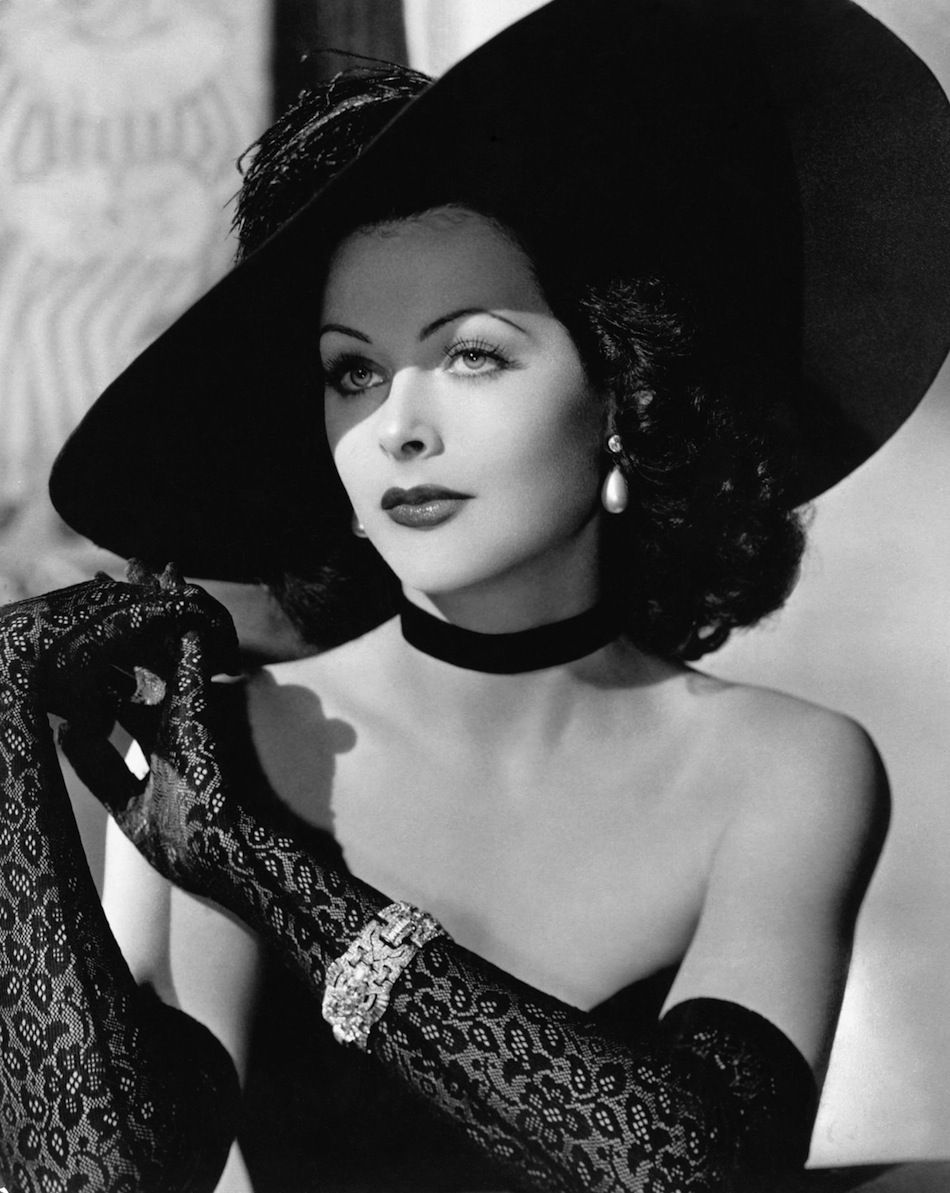
The star was the beautiful young Austrian Hedwig Kiesler, who would later achieve international fame in Hollywood under the name Hedy Lamarr.
Hedy was eighteen when she filmed Ecstasy. Although it wasn’t her first film, it was the one that made her famous worldwide and secured her arrival in the “Mecca of Cinema” years later.
On turning nineteen Hedy married Friedrich Mandl, an important Austrian businessman who owned large armaments factories.
Mandl hated the film, since he held that it exploited his wife and the expression on her face during the simulated orgasm. He bought as many copies as he could to prevent its public exhibition. Once they were married, he forbade his wife to pursue her acting career or to leave his enormous mansion without him.
However, the businessman used his wife’s beauty as a means of improving his business, especially with the fascist governments of Germany and Italy. It is said that the young woman made a great impression on Adolf Hitler during a dinner. Another anecdote claims that Mussolini kept a copy of Ecstasy, which he considered one of his most prized possessions.

The young woman began accompanying her husband to business meetings and conferences on armaments. Hedy was very intelligent. She used to take long walks with her father, a wealthy Viennese banker, talking about science and the mechanical nature of the world. During the armaments conferences she paid close attention and learned how many of the mechanisms of the weapons and munitions developed in her husband’s factories worked.
But Hedy wanted to escape. Not only was the marriage torture for her, she also hated the Nazi regime, because among other things her parents were Jewish. One day she convinced her husband to let her wear all her jewels during a dinner. That same night she disappeared disguised as a maid.
She reached Paris, where she contacted Louis B. Mayer and got a contract to make films for MGM, on the condition that she change her name. Mayer wanted somehow to divert the censors’ attention (until then she was known in the United States as “the Ecstasy Lady”). That is how a successful career in American film began.
The piano man
In June 1926 an exclusive private concert was held in Paris. The event was the premiere of a curious Dadaist-style work, titled “Ballet Mécanique”, which was to be performed by, among other things, a player piano, eight grand pianos, several anvils, and an airplane engine.
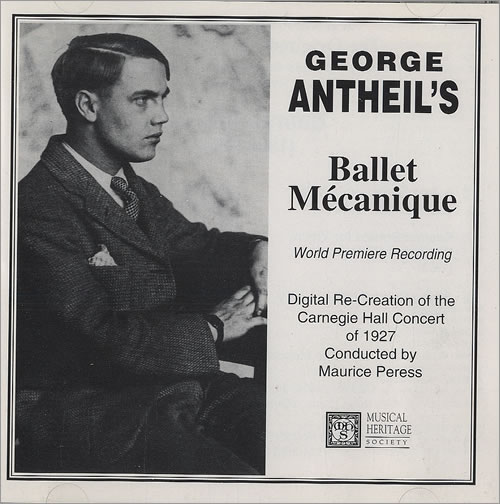
The cacophony of the concert bewildered the audience and several of them left the theater outraged, causing disturbances in the street. The sponsor, a wealthy American woman, was tossed in a blanket by two princesses, three baronesses and a duke.
The author of such a scandalous work was George Antheil, a young American pianist and composer of twenty-six. Five years earlier this young musician had arrived in Europe intending to become a renowned ultra-modern composer and pianist. He achieved moderate success, and in some concerts his works were even played alongside those of Stravinsky and Debussy.
After the fiasco in Paris he traveled to Germany, where he managed to premiere his first opera in 1930. But his avant-garde music was not well received by the Nazis, and in the middle of the Depression he decided to return to his native country. Antheil went to Hollywood, where he wrote scores for various filmmakers, Cecil B. DeMille among them.
Apart from composing, Antheil wrote mystery novels, and also worked as a reporter and critic for music magazines. Before World War II he took part in the Hollywood Anti-Nazi League, exhibiting works of art censored by Hitler’s Germany.
He also wrote an advice column for couples, syndicated in newspapers nationwide, along with regular columns in magazines like Esquire and Coronet. He considered himself an expert in “female endocrinology” and published a series of articles on “how to determine a woman’s availability based on glandular effects on her appearance”. He even went as far as writing books on the subject.
It was these articles and books that led him to meet Hedy Lamarr.
The Hollywood star wanted the expert’s advice on how to improve the appeal of her upper torso. The pianist recommended glandular extracts. Then the conversation drifted to other matters, and in particular to torpedoes.
Torpedoes
Radio-controlled torpedoes were developed at the end of World War I. But their control and guidance mechanism had several flaws. An effective countermeasure was to send a jamming signal on the same frequency used to steer the weapon.
Lamarr knew this effect from her experience at the conferences she had attended alongside Mandl, her ex-husband. When she learned of the German submarine attacks on civilian ships, she became obsessed with finding a way to support the Americans with her ingenuity and her knowledge of armaments.
Hedy wanted to improve the torpedoes’ control mechanism, and for this she conceived the idea of transmitting a guidance signal in short bursts on different frequencies. The code for the sequence of frequencies had to be identical on both the control ship and the torpedo. Since the sequence would be unknown to the enemy, the transmission could not be blocked by flooding the spectrum with noise. And trying to jam every possible frequency would require too much power.
Antheil’s contribution was to control the frequency hopping using a mechanism similar to a player piano’s. He knew very well how it worked, since he had composed Ballet Mécanique to be performed by eight synchronized pianos.
They designed the device so that the signal would hop among 88 frequencies, just like the 88 keys on a piano. In 1941, Lamarr and Antheil signed patent US2292387: “Secret Communication System”.
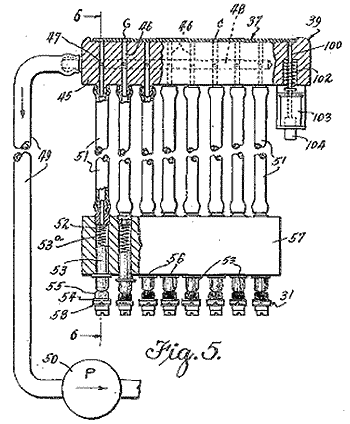
Although a technical presentation was made to the US Navy, the invention met opposition and was rejected. It has to be said that the technology of the time wasn’t ready; only in 1957 was the concept adopted, and it was tested in the 1962 blockade of Cuba.
It is known that Hedy Lamarr wanted to join the National Inventors Council, but she was persuaded that she could contribute more by selling war bonds.
So in 1942 she gets her most memorable line, “I am Tondelayo...”, in the film White Cargo, and becomes one of the favorite pin-up girls of the troops fighting in the Pacific.

Wireless networks
Lamarr and Antheil’s invention is the basis for the signal modulation techniques known as Spread Spectrum.
This technique has been used in the mobile communications standard known as CDMA, a variant of which, known as W-CDMA, is used in the 3G protocol. The same principles are applied in Bluetooth and in WiFi networks.
The fourth generation of wireless networks, known as LTE, is also based on the same principle, and much of its speed is due to its signals being spread across the spectrum using this frequency switching.
Lamarr and Antheil’s technological legacy was only recognized in 1997,
when the Electronic Frontier Foundation gave her its sixth annual
award for technology
pioneers.
On hearing the news Lamarr exclaimed “it’s about time!”, and sent her son
to receive the award on her behalf. Antheil died in 1959, so he never
even got to see the practical application of his idea.
Lamarr died in 2000 at her home in Florida. She is probably remembered more for her spectacular beauty than for her technological contributions. “My face has been my misfortune,” she once said, “it’s like a mask I cannot remove. I curse it.” She was probably expressing her frustration at not being accepted as something more than a pretty face, as a woman with original and effective ideas.
Comments
comments powered by Disqus