$ cat posts/turing-alan-turing.md
Turing... Alan Turing
You may not know this, but Alan Turing and Ian Fleming (the author of the novels about Bond, James Bond) worked together.
During the Second World War Alan Turing led the Hut 8 group at
Bletchley Park, the headquarters of the
Government Code and Cypher School (GC&CS).
Hut 8 was in charge of breaking the secret codes
created with the Enigma machines used by the German navy. This
famous machine had an encryption mechanism that was considered
impenetrable at the time.
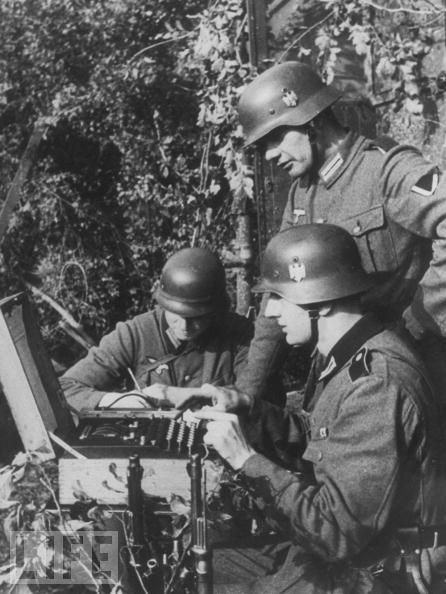
The photograph shows three German soldiers using one of these devices.
The Enigma machine is an electromechanical device. From the point of view of the “user interface”, it has a keyboard where you type the message in plain text, and at the top, on a lamp board, the lights come on with the letters that make up the ciphertext. The mechanism is symmetric, so to decipher a text you perform the same operation: you type the ciphertext on the keyboard and the letters of the decrypted text light up on the lamp board.
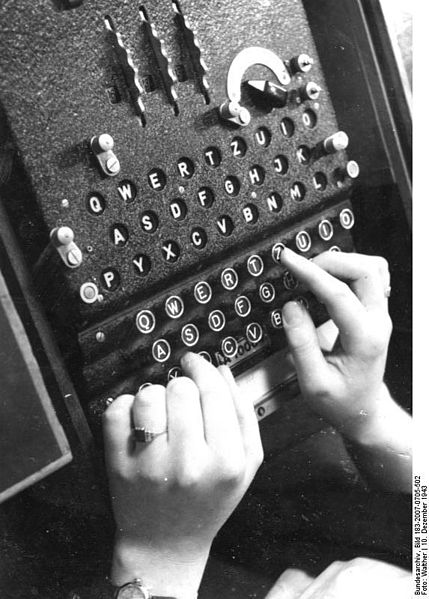
A mechanism of rotors and plugs is used to configure the machine for operation, and this initial setup is the encryption key. These keys were changed every day, and were recorded in codebooks that were distributed to the various units of the German army and navy.
I am not going to describe in detail how Enigma works; I would need a fairly long article to explain it. You can dig into the details in this Wikipedia article, although I recommend reading the book “The Code Book” by Simon Singh
An early version of the Enigma machine was broken by Polish intelligence before that country was invaded by the Germans in September 1939. The Germans added more complexity to the machine, adding new rotors and plugs. The number of possible combinations to go through to determine the encryption key was astronomical.
Turing had the advantage of his theoretical work devising his famous universal computing machine. When he joined the team of codebreakers at Bletchley Park he was able, in a few weeks, to devise a mechanism capable of determining the keys of the Enigma machines used by the German army. His work led to the design of machines called Bombes, which could calculate the keys in a few hours.
However, the Enigma machine used by the German navy was more sophisticated, and on top of that this group applied “best practices” that made decryption harder. For example, the cryptanalysts relied on stereotyped messages to determine “cribs”, sequences of text that could be “guessed” and that made the bombes’ work easier. The German sailors avoided that kind of stereotyped message.
For months Turing’s team could make no progress deciphering the German messages. That was when Ian Fleming suggested Operation Ruthless. A plan to stage the crash landing of a German bomber, with the idea that it would be rescued by a German ship, and in this way steal the Germans’ codebooks. Turing was especially anxious for this operation to succeed, since having those books would let him improve his decryption mechanisms. Although Operation Ruthless was cancelled, the books were eventually obtained in other attacks on German submarines and weather ships.
The information obtained by these teams of cryptographers made up a body of intelligence known as ULTRA.
Ultra gave the Allied command a high degree of confidence. It has even been claimed that Ultra shortened the war by several years. According to the historian David Kahn, breaking Enigma “saved lives. Not only Allied and Russian lives but, by shortening the war, German, Italian, and Japanese lives as well. Some people alive after World War II might not have been but for these solutions. That is the debt that the world owes to the codebreakers; that is the crowning human value of their triumphs.”
After the war ended the British captured thousands of Enigma machines, which they gave away to their former colonies. Of course they never revealed that these machines were completely transparent to their cryptanalysts. For years the former colonies believed the Enigma machine was unbreakable. That is the reason the contributions of Bletchley Park stayed hidden for more than 30 years. That is the reason the world did not learn of Turing’s contribution during his lifetime.
In 1952 Turing reported a burglary at his home, and during the investigation he naively revealed that he was in a homosexual relationship. The police decided to arrest him and charge him with “gross indecency contrary to Section 11 of the Criminal Law Amendment Act 1885”. The trial was reported in the newspapers and Turing was publicly humiliated. The British government withdrew his security clearances, and he was barred from working on projects related to the development of the computer. He was forced to see a psychiatrist and undergo a hormone treatment that affected him physically: he was left impotent and obese, developed gynecomastia (he grew breasts), and fell into a deep depression. In 1954 he killed himself by eating an apple poisoned with cyanide. The world lost one of its most brilliant minds, and the savior of thousands, perhaps millions of lives, all because of prejudice and intolerance.
References:
The Code Book, Simon Singh, Editorial DEBATE.
The Codebreakers, David Kahn.
Comments
comments powered by Disqus