$ cat posts/don-francisco-and-cognitive-dissonance.md
Don Francisco and cognitive dissonance
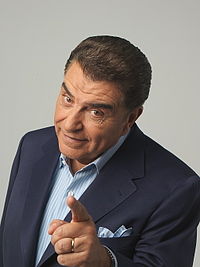
Don Francisco
When I was a kid there wasn’t much to watch on television, and Sábados Gigantes (that’s what it was called back then), the Chilean variety show, ruled the weekend screen.
Its game shows were popular, all of them copies of American programs, though many of us didn’t know it (which explains the nickname "Guatón Copión", the copycat fatso, given to Don Francisco by the comedian Fernando Alarcón, with his character Pepito TV, who was in charge of entertaining us on Sundays).
One of the typical games was the one with the doors. There were 3 doors, A, B and C. The contestant had to pick one of the three; behind only one of them was a juicy prize, typically a car.
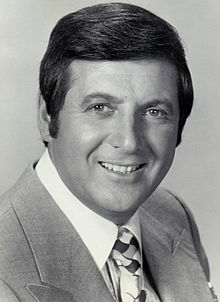
Monty Hall, famous American game show host of the 1960s.
This game was a variant, or adaptation, of an American game show called Let's Make a Deal, hosted by Monty Hall. That show is the inspiration for an interesting mathematical problem called the Monty Hall problem.
The problem is stated as follows:
“The contestant must choose one door out of three (all closed); the prize is whatever is behind the chosen one. It is known for certain that behind one of them there is a car, and behind each of the other two a goat. Once the contestant has chosen a door and announced the choice to everyone present, Monty, the host, who knows what is behind each door, will open one of the other two and show that there is a goat behind it. He then gives the contestant the option of switching doors, if desired (there are two options). Should the contestant stick with the original choice or pick the other door? Does it make any difference?”
If you remember, Don Francisco’s game was very similar. But let’s concentrate on the problem. Here is a diagram taken from Wikipedia:
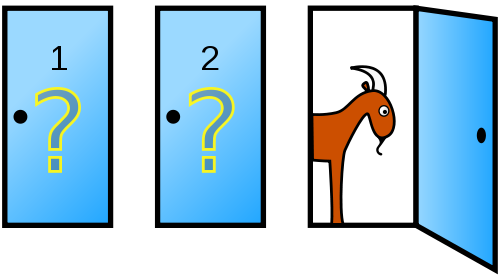
The situation after the host has opened the door
Since there are two doors left to open, you would think the probability of the car being behind either door is 1/2 (50%), right? So it would make no difference whether you stick with your initial choice or switch. But the truth is that it does. If you were in this situation, the right thing to do is switch, to have a better chance of winning.
This seems paradoxical, but if you do the probability analysis correctly, what maximizes your chances of winning the car is switching doors.
The reason is the following. First, Don Francisco, or the host, knows which door hides the car. Initially, before the host opens a door, the probability of picking the door with the car is 1/3. If you have picked the car, Don Francisco can choose either of the other two doors, and if you switch doors you lose. On the other hand, if you have picked a door that hides a goat, then Don Francisco can only choose the door that hides the other goat. In that case, if you switch you will pick the door with the car. To sum up: if you stick with the original choice you win if you originally picked the car (with probability 1/3), while if you switch you win if you originally picked one of the two goats (with probability 2/3). Therefore, the contestant should switch if he wants to maximize the probability of winning the car.
This is a diagram of the possibilities. I suggest you go over it so you can follow the reasoning:
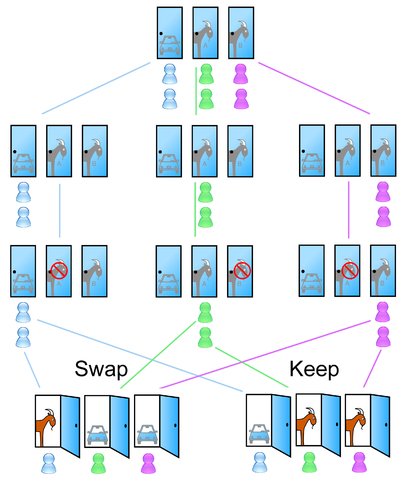
Or you can read the Wikipedia article, which has the mathematical calculation of the probabilities.
Now, this paradoxical result affects some results in psychology experiments used to study one aspect of cognitive dissonance. In particular, something known as the choice rationalization paradigm.
There was an experiment at Yale involving capuchin monkeys. The monkeys were shown colored M&M’s, say red, blue and green. The monkeys were given a choice between two of them.
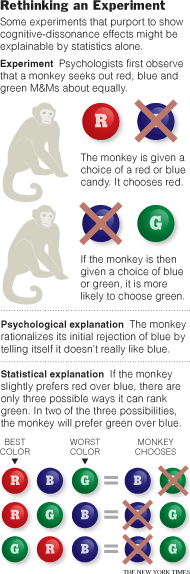
If the monkey chose the red one over the blue one, it was then given the option of choosing between blue and green. The researchers noticed that two thirds of the time the capuchins rejected the blue M&M’s in favor of the green ones, which seemed to confirm the theory of choice rationalization: once we reject something, we tell ourselves we didn’t like it anyway (and with that we get rid of the dissonant thought that we made the wrong choice).
The image on the right, taken from this article in the New York Times, shows the psychological explanation, based on the rationalization paradigm. But it turns out it can be explained statistically using the same principles as the Monty Hall problem.
That is the result reached by the economist M. Keith Chen. Chen questions the validity of many psychology experiments on rationalization theory, going back to 1956!
According to Chen there are hundreds of psychology experiments that fail in the same way.
For Chen it’s possible that the choice rationalization paradigm is still valid, but he has not found scientific experiments that measure this effect correctly. "The whole literature on this subject operates as if the Monty Hall problem didn’t exist", is his conclusion.
Sources:
Wikipedia: The Monty Hall problem
Go Ahead Monkeys, Rationalize, Monkeys Do It Too, New York Times, November 2007.
And Behind Door No. 1, A Fatal Flaw, New York Times, April 2008.
How Choice Affects and Reflects Preferences: Revisiting the Free Choice Paradigm, M. Keith Chen & Jane L. Risen.
Comments
comments powered by Disqus