$ cat posts/energy.md
Energy
A few days ago I was talking with a datacenter services provider here in Chile. He told me that unfortunately it is not possible to have Tier-4 certified datacenters in our country. The reason, in simple terms: we have only one “electrical highway” supplying power to the computing centers. To reach the highest level of datacenter certification, the power has to come from two sources that are independent of each other.
We all sense how fragile our energy infrastructure is. Just remember the events after the earthquake, and the big blackout that hit much of the country a few months after the 2010 earthquake.
The truth is that our energy policy as a country is hurting us when it comes to technological development. It is very hard to aspire to build an international-grade infrastructure services industry with this level of immaturity in managing our energy needs.
Modern datacenters, high-density and with green technology, consume between 800 and 1,200 watts/hour per square meter. A datacenter of some 1,000 square meters, like the ones that already exist in Chile, can end up consuming the equivalent of what some 2,500 to 4,000 homes consume.
But that is quite efficient. Thanks to new virtualization and high-density technologies, these datacenters can sustain 10 times more computing power than many current technologies.
Next I am going to share with you some images from an Intel presentation from last year, in which they introduced their new server-oriented CPUs.
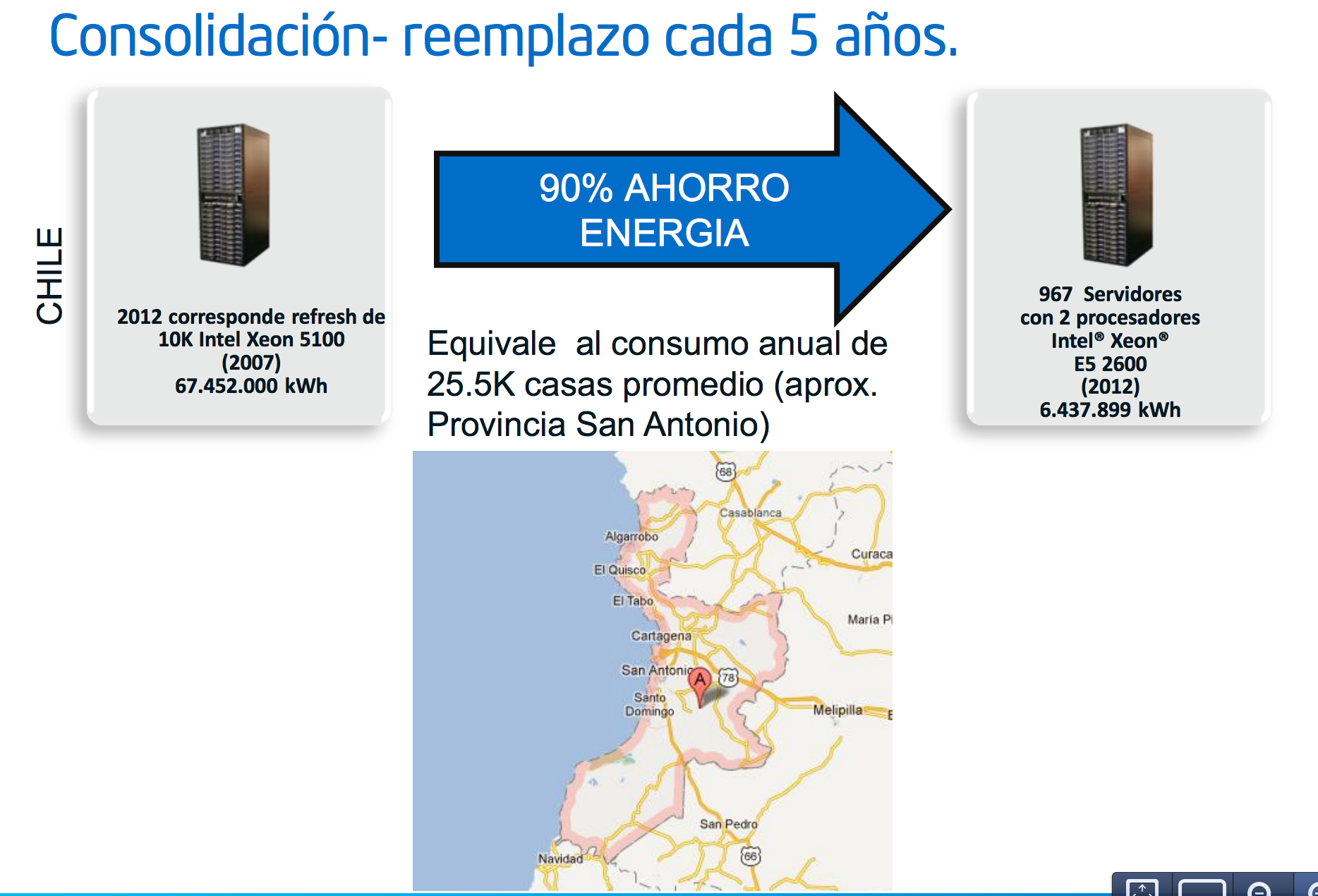
What this first slide tells us is that in 2012 it was time to replace 10,000 Xeon 5100 servers located in Chile. These servers consume every year the equivalent of what all the homes in the Province of San Antonio consume.
All of those 10,000 servers can be replaced by 967 Xeon E5 2600 servers, and consumption drops drastically, to 10% of current demand!
For Argentina, we have the following:
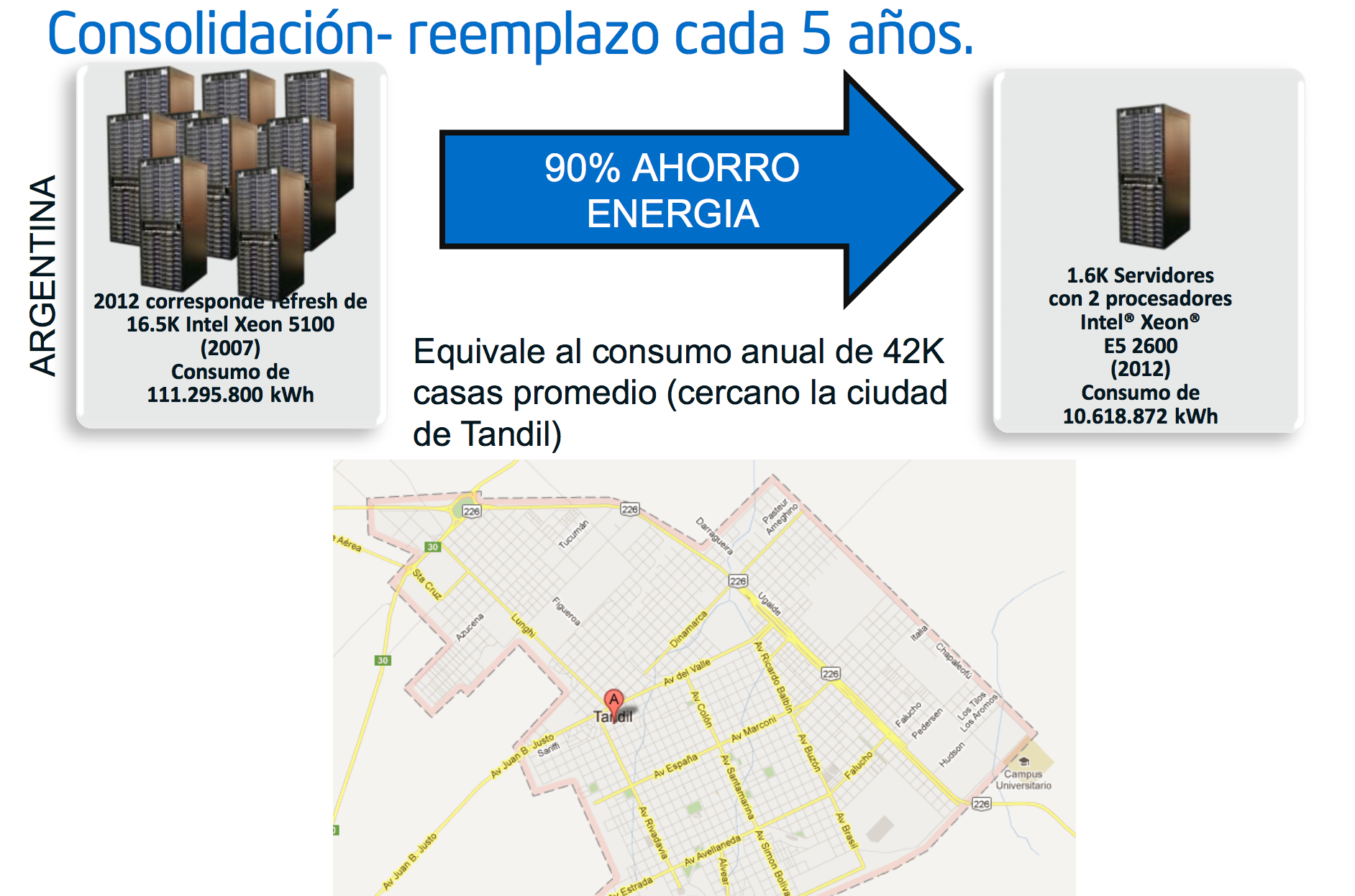
The servers that would have to be replaced consume the equivalent of the homes in the city of Tandil. Again, with the change in technology we can save 90% of the energy.
In May of this year Alejandro Barros requested, under the transparency law, the report on the impact of the daylight saving time change. In this post by Alejandro you can see an analysis of that document.
According to that memo, the measure meant estimated savings of 39 GWh (a calculation apparently done on the back of an envelope, because there do not seem to be any concrete measurements or evidence for these results.
But let’s accept those figures as real for a moment. According to our authorities, changing winter time saves 39 GWh. Well, if you look at Intel’s proposal to replace servers more than 5 years old, you get 68 GWh of savings a year, real and permanent, without the externalities of changing the clocks. And that study only considers part of our installed base of servers and computers.
There are two problems I have laid out in this post. One is that there is no serious policy for generating and distributing energy, and that is holding back the development of high-quality standards in a specific service industry: providing computing infrastructure and data processing services (datacenters). Until we fix this, our datacenters will not be able to certify at the highest standard (Tier-4).
The other problem is that the authorities apparently have not had the right expertise to analyze effective solutions for improving energy efficiency. I have shown you the case of improvements the IT industry can make, which with moderate effort can be more effective than the current measures. But all of this requires the authorities to listen to the specialists, and not insist on solutions that worked 5 or 6 decades ago, when technology and the way it was used were very different.
Comments
comments powered by Disqus