$ cat posts/mars-needs-women.md
Mars needs women
why there should be more women in technology
“Men are from Mars, women are from Venus,” “vive la différence!” At the end of the day, every debate about gender equity and women’s participation in working life ends up drifting into the classic stereotypes that sell millions of books and make second-rate psychologists rich.

My alma mater recently set up a priority admission program for gender equity. The idea is to add extra places reserved for women. We will have to see what effect a measure like this has. I don’t want to argue about it; I assume its timing was thought through and that steps will be taken to evaluate its success.
The fact is that women’s participation in engineering is low, in our country and worldwide too. The table below, taken from this post written by Mauro Grossi, shows the reality of female participation in our country:
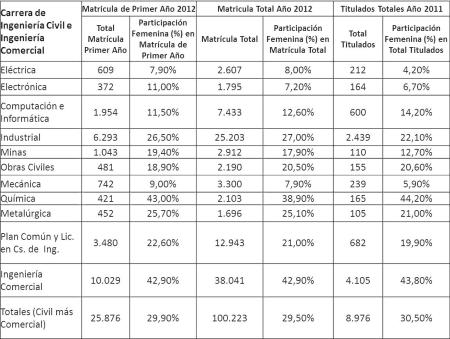
People have tried to explain this phenomenon in various ways, but there is still no explanation that convinces everyone (nor will there be).
However, what we observe in traditional engineering is inexplicable to me in computing, and even more so in the case of “software development.” My longtime readers know I take a critical view of the idea of “computer engineering.” I acknowledge that systems engineering exists, or communications engineering, but in the field of software development, what we have called “software engineering” is, in my view, quite far from what we understand as engineering.
There are studies showing that women feel a greater affinity for activities or professions that foster social interaction, which is why you see them in medicine, psychology, sociology, and all the so-called “social sciences.” The hard sciences and the technical fields, being more individualistic by nature and more centered on structured knowledge, are not to women’s taste. If that is the case, the fact that fewer women are developing software is a great mystery, because software development is a “social science”.
Let’s clear up once and for all the myth that women do not have the ability to study the hard sciences. It is a stereotype that must be banished. In fact this chart should settle any doubts (taken from the book Science Left Behind):
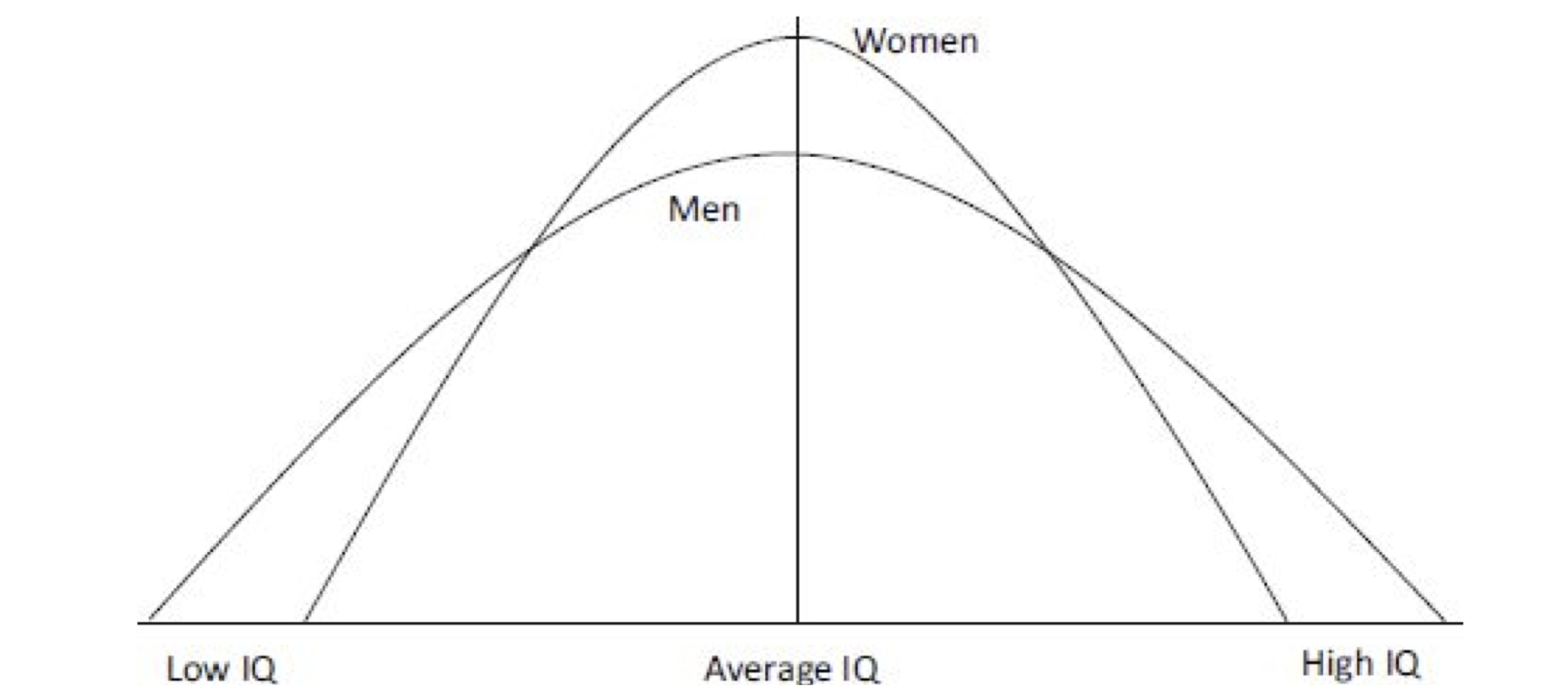
What this chart says is that on average men and women have a similar IQ, with a certain edge for women, but that among men you are more likely to find super geniuses like Einstein, or idiots willing to set fire to their own farts and post their exploits on YouTube. Incredibly stupid or tremendously intelligent people are more likely to be men than women. But in general, men and women have the same intellectual abilities.
So there are no natural reasons that explain why fewer women go into engineering.
The effect of women’s participation on innovation
But what happens when we bring women into work teams? What effect can they have on the teams’ performance? Or does it make no difference?
In 2007 the London Business School published a study titled “Innovative Potential: Men and Women in Teams” (you can download it here).
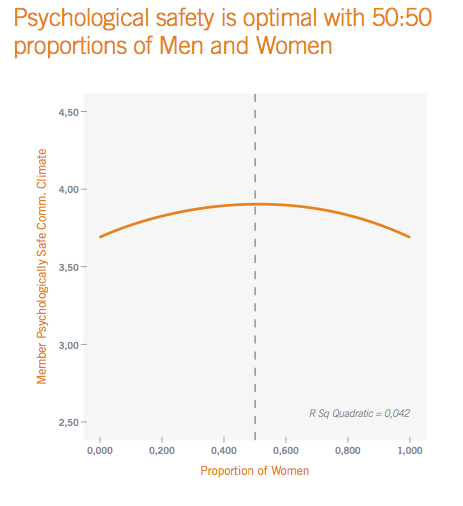
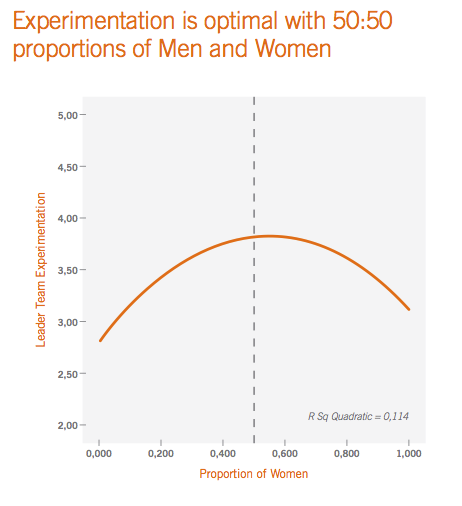
This study made important findings about the impact on teams’ capacity for innovation depending on the proportion of men and women. The main conclusion that emerges is that at the team level, innovation is strongly influenced when you have a team with a 50:50 proportion of men and women.
“On a team level it was interesting to note that the key levers and drivers for innovative processes are positively influenced by having a 50:50 proportions of men and women in teams. This clearly shows that equal gender representation can help to unlock the innovative potential of teams.”
The study covered a range of industries: technology, manufacturing, education, consulting, financial services, telecommunications, etc. More than 100 teams were selected for the research, spread across 17 countries.
The study reaffirmed certain things we already know, such as that women have more domestic responsibilities, that problems at home affect women more than men, that the decision to have a family or not is influenced by the level reached in the organization, and that each country’s cultural differences put these results in context. The interesting part is the impact of the proportion of men and women on the different dimensions that drive innovation.
For their work, the researchers used the following model of what drives innovation:
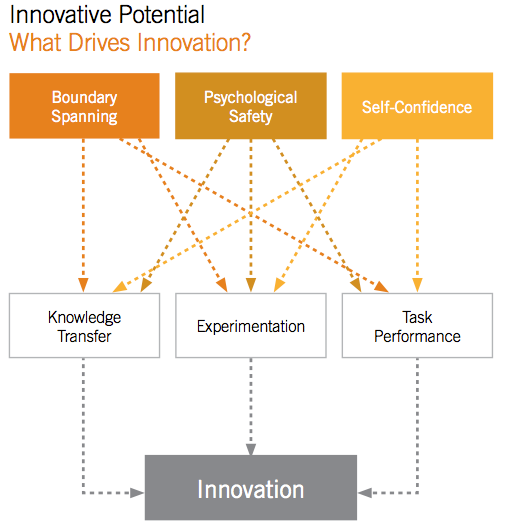
One of the first findings is that when men or women are in the minority they have lower satisfaction with their personal lives, a more negative mood, and show less commitment to the organization.
When women are in the minority they tend to network with people outside the team, but with a greater positive effect on knowledge transfer.
In the case of men, when they are in the minority, they do less boundary spanning, that is, they explore their surroundings less, which reduces knowledge transfer. They show less personal satisfaction with their lives, have a more negative mood, and are less committed to the organization.
As for psychological safety, the result is in the following chart:
On the other hand, the team’s self-confidence increases, peaking when there are 60% women:
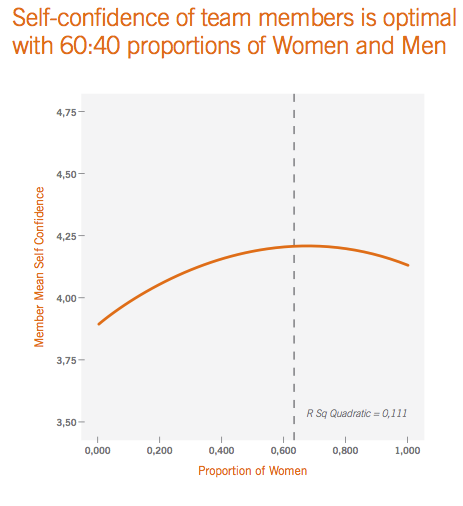
When it comes to experimentation, once again the optimum is found when the proportion is 50:50 between men and women:
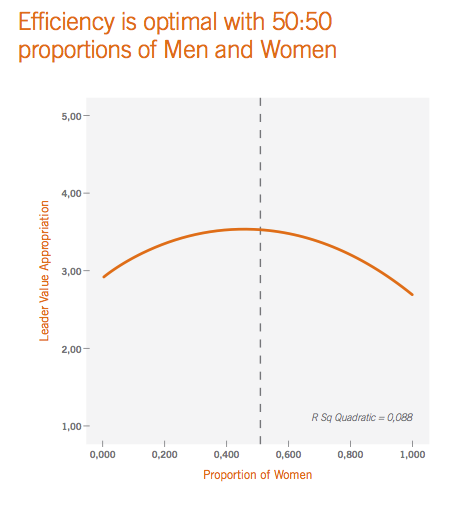
And finally, team efficiency is also optimal when we have gender parity:
Among the recommendations of this study are the following:
- Do more to promote the sharing of domestic work. Company policies should be friendlier to the families of their employees. Both men and women should be allowed leave to care for their children.
- Those most affected by overwork, or work pressure, are men, since it spills over into their homes. Try to avoid long working hours and working under deadline pressure. Promote male roles.
- Remember that men resent being in the minority more. It is better to promote an equal proportion of men and women. Avoid labels and stereotypes. Promote triads (something I am going to write about in another post).
- To optimize the team’s innovation potential, build a team with the following criteria in mind: a) gender diversity, b) the ability to span its boundaries (interacting with other teams), c) psychological safety.
- Look for talent that brings diverse views. This takes courage and conviction.
My personal experience
For 5 years now I have been building and leading a technology team at my company. It currently has 13 people (including me), of whom 7 are women and 6 are men. I have to say I had never led a team as innovative, committed and efficient as this one, and mind you, I have worked with very good teams. I am not saying they are the best team in the world, we have a lot left to improve, but this is a team on its way to being high-performing, no question, and I am very proud of it. If you want to know a bit more about my team, and what motivates us, let me take this chance to invite you to my talk at StartechConf 2013, where I will be speaking about these topics.
So I hope the message is clear: it is not only for reasons of “fairness” to women that we need more of them participating. It is because it is the way to foster more innovation in our teams, and that is what will set apart the companies and teams that succeed in the future. And you, do you promote greater integration of women in your teams? Why? I look forward to your comments.
Comments
comments powered by Disqus