$ cat posts/tools-of-the-trade.md
Tools
My father, like any good electronics man, had a lot of interesting tools, some of them dangerous, as my brother and I discovered very painfully. Other tools were intriguing, strange, and complicated. Pliers, screwdrivers, voltmeters or testers, oscilloscopes or plain soldering irons, boards for mounting circuits, a pair of magnifying glasses with a visor and a loupe that were good for inspecting circuits, or for dressing up as an alien. But the best one, my favorite, was that “paralyzing dart launcher used in the clone wars of the 25th century in the hills of Chuquicamata”: the piston desoldering pump. Here is a photo of the closest thing I could find to that wonderful futuristic device, futuristic at least for an 11-year-old boy in 1977 (now you’ll understand why I liked Super 8 so much )

a 25th-century paralyzing dart launcher
Like every good technician, my father took care of his tools, and I certainly don’t think he was amused when my brother and I “kidnapped” them for our space adventures. There were tools he got from his job, and others he bought himself. Someone who works with tools takes acquiring them very seriously, and whenever he could he invested in quality tools.
There are cheap tools and very expensive ones. We have all bought tools, and we know we can buy a screwdriver that won’t last beyond some quick repair. But if you’re serious about this business of using tools, then you’ll invest a bit more time and money. After all, a good tool will not only last, it will also save you time in your work.
The other important thing is the space where you do your work, where you use those tools. My father had his own space, a place for himself, his sacred place, where he was reunited with his tools, just as we humans have done since the days when we were hunter-gatherers.
As Joseph Campbell told Bill Moyers in The Power of Myth:
“This is … an absolute necessity for anybody today. You must have a room, or a certain hour a day or so, where you do not know what was in the newspapers that morning, you don’t know who your friends are, you don’t know what you owe to anybody, you don’t know what anybody owes to you, but a place where you can simply experience and bring forth what you are and what you might be.”
“This is the place of creative incubation. And first you may find that nothing’s happening there, but if you have a sacred place and use it and take advantage of it, something will happen.”

Joseph Campbell
For me that sacred place is at home, where I’m writing this right now, with my mug and a little mint tea to keep me company, and nobody interrupting me. It’s me, my thoughts, a keyboard and 1920x1080 pixels.
This “locus of creation” is as essential as our tools. It is the place where our spears, stone axes, plows, oscilloscopes, keyboards and 25th-century paralyzing dart launchers are kept, like sacred objects that go with us on our adventures.
From the spear points of the Clovis culture to our modern particle accelerators, we have sought to perfect our tools. We are Homo sapiens and Homo faber at the same time, or at least those of us who alter the world to adapt it to our needs and desires are.
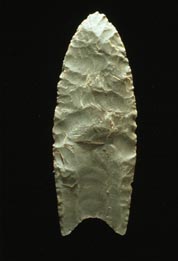
Clovis point
I imagine the fascination felt by those first hominids who carved those ancient stones in the rivers of Zambia, the oldest samples of our technological past. We know that the great apes are able to use tools, and recently we have discovered that some of them make them (although it seems that’s because they learned from us). Still, it seems we are the only beings who have turned this ability to build our tools into an evolutionary advantage that has allowed us to dominate (for better or worse) this planet.
We have the power to create and to destroy stored in our tools. That’s how important they are to us. I don’t think there is a human being who doesn’t use a tool of some kind. We can say this really is one of the essential aspects of what makes us human. Even language could be considered a tool, probably the most important one we have created.
Mastery
Mastery of an art or craft is only reached when you design and manage to build your own tools. Until you have reached that stage you are only an apprentice in your profession.
We programmers have the advantage that we can build powerful tools using something like the sacred space I described earlier. With keyboards and pixels we can create universes of infinite complexity, as Weizenbaum tells us, tools that let us perform miracles, or automate routine tasks, that let us create things that didn’t exist.
Recently a friend won an important prize using the tools he has created. I’m talking about Álvaro Graves, who won the Health Metadata Challenge, a contest that seeks to develop new technological capabilities using the open data repositories of the United States Department of Health.

Alvaro Graves
This is remarkable, and it shows the power of our profession, which I consider, without any embarrassment, one of the most important that human beings have created, and probably one of those that will profoundly change our society (as it is already doing).
So there’s your challenge. It’s not enough to acquire your tools, own them, and master them. You will only begin to reach mastery of your craft when you are able to build your own tools, and even create the tools that others are going to use.
Comments
comments powered by Disqus