$ cat posts/disclosure-you-cant-just-go-and-do-it.md
Disclosure: you can't just go and do it
The following post is by a notable “guest villain”: the security expert, and beer guru ;-), Cristián Rojas.
This piece was born from a conversation with Cristián on El Test Acido, which, given the format of the show, we couldn’t take any deeper. That’s why I asked Cristián to develop the subject in an article that I now share with you.
Disclosure: you can’t just go and do it
By Cristián Rojas
I recently witnessed (was a victim of?) the disclosure of a vulnerability in a set of UNIX servers distributed with NIS on which I have a user account. The vulnerability is that with one command any user could obtain the list of all the users of the NIS server set along with their respective password verifiers. Even though the passwords are turned into verifiers using crypt, as happens on every UNIX-based system, a very easy password (or one based on a dictionary word) could be cracked using tools like John The Ripper.
The problem, however, is not the vulnerability but who disclosed it. The reporter is another user of the system, who mentioned that it was not the first time he had reported the vulnerability through the forum. I privately contacted the system administrators and told them about the problem, which they fixed the next day, and I also asked them whether they had received any private communication from the reporter, to which they answered no.
Most likely, by disclosing the vulnerability on the forum, the reporter felt he was doing the system’s user community a favor. The problem is that in doing so he needlessly exposed the affected users to having their accounts compromised, or worse, to having other services they use compromised as well. Malice on the reporter’s part? Far from it. Ignorance, perhaps.
Models of (non) disclosure
Today there are 3 disclosure models a user can follow on finding a security vulnerability in a computer system, a network or a piece of software.
The first model is Non-Disclosure, in which whoever finds a vulnerability simply keeps quiet. This model is interesting because, if the person who finds the vulnerability is unscrupulous, he could exploit it all by himself and profit from it. Nobody else finds out, not the vendor (by this word I mean the webmaster, sysadmin, or developer in the case of software), and not other users. The problem is that the vulnerability will go on existing, and the information will go on being exposed or illicitly modified, that is, until someone else stumbles on the vulnerability and reveals it, at which point one of the other two models may come into play.
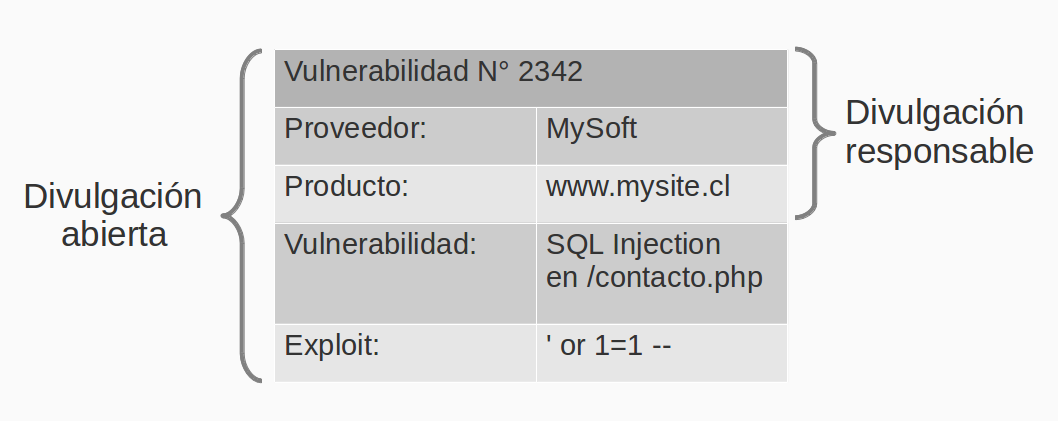
The second model is Full Disclosure, also known to some as Irresponsible Disclosure, in which the user, on finding a vulnerability, makes it public on his blog, forums, etc., and publishes all the details: which application/system it is in, what the vulnerability is and how to exploit it. By doing this he allows, for example, security researchers to start writing new antivirus signatures, system administrators to go on alert and take pseudo-mitigating measures (workarounds), and end users to get very scared. Not only that, it also puts pressure on vendors to patch their systems or software.
There are 2 problems with this kind of disclosure. The first is that with an unpatched vulnerability that everyone knows about, you get what are known as Zero Day attacks, which are attacks against systems that have not been patched against that vulnerability and are therefore completely exposed, and will remain so until a patch comes out. And from there comes the second problem: the vendor will have to rush out a patch and worry about two things: that the patch mitigates the vulnerability and that it doesn’t cause a regression. On top of that, the vendor won’t be able to sleep 100% soundly, because releasing the patch is one thing and people actually installing it is quite another.
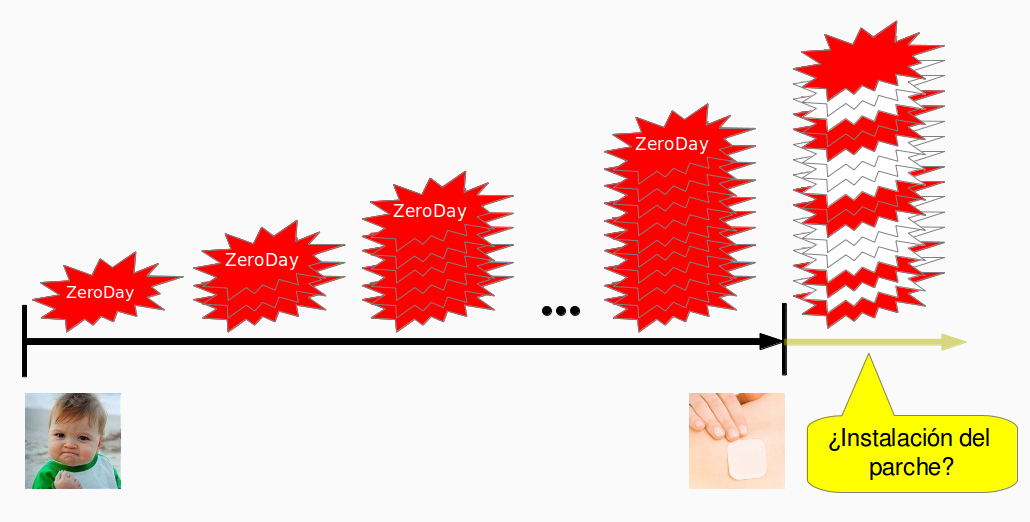
A clear example of this is the following: if you are a Windows user, have you ever wondered what this Windows Malicious Software Removal Tool that arrives through Windows Update is, and why it arrives every month? It is not an antivirus. It is a tool that automatically patches Windows systems against worms like Nimda or SQL Slammer, which were released almost 10 years ago and yet still wreak havoc because many Windows systems around the world are unattended, and these worms keep replicating themselves across the network from and to those vulnerable systems.
Does that mean we are all exposed to vulnerabilities, Zero Days and people who disclose them openly?
Not necessarily. There is a little-known (or little-used) model known as Responsible Disclosure, in which the reporter privately contacts the vendor and reveals the details of the vulnerability only to him, while publicly stating that the application has a vulnerability.
The devil is in the details
In both cases the reporter publishes the vulnerability. Where is the difference? In the details he makes public on discovering the vulnerability. With full disclosure all the details are disclosed immediately, while with responsible disclosure the reporter limits himself to saying “this system has a vulnerability”, without going into further detail. In fact, the “responsible” part is a responsibility both toward the vendor and toward the users of the application, since the reporter agrees on a reasonable deadline with the vendor for fixing the vulnerability, after which the reporter will make all its details public.
The recommendation is to use responsible disclosure. There are even organizations that offer money as an incentive to report vulnerabilities using this model. Not everyone has that financial possibility, however. But now we are clear about what the disclosure models are, and we know how to disclose well (and badly) the security vulnerabilities of the systems we use.
About the author:
Cristián Rojas is a computer engineer (Ingeniero Civil en Computación) from the Universidad de Chile. He currently works as a systems monitoring specialist for Firenxis, and as a freelance consultant in secure software development and corporate information security policies.
He also teaches, as instructor of the Software Security module in the Postgraduate Diploma in Computer Security at the Faculty of Physical and Mathematical Sciences of the Universidad de Chile, and as an undergraduate instructor in the course CC5315: Software Security at the same faculty.
Comments
comments powered by Disqus