$ cat posts/are-some-journalists-antisocial.md
Are some journalists antisocial?
Table of contents
Yesterday our esteemed Francotirador surprised us with this piece on the Radio Bio Bio site: Study explains why engineers, programmers and scientists are antisocial.
I asked my Twitter timeline what they thought of the article, and that set off a very interesting and intense debate.

Part of yesterday’s discussion on Twitter
Many people didn’t like it, obviously, because after all many of us completely disagree with the stereotype that engineers, programmers and scientists are asocial people, and we are even less going to agree with being called antisocial1.
Look at the first comment in the image above, to see how much this kind of article hurts among the professionals who get stereotyped this way. I could say a lot about that, but I’m going to concentrate on this “dialogue” between Carlos Orrego and Christian, because it contains a statement about journalistic responsibility that is very important for the rest of this article:

Dialogue between Carlos and Christian
Notice how the journalist defends himself, but the critic is right, very much so, as we are about to see. Because the piece really is very bad(*), and very biased on top of that, starting with the picture of Sheldon Cooper included in the article.
We will go to the source, to settle whether we should shoot the messenger or not. But first let’s remember how science works.
The scientific method
First, scientific studies never prove or demonstrate anything. The scientific method works like this: a hypothesis is put forward, then scientists run experiments and make observations to test whether that hypothesis is invalid. The fact that a result agrees with what the hypothesis proposed does not mean the hypothesis is correct; it is only a temporarily valid theory. Science is nothing more than a “continuous approximation to the truth”, as some philosopher once put it.
The great Richard Feynman explains it very well in this video:
Science journalism
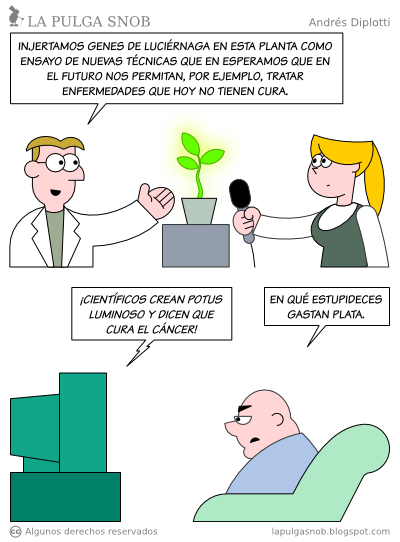
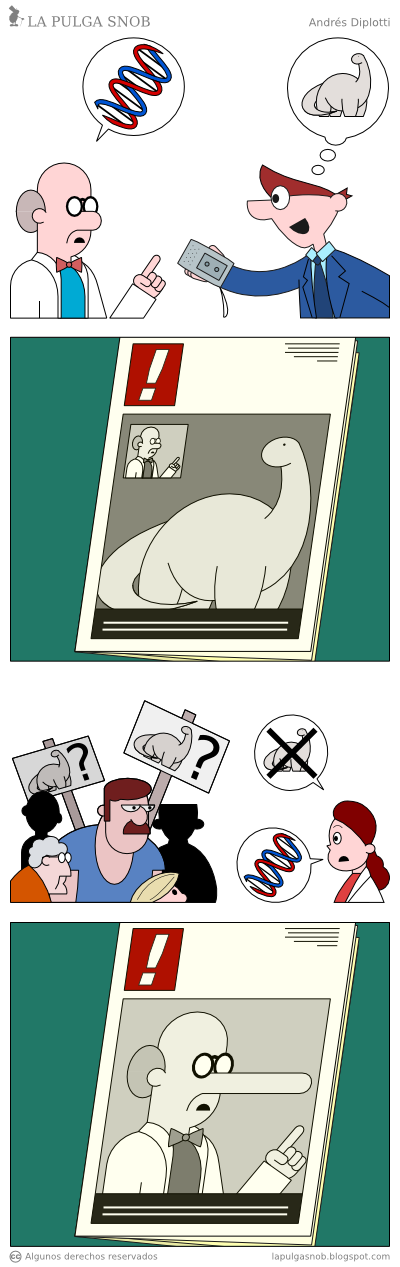
This aspect of science is unfortunately ignored by many journalists. I don’t know whether our universities have courses in science journalism, but anyone who is going to devote themselves to science journalism should at least understand how science really works, or they run the risk of making the mistakes shown in these panels from La Pulga Snob2:
Are we programmers asocial?
All of yesterday’s discussion in my Twitter timeline came from this piece on Bio Bio, which makes several mistakes as I see it. First, the headline is wrong: it calls an entire segment antisocial when it means that they are less empathetic, or asocial.
Second, it distorts the study’s result, presenting it as a definitive explanation of a supposed behavior of a certain group of people. We already saw that a hypothesis is not a definitive explanation, even if the observations and results are temporarily and circumstantially valid (other scientists still have to replicate the observed results).
And third, the original Science Daily article, which is the basis for the Bio Bio piece, never claims there is anything special about the personality of engineers, scientists, programmers or any other profession, except perhaps CEOs.
But let’s look at some other distortions by the messenger:
Traduttore, Traditore!
In his piece Christian writes, quoting one of the study’s authors (his Spanish, rendered literally):
“This shows that scientific personalities really do leave something out: human sensitivity. A great challenge for cognitive science will now be how we can better translate the cold and distant mechanical descriptions that neuroscience produces and the intuitive and emotional understanding that allows us to relate to one another as people.”
The original text in English says:
“This shows scientific accounts really do leave something out -- the human touch. A major challenge for the science of the mind is how we can better translate between the cold and distant mechanical descriptions that neuroscience produces, and the emotionally engaged intuitive understanding which allows us to relate to one another as people.”
I think the first sentence should be translated like this:
“Esto demuestra que las explicaciones científicas realmente dejan algo fuera, el toque humano”
At what point “scientific accounts” turned into “scientific personalities” is something we ought to figure out. Maybe it’s a challenge for the neuroscientists (actually there is a theory that explains this behavior, it’s called cognitive bias, like the ones I wrote about a while ago).
Another example of bad translation, and of a lack of investigative rigor:
“The disconnect between our experimental understanding and our scientific understanding is known as the ’explanatory gap’. In 2006, the philosopher Philip Robbins and I conceived a pretty crazy theory: that the explanatory gap is determined by our neural structure. Now I am surprised to realize how consistent these results are with that theory”
The text in English:
“The disconnect between experiential understanding and scientific understanding is known as the explanatory gap,” Jack said. “In 2006, the philosopher Philip Robbins and I got together and we came up with a pretty crazy, bold hypothesis: that the explanatory gap is driven by our neural structure. I was genuinely surprised to see how powerfully these findings fit that theory.”
A more adequate translation of the first sentence is:
“La desconexión entre el entendimiento experiencial y el entendimiento científico es conocido como la brecha explicativa.” (experiential, not experimental), and further on the word driven should be translated as dirigida, rather than determinada (determined).
It is important to note that at this point we are talking about a fairly complex philosophical concept. The “Explanatory Gap” is an idea introduced by the philosopher Joseph Levine, which addresses the difficulty physical theories of the mind have in explaining how physical properties give rise to the way things feel when we “experience” them3. This thesis is central to what is known as the dualism debate, the idea that mind and body are separate entities.
Put simply, some hold that the experience of subjective consciousness is something located outside the body; the mind, or the soul, cannot be described by means of neural “circuitry”, and is explained by something outside this world (dualism), or by a physical phenomenon not yet explained (such as the quantum mind, or indirect realism).
This matters, because the hypothesis of the work was to test the thesis that there is an explanation in our neural circuitry for this phenomenon we call the “human touch”, the “soul”.
The study
Let’s see what the scientists say about their work directly in the paper they published4:
“Two lines of evidence indicate that there exists a reciprocal inhibitory relationship between opposed brain networks. First, most attention-demanding cognitive tasks activate a stereotypical set of brain areas, known as the task-positive network and simultaneously deactivate a different set of brain regions, commonly referred to as the task negative or default mode network. Second, functional connectivity analyses show that these same opposed networks are anti-correlated in the resting state. We hypothesize that these reciprocally inhibitory effects reflect two incompatible cognitive modes, each of which is directed towards understanding the external world.”
What these gentlemen mean is that when we are doing a task that requires all our concentration we go into a “do not disturb” mode. At that moment, when we are thinking, or working on a task that demands all our cognitive capacity, we will have zero empathy.
That is something we have all observed, and it doesn’t only happen when we are programming; it happens when we are writing a brainy article just as much as when we are playing “League of Legends”.
If we are in intense cognitive task mode, our social brain will be inhibited. “I’m thinking, don’t bother me, OK!”.
What they did in the experiment was take a group of young students. They were shown texts or videos in which they were asked to make observations about other people’s feelings, or to solve physics problems. That is, tasks that required recognizing feelings and tasks that required mechanical reasoning. All of this while their brains were being observed with magnetic resonance imaging.
They observed that different neural networks were activated depending on the type of task, and that while one network was active, the other was inhibited. During the resting phases, however, the minds of the young people studied oscillated between activating one network and the other.
Now, all of this is interesting, because it could have applications for understanding autism, or Williams syndrome, or in the treatment of certain disorders such as schizophrenia, or anxiety and depression, but that requires other experiments.
Now, where does it come from that engineers, programmers or scientists are more antisocial?
From nowhere! There is nothing in the Science Daily piece that implies that kind of conclusion.
In fact, the only reference that amounts to an extrapolation in that direction talks about the personalities of senior executives, such as a CEO:
But, even healthy adults can rely too much on one network, Jack said. A look at newspaper business pages offers some examples.
“You want the CEO of a company to be highly analytical in order to run a company efficiently, otherwise it will go out of business,” he said. “But, you can lose your moral compass if you get stuck in an analytic way of thinking.”
I could say that what this study really shows is that all senior company executives are immoral. But that wouldn’t be true!
The hypothesis this analysis tested is that there are two neural circuits, one more “social” and another more “analytical”, that inhibit each other. They also found that at rest our mind jumps between the two circuits.
The other hypotheses, yet to be demonstrated, say that if we get stuck in one mode or the other we run certain risks. And that can happen to anyone; it can lead us to depression, anxiety, asocial behavior, etc.
We can all be antisocial, because apparently this is the “neural circuitry” of the brains of all healthy people. And future studies will probably show that something happens in the balance of our internal neural networks.
So if a disorder occurs in this circuitry that makes us antisocial, it is something that could affect any healthy person, even a journalist.
(*) The judgment is of the press article; I am not passing judgment on the person.
To clarify, in Spanish the word antisocial denotes a person opposed to the social order; in fact the press itself uses this word when it refers to criminals, it is the favorite word for crime-page headlines. The word asocial, on the other hand, refers to those people who do not integrate or connect with society. ↩︎
The panels were taken from these strips: Sección de Ciencia and Ciencia Popular. La Pulga Snob is the creation of Andrés Diplotti. It is one of my favorite webcomics. ↩︎
Experienciar does not exist in Spanish, but I use it as an alternative to experimentar. The difference between experimental and experiencial does exist, but not the one between experimentar and experienciar (to experiment and to experience), which our language expresses with the same word, and that is rather limiting when it comes to expressing the ideas of neuroscience and the philosophy of mind. ↩︎
The study is available in the online version of NeuroImage; it costs 31 dollars if you are interested, but I’m not going to invest them, so I will use as my source its abstract (quoted below) and this piece from Science Daily that Radio Bio Bio cites. The abstract of the paper is the following: “Two lines of evidence indicate that there exists a reciprocal
inhibitory relationship between opposed brain networks. First, most attention-demanding cognitive tasks activate a stereotypical set of brain areas, known as the task-positive network and simultaneously deactivate a different set of brain regions, commonly referred to as the task negative or default mode network. Second, functional connectivity analyses show that these same opposed networks are anti-correlated in the resting state. We hypothesize that these reciprocally inhibitory effects reflect two incompatible cognitive modes, each of which is directed towards understanding the external world. Thus, engaging one mode activates one set of regions and suppresses activity in the other. We test this hypothesis by identifying two types of problem-solving task which, on the basis of prior work, have been consistently associated with the task positive and task negative regions: tasks requiring social cognition, i.e., reasoning about the mental states of other persons, and tasks requiring physical cognition, i.e., reasoning about the causal/mechanical properties of inanimate objects. Social and mechanical reasoning tasks were presented to neurologically normal participants during fMRI. Each task type was presented using both text and video clips. Regardless of presentation modality, we observed clear evidence of reciprocal suppression: social tasks deactivated regions associated with mechanical reasoning and mechanical tasks deactivated regions associated with social reasoning. These findings are not explained by self-referential processes, task engagement, mental simulation, mental time travel or external vs. internal attention, all factors previously hypothesized to explain default mode network activity. Analyses of resting state data revealed a close match between the regions our tasks identified as reciprocally inhibitory and regions of maximal anti-correlation in the resting state. These results indicate the reciprocal inhibition is not attributable to constraints inherent in the tasks, but is neural in origin. Hence, there is a physiological constraint on our ability to simultaneously engage two distinct cognitive modes. Further work is needed to more precisely characterize these opposing cognitive domains.” ↩︎
Comments
comments powered by Disqus