$ cat posts/from-open-government-to-service-government.md
From open government to service government
Marcos Malamud is one of those friends I found by writing this blog. Through his comments I got to know him and his work on management systems, and we also had the chance to share a memorable episode of El Test Acido. For me it is a great satisfaction that he accepted this invitation as a guest villain and that he is giving us this excellent post. Enjoy:
From open government to service government
By Marcos Malamud (@mismatica – www.mismatica.com)
I am going to open this post by repeating the hackneyed and famous goals of oGov (short for Open Government): transparency, citizen participation and collaboration. Why do I open the post like this, you may ask?
Because it is a “fashionable” term that rides on the advance of information technology (IT, to stay on the good side of the blog’s owner ;) hehe). Ever since we have had stable democracies in our countries these concepts have ALWAYS been the pillars for building citizenship, whether from a technical, personal or collective point of view. Although it does not depend exclusively on IT, the new technologies have allowed the three concepts to reach citizens in a more natural way, affordable and literally “at hand” (with tablets and smartphones). But let’s not fool ourselves: the possibility of demanding and exercising these principles always existed. The big difference is that today the level of citizen engagement and the ease that the “at hand” concept provides boost that demand exponentially. People ask for transparency and participation because it is “comfortable” to do so from the couch at home, or walking down the street, and to a certain extent they collaborate with others to demand similar things. Don’t get me wrong: that apparent “comfort” (I think it’s great that it exists) actually works as strong, massive social pressure that makes things change. That is precisely the greatest fear our government representatives feel today.
A line that captures all this well, which I adapted for a workshop I gave at the Encuentro Nacional de Ciudades Digitales in 2011, was: *“Open government, an old idea whose time has come” by @lnds *– originally it was “Cloud, an old idea whose time has come”.
From the point of view of “citizen-government-citizen demand” (call it local, regional or central), government teams are being pushed to deliver better services. We should stop focusing on principles already acquired (won?) in today’s democracies, and dare to go through the process that takes us “from open government to service government”.
I used the lines above to make very clear my concept of sGov, which I coined as service government (a good “kick in the chest” for “oGov initiatives” ;) hehe). Now I will tell you about my experience over these years of developing and selling management tools for local governments, which are my niche of expertise, combining management and IT in equal parts, on the road to trying (in some cases successfully) to turn municipalities into a service government.
I fervently believe, and I back my statements with concrete data obtained in implementations with some municipal clients (further on I present some interesting results on this), that sGov tools or applications must be “end to end”. In other words, a citizen (I call them neighbor-customers, even if that gives some people hives) should not have to browse around looking for a government service, much less know where to send their complaints or questions. It must be the government itself that redirects and assigns the requests in a way that is transparent to the neighbor (this is where IT comes into play) and that lets them file questions or requests in a simple and direct way, “with no middlemen and no delays”. Of course, this must be “multi-channel”: physical and in person, virtual, mobile or web. This will allow governments to actively listen to the governed, to respond in real time (or as efficiently as possible, as I like to say), and consequently to receive what, in my experience, is the best part of service government: direct, unfiltered *FEEDBACK*. This working model undoubtedly makes it possible to deliver better, quality services, with control from both sides of the problem, committing both actors to the solution and then to watching over and taking care of everything achieved.
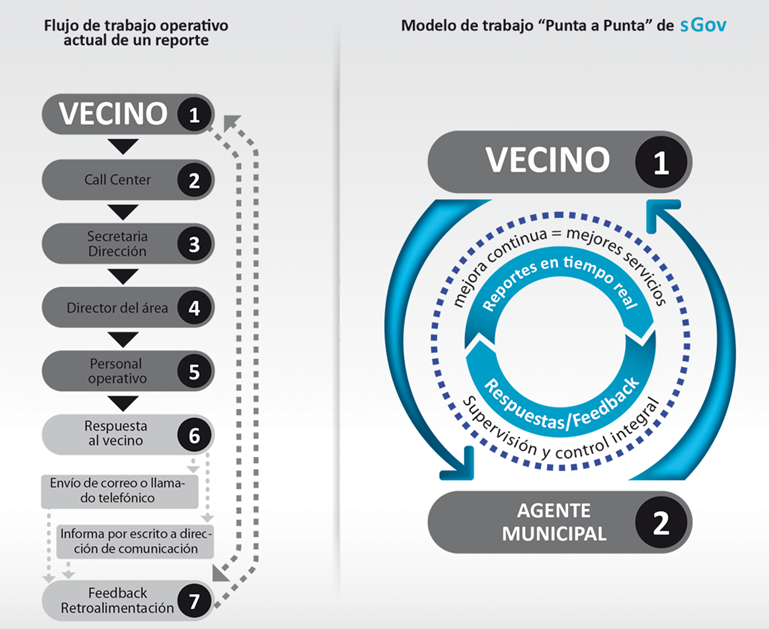
Here I’ll share my experience on this, since many (not to say all) of the mid- and high-ranking officials I visit show me a deep fear of what some call “consumer empowerment”, and I would love to show you the look of panic on their faces when I tell them that with sGov you can give the neighbor a tool to report, ask about or flag problems live from the street as they walk – paradoxically, the lower ranks or field agents think exactly the opposite and understand that the neighbor is not the enemy (since these same agents make up most of the State’s workforce and are in turn neighbors themselves of the places where they work). This “fear” comes fundamentally from cultural, bureaucratic, corrupt or negligent causes (or all of them together ;) hehe), but I must also acknowledge mistakes by software developers who sell systems that do not take into account the operational side of a citizen report or complaint, and who produce mere systems for capturing and piling up report numbers in giant bedsheet-sized lists, which only add more dread to that initial “fear”.
At this point there has to be a turning point among the government agents who make the decisions. They must take the bull by the horns and face the problems seriously and in a planned way, come clean with the neighbors and give them clear and exact information about the times and ways in which the problems asked about or reported will be solved (note that I did not say “honesty suicide”; they are already doing that today, repeatedly promising things they don’t deliver), or else they can bury their heads in the sand like the ostrich, with the consequences that entails.
As I mentioned before, my claims are based on real data, using as an example an analysis I did of indicators for a municipal public service: street lighting (a municipal obligation in every municipality, ayuntamiento or prefeitura in Latam) where, based on 35,000 responses or pieces of feedback, out of 400,000 complaints or reports accumulated in two of my systems from 2004 until yesterday, the results were these:
80% = “Thanks” or “Thank you very much” as a single word or a full sentence.
15% = “Safety, Darkness or More lighting”.
5% = Other words in general.
What point do I want to make with these 3 indicators? – that sGov systems or applications simply deliver BETTER services from the neighbor’s perspective, meaning quality and satisfaction, or in the language of the government official, “votes” ;). As I always tell my clients, the first goal must be “Fix everything that gets reported”, that is, a concept of EFFECTIVENESS, and then, once that step is achieved, to move toward something like “The best service is the one you don’t notice”, that is, a concept of EFFICIENCY.
To wrap up, I believe sGov applications must be conceived as a “business intelligence” tool rather than as mere systems for piling up flat or linear data, but resting their pillars on expert systems for internal operational management, so that, based on concrete data from the daily management of each of the government services and the needs of the neighbor-customers, better, more efficient and higher-quality political and strategic decisions can be made.
It will only be possible to do this well if we take into account something very important that I consider the “Achilles’ heel” of e-government, which is that in most cases the developments or implementations do not take into account the HUMAN FACTOR that has to USE the applications and systems. I am a fervent believer that municipal agents must be taken very much into account when developing, and it is important to listen to them and get them involved, integrating them into the final product. This is a NECESSARY condition for the success of the implementations. Nowadays we focus on usability for one of the “ends” - the neighbors (which is all very well), but we have to concentrate on the other “end” – the municipal agents. In my experience these actors can sink a project completely or launch it to success with the same speed. And then, as I like to put it, let the software “evolve” and grow.
Finally I want to thank Eduardo infinitely for the honorable invitation to write on his blog, and also Marco and Ubaldo who, through that crazy and brilliant digital get-together they chose to call @eltestacido, bring in and give a voice to leading figures in IT, entrepreNERDs and restless minds like mine in their talks, and let us share experiences, knowledge and all of it with plenty of humor and wine. Cheers, friends, and THANK YOU!!
Comments
comments powered by Disqus