$ cat posts/the-turing-enigma.md
The Turing enigma
Table of contents
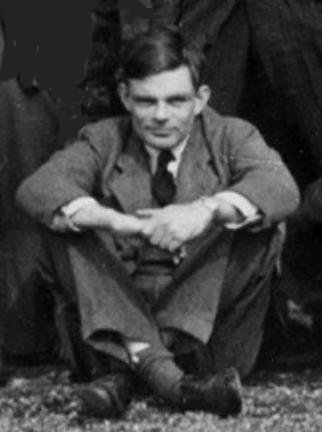
The father of computing was gay. The hacker who broke the Nazis’ secret codes was tried and convicted on the basis of prejudice and intolerance. The mathematical genius died when he was just 41 years old, and whether he was driven to suicide or it was an accident is an open question once again.
His death has traditionally been considered a suicide, although his mother long maintained that it was an accident. The field is wide open for conspiracy theories: after all, Turing held many military secrets; after all, his death was convenient.
The search of a lifetime
In 1928 Alan Turing was a lonely 16-year-old studying at Sherborne School, an institution where the focus was on the humanities and a classical education, and the sciences were looked down on. Alan had other interests that clashed with the atmosphere of the school. Around that time he had read a popular account of Einstein’s work on the theory of relativity. One of the things that caught his attention in Einstein’s work was how this great scientist had doubted the axioms of Newtonian physics. He noticed that Einstein avoided philosophical discussions about what time and space were and concentrated on something that could be done.
Young Turing develops a passion for science. He wanted to complete Einstein’s ideas, and in fact he formulated corollaries to the general theory of relativity that Einstein had not yet published. However, these interests did not find the necessary support in his teachers. But there was a boy, barely a year older than he was, thin and sickly, who took scientific ideas with the same intensity as Alan. Everything suggests this boy was more brilliant than Alan himself. He was Christopher Morcom. Meeting him allowed Alan Turing, for the first time, to communicate deeply with a human being other than his mother. Morcom was his first love, a feeling he kept secret and never revealed to him. We know a lot about this friendship thanks to the testimony of Turing himself, who in 1930 wrote a series of letters to Morcom’s mother after Christopher’s unexpected death from bovine tuberculosis, contracted by drinking infected milk several years earlier.
Morcom’s death inspired Turing to do better in his studies. In one of the letters he asks Christopher’s mother for a photograph of the boy, which he kept on his desk as inspiration and as a spur to study and make it to Cambridge.
The loss also affected him deeply, to the point that he became obsessed with discovering the nature of consciousness, its structure and origin. His letters to Mrs. Morcom reveal that he longed to know what had become of Christopher, of that essential aspect of him: the mind.
Studies
Turing decided to study philosophy, metaphysics, biology and above all mathematics, logic and quantum physics. He wanted to understand how that thing we call mind is embodied. And since he liked to play with and explore mechanical devices, it is natural that he developed his central idea that the mind is a machine. The question was how a machine could evolve from simple, predictable mental operations to a level of complexity capable of producing great innovations.
Getting into King’s College, Cambridge, gave him an environment where he could freely explore his thinking. At 22 he had already written an important contribution to the field of probability, which earned him a fellowship at the university. But he also found in the university environment greater acceptance of his eccentricities and tolerance of his sexual identity, even though homosexuality was illegal in England at the time.
It was in 1935, during his graduate years at Cambridge, that he attends a series of lectures by Max Newman on the “Foundations of Mathematics”, which included the debate between Gödel and Hilbert. In those lectures he learns of the third problem posed by Hilbert, that of decidability. It is in this period that his idea of visualizing an algorithm as a machine surprises the mathematical world and lays the groundwork for the creation of the first computers.
He travels to Princeton to continue his studies and earn his PhD. And although he keeps working in mathematics, he simultaneously explores the development and application of computing devices. The war gives him the opportunity to design his first concrete machines, working on breaking the Enigma codes at Bletchley Park.
Around that time Turing introduces Tommy Flowers to the team of cryptographers; Flowers, guided by Max Newman, develops the world’s first digital computer, Colossus.
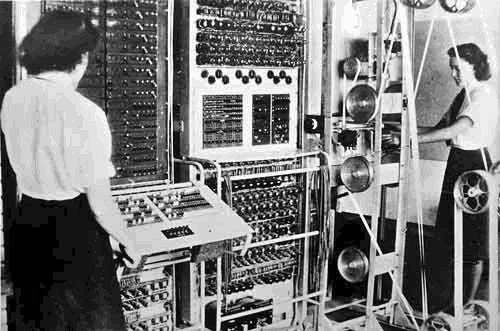
Colossus, the first programmable digital computer
After the war he is asked to design a computer for the National Physical Laboratory in London, a project known as ACE (Automatic Computing Engine). The ACE was an extraordinary machine with a more advanced and sophisticated design than the EDVAC computer developed by John von Neumann in the United States. Turing thought speed and memory size were crucial. He proposed a memory with a capacity equivalent to 25 kilobytes and a speed of 1 MHz. Unlike the EDVAC, the ACE had support for subroutines and an abbreviated instruction system. He proposed that the work be led by Tommy Flowers, whose work on Colossus was secret.
Unfortunately bureaucracy, and ignorance of Colossus, cast doubt on the success of Turing’s design. Several modifications were made and a simpler version was built. Turing became disillusioned and returned to Cambridge, where he focused his research on neurology and the notion of the electronic brain.
Electronic brains
In 1948 his friend Max Newman invited him to work on the development of the Mark I, a computer built at the University of Manchester. During this time Turing takes part in software development, programming for the project.
In 1946 Lord Mountbatten had introduced the term electronic brain while speculating about the development of the primitive computers of the time. In 1949 the pioneer of neurosurgery, Sir Geoffrey Jefferson, set out to discredit the Manchester project, writing in a speech:
“Not until a machine can write a sonnet or compose a concerto because of thoughts and emotions felt, and not by the chance fall of symbols, could we agree that machine equals brain—that is, not only write it but know that it had written it. No mechanism could feel (and not merely artificially signal, an easy contrivance) pleasure at its successes, grief when its valves fuse, be warmed by flattery, be made miserable by its mistakes, be charmed by sex, be angry or depressed when it cannot get what it wants.”
Newman responded with an article in the Times detailing the parallels between the Mark I and the human brain. Newman’s article includes an interview with Turing, who stated
This is only a foretaste of what is to come, and only the shadow of what is going to be. We have to have some experience with the machine before we really know its capabilities. It may take years before we settle down to the new possibilities, but I do not see why it should not enter any one of the fields normally covered by the human intellect, and eventually compete on equal terms.
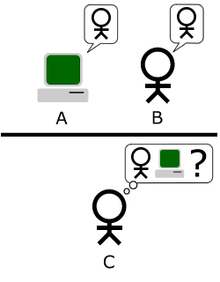
The Turing Test
In 1950 Turing publishes his influential paper “Computing Machinery and Intelligence”, where he proposes his famous test. To deal with the objections of people like Sir Geoffrey Jefferson, and others, he decides to take a more pragmatic path. Since the words “machine” and “thinking” mean different things to different people, instead of asking “can machines think?”, Turing suggests replacing the question with something less ambiguous and closely related.
Instead of determining whether a machine is thinking, Turing suggests we ask whether a machine can win a game, called “The Imitation Game”. The game involves three participants in three isolated rooms: a computer (the one being tested), a human, and a human judge. The judge converses with both the computer and the other human through a terminal. Both the computer and the human try to convince the judge that they are human. If the judge cannot consistently tell which is which, the computer wins the game.
Although the test is now considered inadequate, his proposal inspired a great deal of work in the field of artificial intelligence. Even today a reverse version of the test is used against us in the form of the annoying CAPTCHAs used for entering information in web forms.

CAPTCHA, I don’t think Turing had this pernicious use of his ideas in mind...
Morphogenesis
Although his interest in computers never waned, in his last years he turned his mind to new areas of exploration in the field of biology. The intrigue began with the way Fibonacci numbers seem to show up in nature, especially in the shape and structure of plants, where it is most evident. Inspired by the biologist and mathematician D’Arcy Thompson, he explored the notion that biological form was the product of a chemical process. In 1952 he published a paper titled “The Chemical Basis of Morphogenesis”.
Turing was an experienced chemist. He had been passionate about chemical experiments from a very young age, and kept a small laboratory in his bedroom. His work on morphogenesis turned out to be provocative and original. Only 40 years later was scientific evidence found for his proposals, in what are known as Turing structures and Turing patterns.
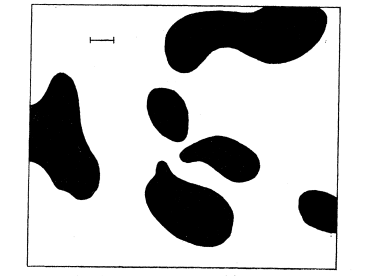
A Turing pattern generated by a “MorphoGen”, calculated by hand by Turing in his 1952 paper on morphogenesis
This work, by the way, is just another manifestation of his search for a mathematical and mechanical interpretation of life and its structures. All of it is a search for the tools that would make it possible to develop artificial life and intelligence.
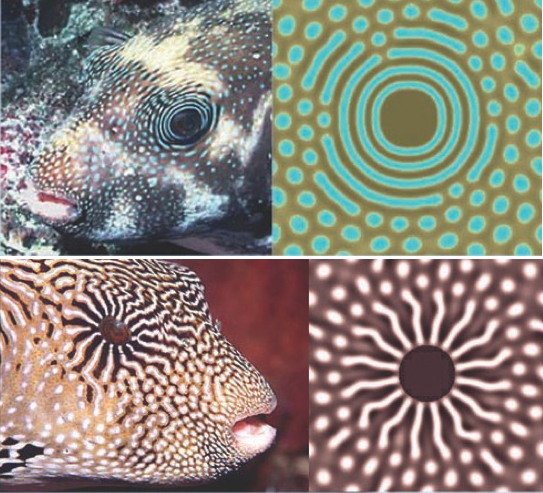
Turing patterns identified in fish skin
Was Turing trying to build a soulmate with whom to share his deepest feelings? Did he feel so alone and misunderstood in this world that he wanted to create a synthetic soul to share his life with? Did he want to resurrect his beloved Christopher Morcom by embodying him in one of his computers?
The mystery of his death
In 1952, during the investigation of a burglary at his house, he revealed that one of the young men involved in the incident might have been his young 19-year-old lover. Since homosexual acts were illegal in England at the time, Turing was immediately arrested and put on trial. He was found guilty under the law against “gross indecency”. To stay out of prison he agreed to undergo psychiatric therapy and a hormone treatment. One of the side effects, which Turing himself told his friends about, is that he became impotent and grew breasts (gynecomastia).
Having been declared a criminal, Turing lost all his security clearances and was not allowed to work on cryptographic projects or on the development of computers for the government. Turing was stigmatized. British intelligence considered that as a homosexual he was more exposed to blackmail, and so he was deemed a high-risk person. Turing was in possession of a great deal of confidential information.
It has been suggested that his death was a murder staged by the British security services. His mother considered it an accident.
Officially Turing died by suicide in a strange way, biting into an apple poisoned with cyanide. According to Andrew Hodges, the film Snow White was his favorite, and several acquaintances reported hearing him chant the witch’s macabre couplet: “Dip the apple in the brew, let the sleeping death seep through.”
The mystery of his death is still there. According to the testimony of his friend Robin Gandy, who spent the weekend before his death with Turing, there were no signs revealing suicidal intentions. On the contrary, he seemed in good spirits, and despite the discomfort and the year of hormone treatment, he appeared to be fine. He even seemed happier than usual.
Turing handled cyanide, and he was a careless experimenter. On one occasion he electrocuted himself, and he tasted compounds with his tongue to identify them. At the time he was doing electrolysis in cyanide solutions and gold-plating spoons, a process that requires potassium cyanide. The electrolysis experiments were wired to the light fittings in his room. It is likely, as his mother suggested, that he accidentally put the apple in contact with the cyanide. Or perhaps, and this is more likely, he accidentally inhaled cyanide fumes from the bubbling liquid. The distribution of the poison in Turing’s organs, according to the autopsy, is more consistent with death by inhalation than by ingestion, according to Professor Jack Copeland, who presented a new theory about Turing’s death at Oxford in the last few days.
We will probably never know the cause of Turing’s death, just as we will never know what his legacy would have been had he lived to our day. His contributions would likely have been astonishing, considering he died so young.
Whether Turing died because of intolerance is an open question, but we do know that intolerance affected him deeply. As a colleague of his at Bletchley Park said, fortunately the authorities of the time did not know that Turing was homosexual, or the war would have lasted several more years.
Nor can we know his personal motivations, but everything suggests that his drive to develop an intelligent machine may have a deeper psychological origin than we suspect.
Turing’s work cannot be separated from his reality as a person, and his work cannot be understood without understanding his life. That makes him a complex, valuable and admirable person.
With this we end this humble tribute to the father of computing. I have barely scratched the surface of a complex life, full of details and achievements. I invite you to keep digging and learning about the contribution of this great thinker.
Read also:
Bibliography:
Alan Turing´s Patterns in Nature and Beyond, article in Wired Science
Controversia sobre Mentes y Máquinas (the Spanish edition of Minds and Machines), various authors; this book includes Turing’s paper where he describes the imitation game.
Comments
comments powered by Disqus