$ cat posts/universal-machine.md
Universal machine
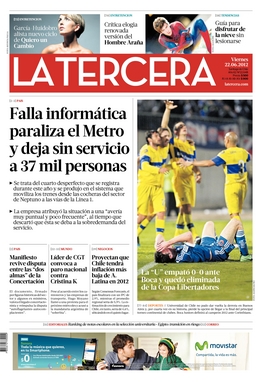
Yesterday’s paper ran the headline “Computer failure paralyzes the Metro and leaves 37 thousand people without service.” The riders’ anger is understandable, I was affected myself. I am not going to talk about this failure, since I don’t know the details. It could be anything from a programming error to a cut communication line, but whatever it was, the incident reflects the high degree of dependence our society has on computers.
The reason is a fundamental principle of computing, described by Andrew Hodges as follows:
“Any mechanical process, no matter how ridiculous, evil, petty, wasteful or pointless, can be put on a computer.”
And this principle has been established since 1936, thanks to Alan Turing. Yesterday’s failure in the Santiago Metro is not Turing’s fault, but if some programmer made a mistake in the system, it is a consequence of this powerful principle.
The Turing machine is a universal machine.
Look at your smartphone. The computer replaces or controls any machine we have created so far. Your phones are no longer just phones, they are clocks, calculators, video cameras, still cameras, barcode readers, game machines, maps, compasses, radios, musical instruments, music players, long-distance communication systems, televisions, and so on. All it takes is the right software and our phone can turn into anything. It is almost like magic.
“Any sufficiently advanced technology is indistinguishable from magic,” said Arthur Clarke. Turing is the first sorcerer who gave us the keys to master this magic. His universal machine is the spell that made all this possible.
In 1935 Alan Turing was facing one of Hilbert’s outstanding challenges, known as the Entscheidungproblem, and that is what led to the creation of computers. This is part of that story.
Ignoramus et ignorabimus
These were hard times for the Republic. The forces of the dark side were winning more and more followers. Many Jedi were perishing at the hands of the Sith... um, sorry, that’s another story.
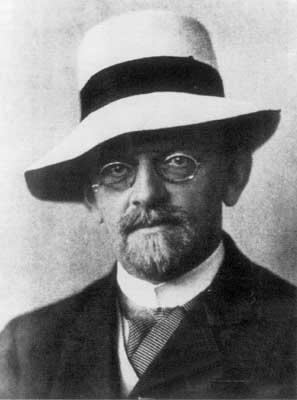
David Hilbert
But yes, the truth is that the first decade of the twentieth century really was a hard time for mathematics. The discipline was in a deep crisis over formalism.
The formalist school is a group of mathematicians who held that “mathematics is a game —devoid of meaning— that one plays with meaningless symbols according to formal rules established beforehand”. David Hilbert was a German mathematician who had founded this school of thought. He was annoyed at the time by the paradoxes that kept turning up in the works and attempts to axiomatize mathematics in those days, such as Russell and Whitehead’s monumental work “Principia Mathematica”.
Hilbert was a strong-willed man who refused to consider that the mind had any kind of limitation.
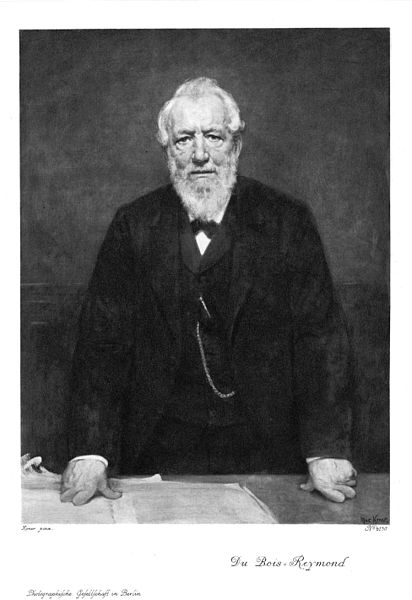
Emil du Bois-Reymond
In 1880 the German physiologist and psychologist Emil du Bois-Reymond argued, in a famous lecture at the Berlin Academy of Sciences, that there are problems that neither science nor philosophy would ever be able to solve. He summed this up in the Latin phrase “Ignoramus et Ignorabimus” (“we do not know and we will not know”).
To Hilbert that view was wrong, and in 1930 he replied:
“We must not believe those, who today, with philosophical bearing and deliberative tone, prophesy the fall of culture and accept the _ignorabimus. _For us there is no ignorabimus, and in my opinion none whatever in natural science. In opposition to the foolish ignorabimus our slogan shall be Wir müssen wissen — wir werden wissen! (“We must know - we will know!”).
What Hilbert did not know is that while he was speaking these words a quiet Austrian mathematician was tearing his whole program apart with a brilliant theorem.
In 1920 Hilbert had proposed a research program to resolve the paradoxes of mathematics and establish a formal system that would give the discipline solid foundations.
Hilbert asked that mathematics have, among others, these attributes:
Formalism, that is, all mathematical statements should be written in a precise formal language and manipulated according to well-defined rules.
Completeness, a proof had to be given that all mathematical statements can be proved within the formalism.
Consistency, Hilbert asked for a proof that no contradiction can be obtained within the formalism of mathematics.
Decidability, there should be an algorithm for deciding the truth or falsity of any mathematical statement.
Kurt Gödel’s work ruled out the first three attributes Hilbert asked for: it is not possible to fully formalize mathematics, so it cannot have the property of completeness, and on top of that it cannot be consistent. I mentioned this earlier.
The problem of Decidability remained open. Gödel got close to this problem, but solving it required a good definition of what was meant by an algorithm.
The Entscheidungsproblem
The decidability problem is the famous Entscheidungproblem. What Hilbert asks for is a mechanism that makes it possible to determine whether a given statement is valid within a formal system, or whether there is a way to decide if a mathematical statement can be proved from a set of axioms by following the rules of logic.
The answer given first by Alonzo Church and then, independently and very shortly afterward, by Alan Turing was that it was not possible. And poor Hilbert was left without a program :pensive:
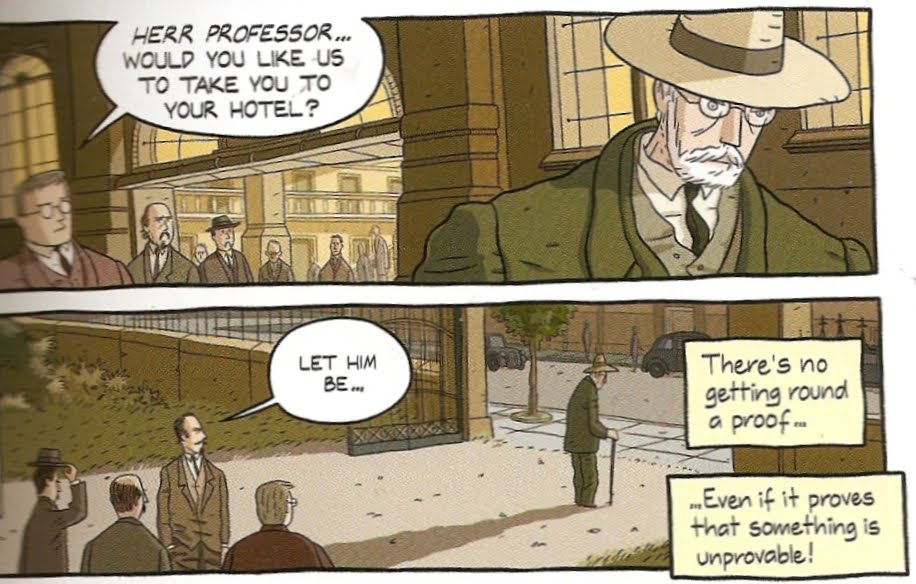
Turing later went to study with Alonzo Church and they showed that both proofs were equivalent. What was new about Turing’s method is that to develop his proof he built an ideal machine that simulates the states we go through when reasoning mathematically.
This machine is really the description of a computer program. Turing found a way to build the hardware and the software into the same idea. The hardware that serves as the substrate for the instructions contained in the software.
Turing taught us the true Nature of Software, and that is why his achievement is so important, and why we celebrate his centenary today.
Read also:
Bibliography
If you want to know more about this subject I recommend these books and comics
Turing The Enigma, Andrew Hodges
The Annotated Turing, by Charles Petzold
Logicomix, by Apostolos Doxiadis, Christos Papadimitriou, Alecos Papadatos and Annie Di Donna.
The Information, by James Gleick
Comments
comments powered by Disqus