$ cat posts/the-father-of-computing.md
The father of computing
One day ladies will take their computers for walks in the park and tell each other, “My little computer said such a funny thing this morning.” -- Alan Turing
I can’t help thinking of Alan Turing’s words when I look at this photograph:

Turing Ladies in The Park
‘One day ladies will take their computers for walks in the park and tell each other, “My little computer said such a funny thing this morning.”’
As Tom Siegfried says, if you don’t like the way computers have taken over the world, you can blame Turing.
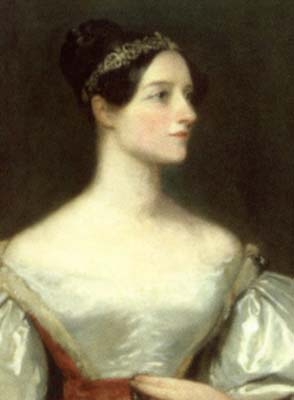
A hundred years ago there were no computers. In fact the word computer was used for a person who performed calculations by hand, usually a woman. Almost 200 years ago a remarkable computer was born who came to be known as Lady Ada, Countess of Lovelace, daughter of the great English poet Lord Byron.
Ada Lovelace
Lady Ada was a pupil of Augustus De Morgan, the famous British logician. On one occasion, at the De Morgans’ house, the inventor Charles Babbage was demonstrating his Difference Engine, and De Morgan’s wife recorded in her memoirs the impression the invention made on the young woman:
“While the rest of the party gazed at this beautiful invention with the same sort of expression and feeling that some savages are said to have shown on first seeing a looking glass or hearing a gun, Miss Byron, young as she was, understood its working and saw the great beauty of the invention.”
Lady Ada and Charles Babbage worked together, and the inventor admitted that she understood and explained the advantages of his machine far better than he did. The big difference between Babbage’s invention and earlier attempts is that it was a digital machine (it performed calculations by counting), and it combined logic to define its operations. Ada understood this very well and developed a series of concepts for programming this difference engine (as a bit of trivia, she invented the concept of the loop). Sadly this great woman died of cancer at 36 and Babbage’s project was abandoned.
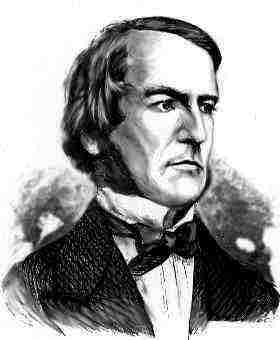
Another pupil of De Morgan’s was George Boole. Babbage did get to meet him, and although he was the same age as Ada, it seems they never met. Perhaps if they had, the computer would have been invented almost 150 years ago.
Boole
At 17, George Boole had a revelation while walking through a park: he thought that all human reasoning could be expressed in the form of an algebra. With Boole’s algebra every logical problem could be reduced to equations, a piece of knowledge that went ignored for generations. In the words of Howard Rheingold, “The problem, at the time, was that nobody cared. Partly because he was from the wrong social class, and partly because most mathematicians of his time knew very little about logic, Boole’s eventual articulation of this insight didn’t cause much commotion when he published it.”
Boole was convinced that logic was the key to understanding human reasoning. His system is simple, and it uses the elements of the algebra we all learn in school, but restricted to only two possible values: the Universe and Nothing, represented by the numbers 1 and 0 respectively. The 1 and the 0 provide an ideal method for analyzing the logic of two-state devices such as electrical relays or vacuum tubes.
The birth of computers
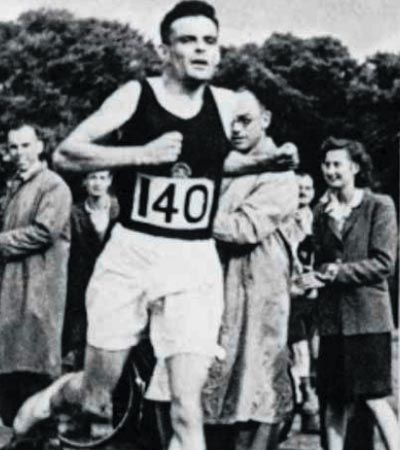
A hundred years after Babbage’s attempts the computer was born in the form of an esoteric paper on mathematical logic. In 1936 Alan Turing was finishing an article he did not expect to be understood by more than a dozen people in the whole world.
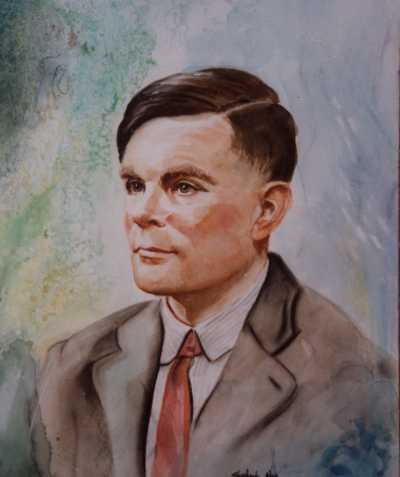
Alan Turing
Despite coming from an upper-middle-class family, the way he dressed, his careless grooming and his harsh, hesitant voice provoked a degree of rejection from his classmates. He had few friends in academia, and preferred to ignore them, burying himself in chess problems, running chemistry experiments or running. Turing was a runner.
Like Boole, Turing believed there had to be a mathematical model that could simulate the way people reason.
Turing’s achievement, which we will analyze in more detail later on, is that he devised a machine that contains all the rules of a formal system, and showed that it makes it possible to determine whether a mathematical statement is or is not decidable within that formal system.
Turing asked himself what a human does when processing symbols during a calculation. He assumed that mental calculations consist of transforming the input numbers into a series of intermediate states that progress sequentially according to a fixed set of rules until the answer is found.
Sometimes we use pencil and paper to keep a record of the intermediate states of our calculations. The rules of mathematics require more rigid definitions than the mental states studied by philosophers or metaphysicians, so Turing concentrated on defining these states as clearly and unambiguously as possible, so that the description could be used to command the operation of a machine.
Turing argued that this machine, given the right configuration, would in principle be able to tackle any mathematical problem, and the goal of his thesis was to demonstrate the real capability of this device.
The Turing machine
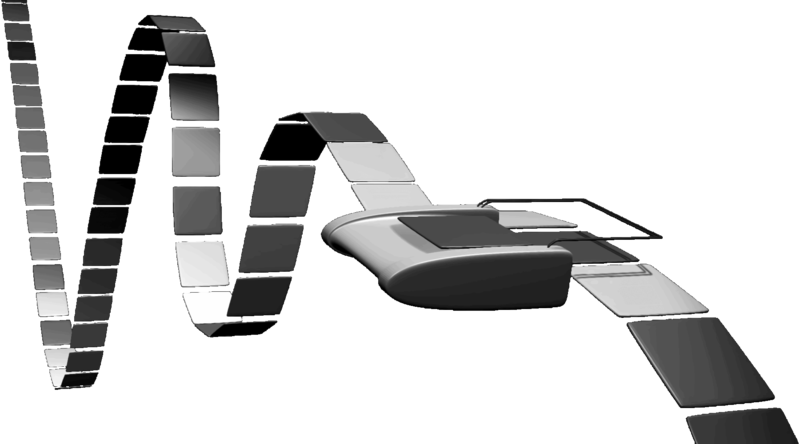
The Turing machine is relatively simple. Its design consists of three parts: an infinite tape of squared paper, where symbols can be written in each square; then a head that can write symbols on the paper or read them, making it possible to decode them; and finally a rule book that tells the machine what to do depending on the symbol under the head.
These rules tell the head how to respond to a given symbol and then which rule to use next.
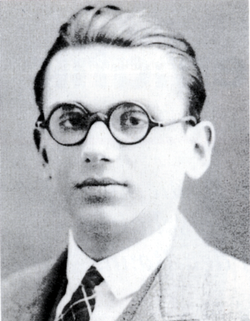
Kurt Gödel
For example, suppose the head detects a 1 on the tape. One rule might be to move the head one square to the left and write a 1, or to stay on that square, erase the 1 and leave the square blank. By designing the right set of rules you can get this mechanism to compute any number that can be computed and write it out as 0s and 1s.
The remarkable thing is that Kurt Gödel had earlier managed to establish a mechanism for representing any mathematical expression as a single number (a process known as Gödelization). Since the Turing machine can compute numbers, it seemed this machine would be able to analyze any mathematical expression and determine whether it is computable or not.
Turing’s contribution to mathematics was to show that there are mathematical expressions that are not computable by this machine, and with that he established the limits of computation (and of formal mathematical reasoning).
This settled one of the open problems of mathematics at the time: “is there some formal procedure for determining whether a given mathematical statement is provable?” Turing’s answer to this problem is a resounding NO.
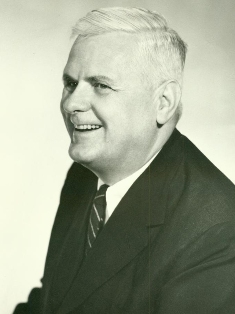
Alonzo Church
Turing was not the only one to prove this; the American mathematician Alonzo Church had established the same result. What was new about Turing is that his proof is simpler, and the invention of the mechanism, a machine that is the theoretical basis for building a computer. Later Turing goes to Princeton to study with Alonzo Church and proves that both results are equivalent.
Turing himself argues from the start that it is possible to build this kind of machine, and he also generalizes the concept. The Turing machine requires a set of rules that must be configured according to the kind of problem to be solved. The generalization is that the set of rules can be read at the start from the paper tape itself. This is known as the Universal Turing Machine.
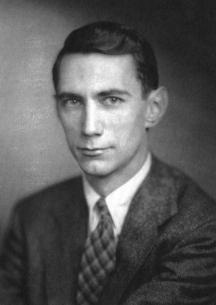
Claude Shannon
During his time at Princeton Turing discusses these ideas with John von Neumann, and the result is that these principles were built into the design of the first modern computer architecture. That set of rules preloaded into the Turing machine is what we now know as a program, and the von Neumann machine establishes it as a fundamental requirement for operating.
Around that time Claude Shannon took Boole’s work and applied it to the design of logic circuits, creating the concept of logic gates and showing how it was possible to build electrical circuits capable of modeling logical statements. It was now possible to put flesh on Turing’s ideas. Shannon also knew von Neumann.
We know the three of them exchanged views on the subject, something I told in A lunch at Lafayette Square. The Turing machine took shape in real computers thanks to the work of Shannon and von Neumann and of many British and American engineers in the 1940s.
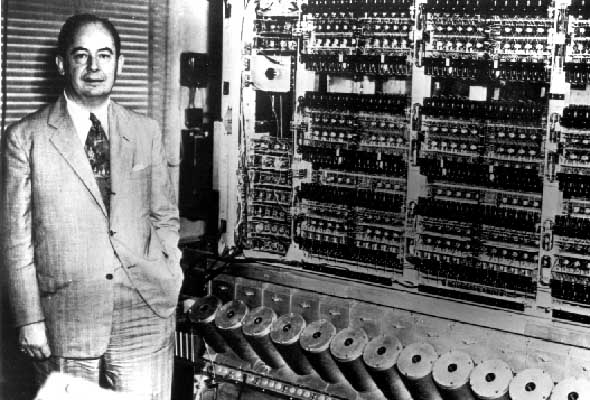
John Von Neumann
Every modern computer, and a large part of our society today, depends on the workings of this machine, probably the machine that has had the greatest impact on humanity. We depend on them more and more, and we will probably depend on them much more in the future to carry out our activities, from communicating to controlling our energy sources. If anyone is to blame for all this, that someone is Alan Turing, and that is why it is a shame that so little is known about him.
This man is on the level of Galileo, Newton, Einstein or Darwin. He is one of the great minds of our history, and his story has a drama matched by almost no other great scientist (perhaps the closest is the case of Galileo). That is why I am devoting my time to writing to you about him, about his life, his disgrace and his redemption. Because you would probably not be here if it weren’t for him. I don’t just mean that the internet as we know it would not exist; our historical context would probably be a different one, with Nazi Germany winning the Second World War, for example. We will see what Turing’s contribution as a war hero was.
Today is Father’s Day, and what better way to celebrate it than by saluting the true father of computing, the man who made it possible for the ideas of Babbage and Ada Lovelace to actually materialize. Happy Father’s Day, Alan Turing!
Comments
comments powered by Disqus