$ cat posts/on-the-intelligence-of-the-coyote.md
On the intelligence of the Coyote
Table of contents
The laws of “Coyotics” (Part I)
1) The Road Runner cannot harm the Coyote except by going “beep,
beep.”
2) No outside force can harm the Coyote, only his own ineptitude or the
failure of Acme products. Trains and trucks were the exception from time
to time.
3) The Coyote could stop anytime, if he were not a fanatic.
(Repeat: “A fanatic is one who redoubles his effort when he has
forgotten his aim.” – George
Santayana)

Caninus Nervous Rex
ACME brand software
This is an interesting definition:
“Software is packaged intelligence.”
Others define intelligence as “the ability to come up with answers to hard problems”.
For example, at some point we had the problem of storing large amounts of data and being able to retrieve it quickly and efficiently. Over time databases were developed, and later relational databases. Some companies packaged the solution to this problem as a piece of software, known as a database management system, and charged money for that product. The more complex the solution, the higher the price; after all, many hours of research and development went into building that system. What you were buying was packaged intelligence.
This view is interesting, and very important, because it is the basis of the wealth of big corporations like Microsoft or Oracle. What these companies sell as a product is the packaged solution to a problem, and going by the definitions above, what they sell is packaged intelligence.
The problem is that this view collides with the so-called “paradox of intelligence”.
The laws of “Coyotics” (Part II)
- No dialogue ever, except “beep, beep” and yowling in pain.
- The Road Runner must stay on the road – for no other reason than that he’s a roadrunner.
- All action must be confined to the natural environment of the two characters, the southwest American desert.
- All tools, weapons, or mechanical conveniences must be obtained from the Acme Corporation.
The paradox of intelligence
In an interesting article1 the English psychologist and neuroscientist Richard Gregory poses the following paradox:
“People are said to be more intelligent when they find an answer to something than when they already knew it beforehand (which is a kind of cheating); and yet we also say that scholars who know a great deal are more intelligent than the ignorant. This paradox can be resolved by pointing out that becoming a scholar requires intelligence – since learning is hard. But the truth is that we speak of knowledge itself as if it were a kind of intelligence. When Macbeth asks “Say from whence you owe this strange intelligence?”, he is asking about the source of knowledge or information. This has the same meaning as the expression “military intelligence”, which does not imply that the military are especially bright. On the other hand, if we say that Einstein was intelligent, we are referring to what he invented or discovered, rather than to what he learned at school or later in life. It is because what he said was not yet known that we regard Einstein – and Newton, Faraday, Darwin and other great innovators – as exceptionally intelligent. This is not the “intelligence” of existing knowledge. It is the “intelligence” of the discovery or creation of new knowledge.”
“We therefore find two very different kinds of intelligence: the intelligence of stored knowledge and the intelligence of processing, applied to solving problems. I suggest it would be useful to call them “potential intelligence” and “kinetic intelligence”. Although they correspond to different concepts, these two intelligences are intertwined, since solving problems takes some knowledge and, to apply knowledge properly, a certain initiative is required.”
Gregory’s proposal is meant as an analogy with the terms Potential Energy and Kinetic Energy used in physics.
The laws of Coyotics (Part III)
- Whenever possible, make gravity the Coyote’s greatest enemy
Analogies, analogies
If you remember the old Road Runner cartoons, you’ll remember that the poor Coyote would haul an enormous boulder as high as he could in order to crush the Road Runner. In doing so the rock accumulated potential energy, so that when he let it go that potential energy would turn into kinetic energy with enough force to flatten the hateful bird (which confirms my suspicion that, in the end, the Coyote didn’t really want to eat that wretched bird; he simply hated it).

Accumulating potential energy
More formally, potential energy2 is the capacity of a system to do work by virtue of its position or configuration. It is the energy stored by the system, its capacity for work. Kinetic energy, on the other hand, is the energy an object has because of its motion. In the diagram below we see that the potential energy a rock accumulates because of its position is transformed entirely into kinetic energy as it rolls.
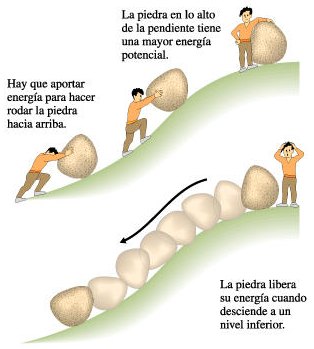
This imitator of Sisyphus shows us the concepts of potential and kinetic energy
Following Richard Gregory’s analogy, when we solve a problem we are applying kinetic intelligence; if we store the solution to the problem somehow, what we have done is turn it into potential intelligence.
Potential intelligence is not only in our minds; it is in our books and tools. Tools contain solutions to practical problems. Take scissors, for example: they are the solution to the problem of how to cut cloth.
“Scissors were developed over many generations through successive steps of problem-solving kinetic intelligence, thereby producing the potential intelligence that is built into their present design.”
This analogy between intelligences and energies seems pretty good and useful. But it is not entirely right. When the weight of the rock is released, the potential energy is lost. What happens to knowledge when it is used? Do scissors lose their potential intelligence when they cut cloth?
In general that doesn’t happen; a tool does not lose its potential intelligence, except when it wears out. In the case of software, which is a kind of tool, that wear is even smaller. Military intelligence loses its reason for being when it becomes common knowledge, since that intelligence must stay secret from the enemy if it is to be useful. Science, on the other hand, gets its power from shared knowledge. Secret potential intelligence is the only kind that wears out like potential energy. Potential intelligence does not wear out except when there is competition.
The laws of Coyotics (Part IV)
- The Coyote is always more humiliated than harmed by his failures.
- The audience’s sympathy must remain with the Coyote.
- The Coyote is not allowed to catch the Road Runner.
On the intelligence of the Coyote
The Coyote3 has at his disposal the resources of the most important corporation in the world, the famous Acme Corporation, which has extraordinary logistics capable of delivering to the remotest desert any kind of contraption the Coyote wants to buy.
And yet, despite all that capability, all the packaged intelligence at his disposal, the Coyote is inept, incompetent. And it’s not that he lacks kinetic intelligence; the problem is that it’s badly aimed. He is so obsessed with his task that he has forgotten his goal. He is a fanatic, and that is his flaw.
(Repeat: “A fanatic is one who redoubles his effort when he has forgotten his aim.” – George Santayana)
“The need for kinetic intelligence is minimized when knowledge is shared cooperatively”.
One of the problems we face in IT, especially in corporate environments, is the inability to manage potential and kinetic intelligence.
“Nobody ever got fired for buying IBM”, goes an old saying in the corporate IT world. What it means is that decision makers prefer to buy packaged solutions from big brands, because that “gives them guarantees”. If something fails we can call in our warranty, support, or whatever. So large sums get invested in licenses, support contracts, license renewals, and so on. That is operating like the Coyote: to solve the problem I buy Acme products, and I spend large sums of money protecting myself against the eventual failures of the software.
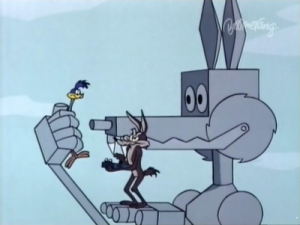
That may have been true many years ago, when knowledge really was packaged, and nobody but Acme had the formula for building complex Road-Runner-catching robots.
But today many of the basic packages are practically commodities: operating systems, databases, programming languages, office suites, and so on.
We have open source software, free software, containing thousands of hours of accumulated potential intelligence. The knowledge for solving problems is being stored in repositories like GitHub or Stack Exchange.
The world has changed; the IT executive is no longer the administrator of the infrastructure and the great custodian of development methodologies. The modern IT executive is the manager of intelligence, not of packaged intelligence; he is the one who manages the two kinds of intelligence we have discussed: potential intelligence, in the hands of the security and infrastructure teams, and kinetic intelligence, in the hands of the development areas. More resources should be spent on what adds the most value, and that is development. I’ll come back to this later in another post.
The problem, I think, is that many IT executives have lost sight of their goal; they have become fanatics: of security, of order, of methodology. They have forgotten what they are there for.
There is a cartoon in which the Coyote finally catches the Road Runner, and guess what happens...
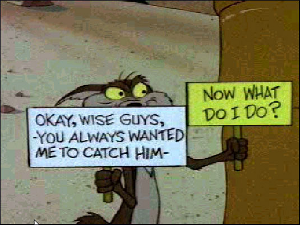
Now what? The question of the fanatic who has forgotten his goal
What Is Intelligence (Darwin College Lectures), Jean Kalfa (editor), Richard Gregory, Roger Penrose, Daniel Dennett, et al. The passages are from chapter 1, “Seeing intelligence”, taken from the Spanish translation by Paloma Gómez Crespo, Editorial Alianza, Madrid 1995. ↩︎
The potential and kinetic energy diagram was taken from here. ↩︎
The Laws of Coyotics is the name I’ve given to the 11 rules drawn up by Chuck Jones and the artists who worked on the original Road Runner cartoons. You can read more about this cartoon in this Wikipedia entry. ↩︎
Comments
comments powered by Disqus