$ cat posts/the-strange-case-of-ettore-majorana.md
The strange case of Ettore Majorana
Table of contents
In 2006, on the centenary of the birth of the great Italian physicist Ettore Majorana, the Electronic Journal of Theoretical Physics established a prize in memory of the Sicilian scientist. The Majorana Medal is an annual prize for researchers who show great creativity, critical sense and mathematical rigor in theoretical physics.
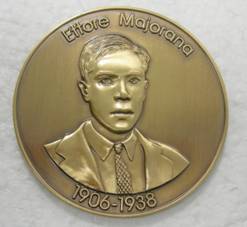
The Majorana Medal
His little-known story would make a plot for a novel. A true genius: according to Enrico Fermi his intelligence was comparable to that of Newton or Galileo.
Born in 1906 in Sicily, one year after Einstein’s first publication on the special theory of relativity, Majorana was a precocious child, very fond of mathematics. According to several physicists, Majorana is one of those young men who revolutionized physics, inspired by Einstein’s work.
The brilliant student
In 1928 he enters the Institute of Theoretical Physics at the University of Rome, under the direction of Enrico Fermi.
“The following year
\[1929\]he received his doctorate with honors, but for the next five years he worked with Fermi solving problems in nuclear physics. Although Majorana’s academic output amounts to barely nine papers published between 1928 and 1937, his work is still admired today by the scientific community. The papers reveal a meticulous knowledge of experimental data, a knack for simplifying problems, a sharp mind and an uncompromising perfectionism. His criticism of the work of others earned him the nickname “The Grand Inquisitor”. But he was just as severe with himself, which could explain his slow pace and the scarcity of his academic output. At Fermi’s urging, Majorana left Italy in 1933, on a grant from the National Research Council. In Leipzig, Germany, he met Werner Heisenberg, also a Nobel laureate. His later correspondence with Heisenberg reveals that Majorana found in him not only a scientific colleague, but also a close friend. Heisenberg urged the young Italian to publish more often, but he was reluctant. "
The depression and his disappearance
In 1933 he returns from Germany, with severe gastric problems and symptoms of exhaustion:
“His attendance at the institute became irregular and then he shut himself up at home: the promising young physicist became a hermit. For four years he cut himself off from his friends and stopped publishing. It was not until 1937 that Majorana returned to what could be called a “normal” life. That year, after a long silence, he published what would be his last scientific paper and applied for a chair in physics. In November he was appointed professor of theoretical physics at the University of Naples. Unfortunately for Majorana’s self-esteem, his classes in Naples were poorly attended. His students simply did not understand what he was trying to explain to them. On January 22, 1938 he asked his brother, with a certain desperation, to transfer all the money he had in Rome to a bank in Naples. In March he withdrew a large sum from his professor’s salary, which he had not touched since his appointment. With this sum and his passport, he boarded the ship on March 25 and disappeared forever. "
The mystery
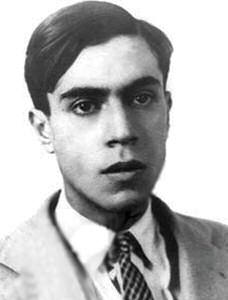
Ettore Majorana
His whereabouts are unknown; nobody knows whether he killed himself. One of the two letters he writes before disappearing is addressed to his family:
“I have only one wish: do not wear black for me. If you wish — or have — to follow social custom, wear some other sign of mourning, but for no more than three days. After that, I should remain only in your memories and, if you are able to, forget me.”
Why did he fall into this state of depression? Could he have been shaken by Nazi Germany and decided to flee so that his work would not be used by the fascist government?
Years later the first intriguing clue about Majorana’s fate appears, a clue that involves a fellow Chilean:
“In 1950, the Chilean physicist Carlos Rivera lived in Buenos Aires, the capital of Argentina, and stayed temporarily at the home of an elderly woman. By chance, the old woman came across Majorana’s name among his papers, and told him that her son knew a man with that surname, but that he no longer worked in physics, but in engineering. Rivera had to leave Buenos Aires and could not follow the lead. Curiously, Rivera came across Majorana’s trail in Buenos Aires once more. In 1960, while having dinner in a restaurant, he was absently scribbling mathematical formulas on a napkin. A waiter came over and said: “I know someone with the same habit of scribbling math on napkins. He comes here from time to time. His name is Ettore Majorana and he was a famous physicist in Italy before the war, when he left his country to come here. But this lead went nowhere either: the waiter did not have Majorana’s address, and once again Rivera had to leave before solving the mystery. "
Much of Majorana’s work was far ahead of its time. Apparently, in the 1930s he had solved problems that were rediscovered by the great physicist Richard Feynman in the late 1960s.
Three old women keep the secret
I wrote about Majorana in 2007, and in 2008 Mauricio Zapata extended the investigation, giving us more background that deepens the mystery:
“The fascinating news of Rivera’s findings in Argentina spread through scientific circles and reached Italy in the late 1970s. The physicist Erasmo Recami and María Majorana, Ettore’s sister, followed the leads and, in their search, came across yet another clue pointing to Argentina. While visiting Italy, the widow of the Guatemalan writer Miguel Ángel Asturias heard about the new attempts to clear up the matter of Ettore Majorana’s disappearance. She offered the information that during the 1960s she had met the Italian physicist at the home of the sisters Eleonora and Lilo Manzoni. Mrs. Asturias said that Majorana seemed to be a close friend of Eleonora, who was a mathematician. But the solution to the riddle, at last almost within reach, vanished. Mrs. Asturias refused to give more details. In reality, she had not seen Majorana in person, but had heard from third parties about his friendship with Eleonora. Mrs. Asturias said that her sister and Lilo Manzoni could give testimony, since Eleonora had died in the meantime. But the two old women could not or would not give answers. Had the Asturias sisters made a pact with Mrs. Manzoni to keep Ettore Majorana’s secret? Because two independent leads pointed to Argentina, it is quite possible that the Italian physicist went there in 1938, instead of shutting himself away in a monastery or committing suicide. The reason for his sudden flight is still unknown and may never be known. Perhaps the dry comment on the investigations into the disappearance was right on the mark. If Ettore Majorana had truly decided to disappear without a trace, he would have done so easily, with an intelligence like his.”
Revisiting this story, I can’t help still being fascinated by the mystery of this man’s fate. Did he die in Argentina, or shut away in a convent as other versions claim? Will we find a new clue in the coming years? If you know anything more about this case, if you discover any additional clue, remember to let me know. :)
Sources:
My original post from 2007: The mysterious disappearance of Ettore Majorana.
El misterioso caso de Ettore Majorana, visited on April 9, 2012.
Comments
comments powered by Disqus