$ cat posts/a-lunch-in-lafayette-square.md
A lunch in Lafayette Square
The origin of the computer
In December 1942, the exact date is impossible to pin down, three men met for lunch at the restaurant of the Hay-Adams hotel in Lafayette Square, Washington D.C. They were not three politicians, or generals worried about the course of World War II. They were three geniuses thinking about the future.
Each of them had already made a great contribution to science. Although we don’t know what they talked about at that meeting, that afternoon they probably laid the foundations for the development of the modern digital computer, and for everything that came afterward and that we know as information technology. The three men who met for lunch in Lafayette Square were none other than the founding fathers of computing: Alan Turing, Claude Shannon and John von Neumann.
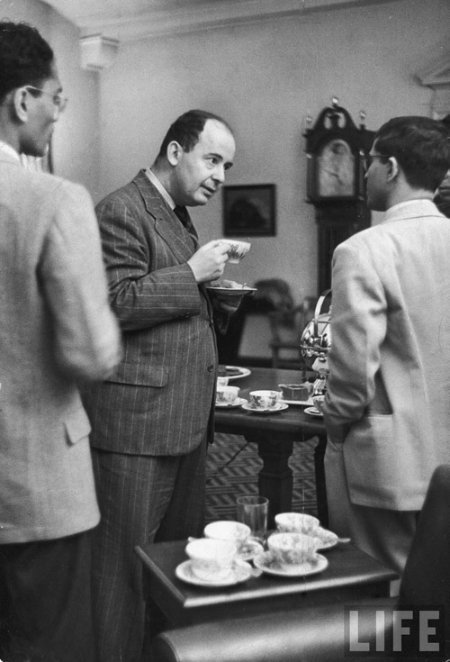
John von Neumann
The first two to arrive at the restaurant were Turing and Shannon. Both were working on secret cryptography projects at AT&T’s laboratories. By then Alan Turing had left the leadership of the Hut 8 group at Bletchley Park, the famous home of the British government’s Government Code and Cypher School. Hut 8 was in charge of breaking the messages encrypted with the Enigma machine used by the German navy. Alan Turing had expressed his interest in working on the encryption of human speech, and to that end he asked to visit Bell Labs. He and Shannon shared a table there several times, and we have a record that on one occasion, at tea time, Turing showed him his 1936 paper on what we now know as the “Universal Turing Machine”. Claude Shannon was of course impressed, since many of the ideas laid out in that paper complemented his own. He had already shown in his 1937 thesis that it was possible to express statements of logic and arithmetic by combining relays and electrical circuits.
Besides working together at Bell Labs, Turing and Shannon shared the fact that, at different times, they had studied at Princeton’s Institute for Advanced Study, both under the tutelage of John von Neumann. When von Neumann heard about Turing’s visit, he arranged the get-together with his two brilliant former students.
Dan Wohlbruck imagines the scene:
Neither Turing nor Shannon had previously dined at the Hay-Adams and as they got out of the taxi cab they shared, they paused. Turing turned to look at the White House just across Lafayette Square. Shannon, a true American from the Midwest, had seen the White House but had never enjoyed the luxury of a restaurant like the Lafayette Room. A bit intimidated, Shannon waited for Turing to lead the way. The men were seated at the table von Neumann had reserved and waited for their host to arrive.
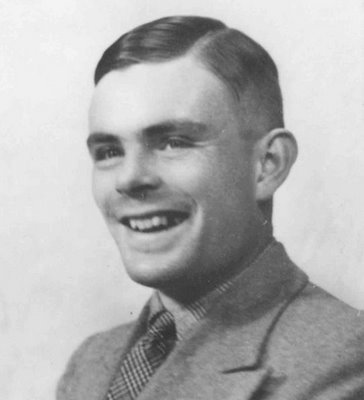
Alan Turing
The two men couldn’t have been more different. Turing was short and well dressed. Shannon was tall, thin, and ill at ease in his clothes. Apart from having been von Neumann’s students, the only thing the two men shared was their common project, and that was no help because they weren’t allowed to discuss it in public. So, with nothing else to talk about, they swapped stories about Johnny.
John von Neumann was well known and admired in Washington. His intelligence was obvious without being showy. He handed out his expertise and wisdom without wanting favors in return. When he testified before congressional committees, senators and representatives hung on every phrase. He was trusted, believed, and known by everyone.
Suddenly the room fell silent, as all eyes turned to the man making his way among the tables from one end of the restaurant to the other. Johnny von Neumann had arrived. He stopped to greet Senator Truman and, farther along, to say a word to a White House staffer. Without consciously thinking about it, both Turing and Shannon stood up and waited by their chairs as a show of respect. Von Neumann finally reached the table and the three men shook hands with warm affection, then sat down and ordered lunch.
Over coffee, once the lunch dishes had been cleared, von Neumann steered his former students toward a problem he was facing.
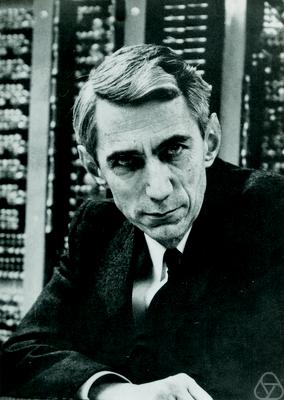
Claude Shannon
What followed was something rare and possibly unique. These three shared a different kind of genius. Turing’s mind knew no limits. He acted without prejudice or inhibition and could work out a solution without worrying about conventional wisdom. Shannon, for his part, was able to connect two different fields of study by finding how they interacted. John von Neumann was an assimilator. Where Turing and Shannon could explain what should be done, von Neumann could describe how to do it.
“Alan,” he said, “I need a machine that can reason. I want something that I can feed with information, and to which I can then pose a question, and wait for an answer.”
Turing considered the challenge. After thinking for a moment he suggested an approach. Shannon had an inspiration and added his own insight. As the two men grew more excited, von Neumann took notes and drew diagrams on a napkin. Forty minutes later, it was done.
As a final flourish, Turing said, “And thus a machine can think.”
“What, I wonder, would such a machine think about?” von Neumann mused...
Dan Wohlbruck’s account is fiction. The meeting of these three men did take place at that hotel in December 1942, and we cannot know what they talked about, but it is very likely that they discussed how to build a general-purpose digital computer. We know that von Neumann put his idea into an important document describing the architecture of computers with programs stored in memory, and that he worked on the EDVAC project and on the famous ENIAC, the first general-purpose electronic computer. Turing knew Colossus, the secret computer developed by the British to break the German codes, and in later years he also worked on the Manchester Mark 1.
Practically every modern computer implements the Turing machine model, is built from basic logic circuits based on the ones Shannon proposed, and has an architecture similar to the one von Neumann proposed.
Without the ideas of these three great scientists you could not be reading this article on your phone, tablet, or computer, nor would I be able to write it on my laptop, and perhaps our world would be completely different. Either way, I’d love to be able to travel back in time and peek through the windows of the Hay-Adams to watch these three remarkable men talk...
Comments
comments powered by Disqus