$ cat posts/origins.md
Origins
The first programming language I learned was Basic, back around 1981, on a Sinclair ZX81. Do you know what Dijkstra said about Basic? Dijkstra said: “The teaching of BASIC should be rated as a criminal offence: it mutilates the mind beyond recovery”.
You’ll understand my concern when I found out that one of the people I admire most thought that way. Was my mind mutilated forever?
But then there’s another of the great heroes of our field, Alan Kay, who said: “arrogance in computer science is measured in nano-Dijkstras” (to which someone replied “and in microkays”).
It turns out that in the early 1970s Alan Kay was a researcher at the University of Utah who had taken part in developing the Flex language. The idea was to bring in the ideas of Simula and Sketchpad to develop graphical interfaces for personal computers.
Alan Kay had this vision he called the DynaBook, a portable system with a flat, touch-sensitive screen. A device that is the direct ancestor of the notebook and the tablets. A machine to be used by adults and children alike.
Alan Kay cared about education. In 1972, when he presented his prototype of the DynaBook, at MIT Seymour Papert and his team, inspired by the educational ideas of Jean Piaget , were designing the Logo language. The key to Logo was its ability to create small building blocks, which were later combined to build more complex structures. These ideas inspired Alan Kay to develop SmallTalk, a language based entirely on the notions of objects and message passing between them.
All of this was built at the Xerox labs in Palo Alto, the same ones visited by Steve Jobs and his “pirates of Silicon Valley”. Kay’s ideas, embodied in SmallTalk, changed user interfaces and have shaped the development of personal computers ever since. While I write this on my notebook, my wife is playing Sudoku and browsing the web on a tablet. Our world has been shaped by his ideas.
The most interesting part of this whole story is that the first SmallTalk interpreter had to be built in a language that could run in real time, and efficiently, on the computers of the day. The first SmallTalk interpreter was written in BASIC.
:smile:
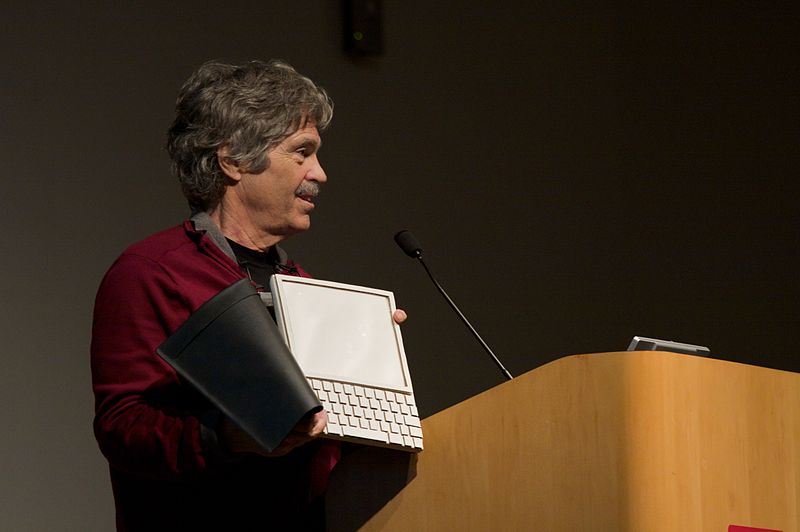
Alan Kay showing the Dynabook prototype
Comments
comments powered by Disqus