$ cat posts/concept-album.md
Concept album
Table of contents
Intro
Time is a gypsy caravan Steals away in the night
In 1997 Rush was a successful band, and its drummer, Neil Peart, was considered the best in the world, by his peers and by the critics alike. But that year his only daughter, 19 years old, died in a car accident; ten months later his wife, who never got over the loss, died of cancer. A grieving Neil told his bandmates he had decided to take a break, to reflect, he didn’t know for how long, got on his motorcycle and took to the road. The band’s future was uncertain.
Verse
We will pay the price, But we will not count the cost

Nicholas Taleb would tell us that what happened to Neil Peart is one of those disastrous events that hit our surroundings hard, something totally unpredictable, something we are not prepared for. A “Black Swan”, for the musician and for the band alike, which from that event on went through a hiatus of almost eight years.
The image of the black swan, introduced in the book The Black Swan, The Impact of the Highly Improbable, by Nicholas Taleb, comes from the fact that for many years, as far as European naturalists were concerned, all swans were white, until one turned up in Australia. The concept illustrates how fragile our knowledge is. A single observation invalidates a general statement held for millennia after the sighting of millions of white swans.
In his book, Taleb introduces the concept of the black swan as an event with three attributes: first, it lies outside all regular expectations, because nothing in the past can convincingly point to its possibility. Second, it carries an extreme impact, and third, in spite of its outlier status, our nature makes us concoct explanations for its occurrence after the fact, so we take it in as if it were something explainable and predictable.
Riff
Why are we here? Because we're here
Roll the bones
Taleb describes himself as a skeptical empiricist, in the tradition of Montaigne and, above all, of David Hume; this author reminds us of the old maxim that the past is no good for explaining the future. Something we talked about in “imagined causes”. The book covers many of the topics we have dealt with here, which is no surprise, since it joins a list of texts that are all talking about the same things: handling complexity, human irrationality, and our cognitive limitations in dealing with reality.
What we are going to look at now is whether this applies to managing software projects, because apparently we have black swans. What follows is an exploration of that idea, and also a reply to a post by my esteemed colleague Alejandro Barros, with whom I have had more than one argument about how real the “software crisis” concept is, or about the debt in the efficiency of IT project management 1 2.
Chorus
Why does it happen? Because it happens
Roll the bones

We were fooled, by people who didn’t understand what they were reading, and piles of books taught software engineers how to do things badly, “the curse of the waterfall”; only now are some people questioning the worst methodology for running a software project that has ever existed, but there are still people waiting for miracles, crashing into reality. “Insanity is doing the same thing over and over and expecting different results”.
I am convinced we must abandon “the image of software as something that gets built”. I refuse to believe this craft should be lumped in with civil construction, or with the engineering of works, the kind that builds bridges, because that view is the source of so much frustration and confusion.
Bridge
Face up! There's still time to turn the game around Face up! – Turn it up
Or turn wild card down
Alejandro tells us about an article called Why your IT Project may be riskier than you think.
The article’s subject is the usual one: IT projects are doomed, we are terrible at estimating, and our projects always end badly. Well, not always, but the average cost overrun on projects is above 27%. The bad news, though, is that 17% of IT projects turn into black swans. What the article’s authors define as black swans are projects whose costs unexpectedly shoot up by more than 200%.
Break
Shadows on the road behind Shadows on the road ahead
Nothing can stop you now
After his loss Neil Peart rode 80,000 kilometers by motorcycle across North America, and poured what he lived through into a book and a song. The pain dissolved with time, and suddenly, while he was visiting a friend in Los Angeles, the friend introduced him to the woman who would end up being his second wife. After that he called his bandmates to announce that he was back, that he wanted to return to the studio to record and write; after 14 months Rush came back with “Vapor Trails”3.

Solo
Well, I was only a kid -- didn't know enough to be afraid Played the game, but not the way the big boys played
Nothing to lose -- maybe I had something to trade
I don’t consider myself an optimist, but it seems I am one. I care less about failures than about how they are overcome. Success is always boring; engineering is boring if there are no challenges. To me, the idea that the right methodology will lead projects to success is always comforting, but it is pure fantasy, wishful thinking, born of not recognizing the nature of software development. The bad part is that you can’t say that to the people putting up the money, who expect the project to come in on time and on budget. And there lies the problem.
The authors of the study mentioned above say they collected a global sample of 1,471 IT projects, comparing their budgets and expected benefits with the actual costs and results. The projects ranged across things like ERP and CRM rollouts and information management systems. The average project cost was 167 million dollars, and the largest came to 33 billion dollars. These were big projects, several of them planned to run over a number of years. 92% of the projects were in public agencies and 83% were based in the USA. But since they found little difference between the 92% of public projects and the 8% of private projects in their sample, the authors figured the behavior is the same in the private sector. Oh, I forgot to mention: of the authors, Bent Flyvbjerg is an academic at Oxford, and Alexander Budzier is a consultant at McKinsey & Co. and a PhD candidate.
What can a (not so) humble developer argue against credentials, and a sample base, of that size?
Quite a lot, I think. To begin with, it seems to me the authors make many of the mistakes the author of The Black Swan takes care to point out in his book. We know that at the end of 2008, after the financial crisis, Taleb was a mandatory reference, and many people have cited his work without so much as skimming the back cover. There have been so many misreadings of Taleb’s ideas that the author decided to write a long appendix for the second edition of his book:
“The fact is that many researchers do not immediately realize that a Black Swan corresponds mainly to an incomplete map of the world, or that some researchers have to stress this subjective quality
\[...\]which takes us to the historical problem of the very definition of probability.
\[...\]The notion that two people can have different views of the world, and then express them as different probabilities, remains foreign to researchers. So it has taken scientists a while to accept the non-Asperger notion that different people can, while being rational, assign different probabilities to different future states of the world. This is called “subjective probability”
– Nicholas Taleb, “Probability has to be subjective”, postscript essay: On Robustness and Fragility… Second Edition of The Black Swan.
That paragraph holds the key to understanding what the problem is with these analyses, as we will see.
Chorus
Do we have to be forgiving at last? What else can we do?
Do we have to say goodbye to the past?
Yes I guess we do
We have not only been fooled, we have also fooled ourselves; we have suffered an unforgivable amnesia. Because we have known this for more than 30 years: the fallacies of estimation were laid out by Brooks in his classic essay The Mythical Man Month. We make mistakes because we forget the past; we live as if software development had been invented yesterday, as if all these problems were new. Taleb smiles from his empiricist skepticism…
Verse
I don't believe in destiny Or the guiding hand of fate
But I believe there's a ghost of a chance
Whatever objections I might have about the choice of sample, or about the methodology of Flyvbjerg and Budzier’s study, the numbers are there: when an IT project goes off the scale, the cost is very high. Why does that happen?
At the start of his essay Brooks quotes the menu of Restaurant Antoine in New Orleans:
“Good cooking takes time. If we make you wait, it is to serve you better, and to please you”
How badly we need Chef Antoine’s attitude! If we negotiated deadlines and costs with the Chef’s polite inflexibility, Alejandro Barros would lose so much material to write about…:wink:
More than 30 years ago Brooks identified the problems with estimates:
Unjustified optimism: programmers are optimists. Many estimates start from the premise that everything will go well. Code is such a malleable medium that it gives the programmer a deceptive sense of absolute control, because he trusts that everything depends on his own intellectual capacity, on his own ideas. But our ideas evolve as we understand the problem better, so our optimism is inherently unjustified. And this feeling also slides into the Asperger-ish attitude that it depends on nobody else, it’s me and the code in front of me. All the other components will honor the interface and there will be no compatibility problems, or problems in the infrastructure.
The man-month fallacy: the same unit is used for estimating and for scheduling the work: the man-month. Cost is the product of the number of men and the number of months, but progress must not be measured that way. “The man-month as a unit for measuring the size of a job is a dangerous and deceptive myth.”
Brooks says: “Men and months are interchangeable commodities only when a task can be partitioned among many workers with no communication among them. This is true of reaping wheat or picking cotton; it is not even approximately true of systems programming.”
In the essay Brooks includes several charts that make this problem clear. The first shows time versus the number of workers for tasks that can be perfectly partitioned (like harvesting wheat):
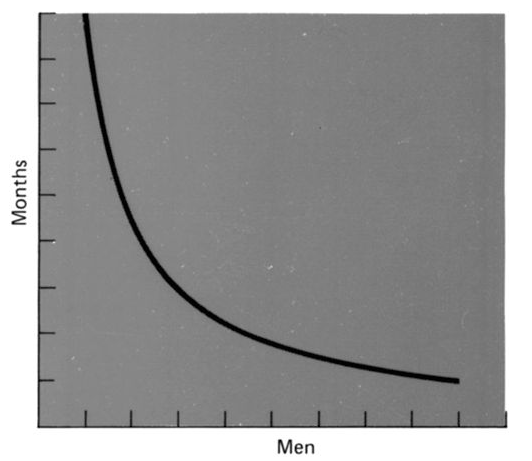
Time versus workers for perfectly partitionable tasks
If the task cannot be divided (debugging, for example), this is the chart of time versus workers:
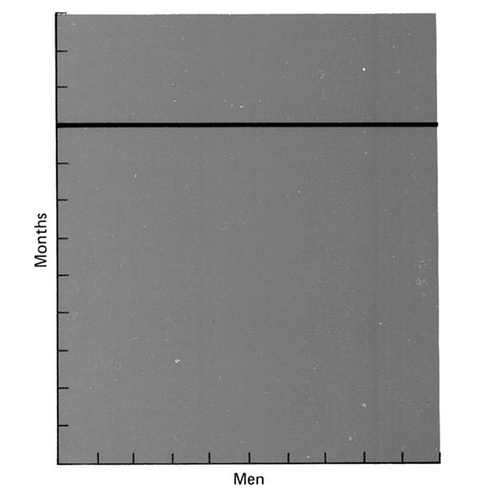
When there are complex interrelationships (as when we develop a system), the work and the division of labor will behave like this:
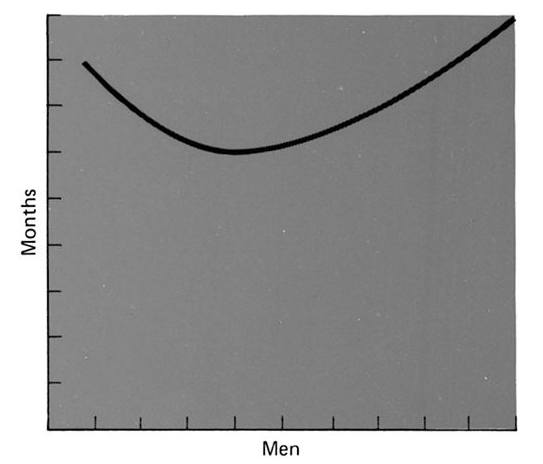
We know this; Brooks published these essays in 1975. No wonder the initial estimates were lowballed. The last chart explains many of the observations Flyvbjerg and Budzier came across.
Another of the problems Brooks also identified is the famous “second-system effect”4. I suspect many of the projects Flyvbjerg and Budzier found suffer from it. The “second-system effect” is a dangerous trap architects fall into when designing the second version or the reimplementation of a process or system: they will tend to add everything they left out the first time around because of time constraints, and that leads to overload; the complexity curve shifts so that the project’s cost goes up (guess by what percentage: 200% or more, exactly!).
Bridge
You just don't get it What it is ... well, you're not really sure
You move like you're walking on thin ice
Talking like you're still insecure
The projects presented in Flyvbjerg’s paper are not black swans. They don’t meet Taleb’s definition, because they represent known problems; the surprise factor isn’t there, except as an excuse. Maybe the companies that embarked on these projects had never heard of Brooks’s ideas; that wouldn’t surprise me, plenty of software engineers still haven’t.
Brooks isn’t taught at universities, he’s an old-timer, “we’re talking about a book from 1975, what could it teach us that we don’t already know?!”. Universities have decided that only PhDs and full-time academics may teach in their classrooms, not people with real experience in software development (the professor Andrés Bello was talking about). So what can we expect from the arrogant new engineers who go out and repeat mistakes from 1960 when building systems for the public or corporate sector?
History teach us nothing, sang Sting…
Collision
The odds get even You name the game
The odds get even
Neil Peart rebuilt his life, and Rush came back; it was hard, but they came back. And not only that, they became a bigger band than before.
Rush’s drummer says one of their concerts is like running a three-hour marathon while solving equations4. Well, programming is more or less like that :wink:
Despite the image many people may have, rock requires a lot of discipline. (There is a connection between developing software and rock, there has to be, I promise I’ll find it!)
The most remarkable thing about Rush’s story is their evolution. This is a band that experimented with synthesizers, that went back to basics, that took on modern elements from grunge and alternative rock, even from hip hop and jazz, without losing its progressive base. All three are virtuosos, intelligent, well-read. They had commercial failures, and sometimes blew the budget they were given. Brilliant men proud of their work, the best at what they do, people without fear.
Software engineers, software developers, should have that progressive-rock musician’s attitude: no fear. I believe software development is better today than in 1975, or than in 1984, when Brooks wrote “No Silver Bullets” (another forgotten text). Brooks tells us about the mistakes that get made not to scare us but, on the contrary, to encourage us to face them and overcome them.
Heavyweight methodologies, consulting, the literature, even the estimating of time and effort, are all full of fear. The idea that software projects will always fail, or will run over budget.
Black swans are the new werewolves5.
Coda
The stakes are the same You bet your life...
Software is developed by people, for people. People make mistakes, estimate badly, are optimistic, are ignorant, are intelligent, are brilliant, are deficient. People are the key factor.
The Asperger view (to use Taleb’s expression) will not take the human factor into account, and will end up condemned to underestimate the work, and to deliver late and over budget.
The key to the success of any project, and above all of IT projects, is managing people. We forget that. Risk management starts with managing the human team.
There are no black swans, there is bad management, above all bad management of people: expectations, communication, coordination, trust (distrust), attitude, and so on.
Software is developed, not built. It is developed in a social setting, among interconnected people. With that in mind, we have to look at our processes and question them. Every methodology is in vain if it doesn’t go to the essence of things; we pay the price, but we do not count the cost, and that is how we run our projects.
Black swans are excuses.
Bow
Alejandro Barros has a remarkable blog, a mandatory reference for all of us who care about IT, and one I read whenever I can; you should follow it.
This little controversy, which I don’t think really is one, is just a game, a matter of more or less optimistic views of our profession, and it is stimulating. I thank him for the hours of fun that preparing this reply to his post gave me.
All the epigraphs are lyrics from songs on the album Roll The Bones by Rush, except the epigraph under Break, which is from the song Ghost Rider on the album Vapor Trails. Roll The Bones was the soundtrack while I wrote and researched this post. The headings are, obviously, the parts of a rock song.

Notes
Comportamiento de proyectos TI: Están en deuda! (“How IT projects behave: they are in debt!”), on Alejandro Barros’s blog, published in January 2010, visited on January 14, 2012. ↩︎
What debt are you talking about?, my reply to Alejandro’s article, published on this blog on January 7, ↩︎
I admire Peart, one of the greatest drummers in rock. In an interview he says that playing drums is a way to get kids who hate sports but love music to exercise. That is exactly what I did, to the surprise of my gym teacher, who never understood how I, the worst in his class, could play drums with such coordination (true story :wink:). ↩︎
I have an example at my job that suffered from second-system syndrome: the final effort is double the initial estimate, precisely because they tried to put in all the things that weren’t in the first version. ↩︎ ↩︎
The reference is to the werewolves Brooks talks about in No Silver Bullets. ↩︎
Comments
comments powered by Disqus