$ cat posts/reading-comprehension.md
Reading comprehension
It turns out the waterfall model is perhaps one of the biggest reading comprehension failures in the entire history of software engineering. In 1970 Winston Royce wrote a paper in which, unfortunately, he used the words “grandiose approach” to refer to the following figure:
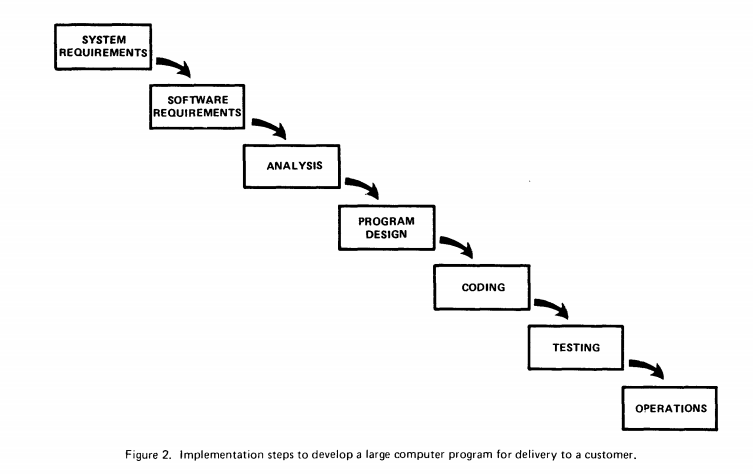
Winston Royce actually wrote this paper to criticize this model, but it ended up being cited over and over by the “scientific” community as a classic, established model.
It’s typical to find references like: “the waterfall model is a proven model (Royce, 1970)”. But in reality Royce made up this diagram in his article to illustrate how the projects he had taken part in were run, and then went on to propose his own iterative development model.
Royce’s model is not only iterative and incremental, it also proposes 5 elements that are fundamental to a project’s success.
Design first.
Document the design.
Build it twice: a first version that is reviewed by the users, a sort of working prototype, and a second version that is the finished product.
Plan, control and monitor testing.
Involve the customer.
Sadly, everything Royce said was lost. When the US Department of Defense had to define its standard for software development it adopted the waterfall model, simply because “Royce already invented the right model, let’s use it”, and DoD-2167 was born. And when NATO faced the same problem, guess who they asked what should be done.
Zero reading comprehension. Even today we still see consultants who regard the waterfall model as an established, traditional model (worse yet, it is still taught in universities as a good model for developing software).
Now, the interesting thing about this story, and about rediscovering Royce’s paper, is that agile software development models are not new, that it has never been scientifically proven that the waterfall model was ever successful, and that it’s not a good idea to put a diagram of a bad idea at the beginning of an article: people probably don’t read past the first page.
Sources:
Comments
comments powered by Disqus