$ cat posts/framing.md
Framing
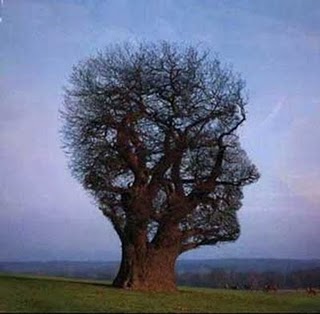
We human beings are cognitive misers: we try to think as little as possible. That’s not something I came up with, it is what many cognitive psychologists argue. One of the mental shortcuts we use is framing.
Framing is a schema of interpretation, a collection of anecdotes and stereotypes we rely on to understand or respond to different events. As we grow up we develop a series of emotional mental filters, which we later use to make sense of the world we live in. These mental filters take the form of simple narratives.
All complex narratives are made up of smaller narratives with very simple structures. These simple structures are known as “frames”. Frames are a kind of cognitive structure, a mechanism we use to think. For example, when we read a murder mystery there is a typical frame with several kinds of characters: the murderer, the victim or victims, the possible accomplices, the suspects, the motive, the murder weapon, the detective, the clues, and a scenario, in which the murderer kills his victims and is later caught by the detective.
It has been found that frames are cognitive structures that require a fairly simple neural circuit. Jerome Feldman argues in his book “From Molecule to Metaphor” that combinations of “triangle nodes” are enough to characterize the computational properties of a frame. Each node is a small collection of neurons forming a circuit. In a triangle node there are three of those circuits, and activating any two of them activates the third. There is a control node that triggers this process. Our brain uses these frames in many of our mental processes.
Frames have been described in several fields. Sociologists have found that all institutions are structured as frames. Linguists have found that words are defined relative to conceptual frames. Groups of related words, known as “semantic fields”, are defined with respect to the same frame. Words like “cost”, “sale”, “goods”, “price”, “purchase”, etc., are defined with respect to the same frame, the one that describes commercial events. It has even been found that the physical understanding of an object can be observed at a neural level that takes the form of a frame structure.
Frame structures are also found in all narratives. They are easy to spot in mythological tales and folklore, and in all cultural prototypes. In all these narratives we have a series of “semantic roles”, such as the main characters, the actions and the instruments.
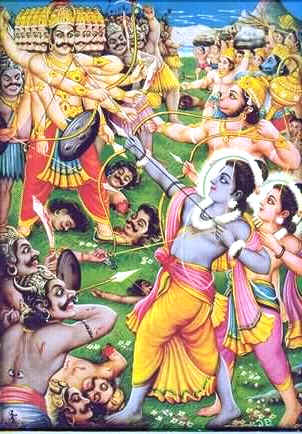
Rama rescuing Sita from the demon Ravana
Consider the “rescue narrative”. The characters are the Hero, the Victim, the Villain, the Helpers. The Hero is inherently good, the Villain inherently bad. The main actions form a scenario: “The Villainy, committed by the Villain against the Victim. The Difficulties the Hero must overcome. The Battle of the Hero against the Villain, the Victory of the Hero over the Villain, the Rescue of the Victim by the Hero, the Punishment of the Villain, the Reward for the Hero. The Villainy upsets the moral order. The Victory, the Rescue, the Punishment and the Reward restore the moral order.
It doesn’t matter whether the story is about Rama, Hercules or Batman, the same structure is used. This is what is known as a “deep narrative”, and it is what establishes a series of cultural prototypes. There are many of these prototypes: the martyr, the rogue, the freeloader, etc.
So what is it that lets the brain combine these simple narratives to create new narratives? What is the mechanism that lets us identify the different semantic roles in different narratives? What lets the brain apply a general form to a special case?
The answer is “neural binding”. For example, when you see a blue cube you perceive it as a single object, but in reality color and shape are registered in different parts of the brain. Neural binding lets us bring together these neural activations, in different parts of our brain, to form an integrated whole.
There are various theories that try to explain how this mechanism works. The important thing is that it isn’t magic; it requires the interaction of different circuits of neurons firing simultaneously in our brain. These neural bindings are what shape our different experiences. The repetition of these bindings over and over in our brain creates patterns that get “recorded” in our brain. When we face new situations, our brain turns to this warehouse of stored experiences and produces associations. It is the cheapest mechanism for our brain. Only when it finds nothing analogous does it form a new circuit, which will be recorded in our brain for future use.
Neural binding is important for understanding the temporal structure of a narrative. Even the simplest narratives have a structure that is activated over time again and again, in the following stages:
Preconditions, the prior context required by the narrative.
The Buildup, the events leading up to the central event.
The Main Event, the subject of the narrative, what the narrative is about.
The Purpose, what is achieved (if there is a purpose).
The Wind-Down, the events that end the narrative.
The Result, the final context, and
The Later Consequences
There are variations, but this is the typical structure of a simple narrative. It is a structure known as the “executing schema” in the field of computational neural modeling. Software people will recognize a similarity with use cases, as used in software development.
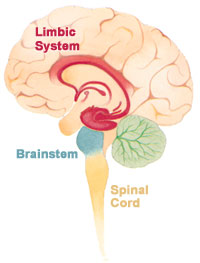
The limbic system
Neural bindings can create emotional experiences. In fact, at the level of the limbic system, the most primitive part of the brain in evolutionary terms, there are two emotional circuits with different neurotransmitters. The one for positive emotions (happiness, satisfaction), known as the dopamine circuit. And the one for negative emotions (fear, anxiety and anger), the norepinephrine circuit. There are pathways in the brain that link these emotional circuits to the prosencephalon, the forebrain, where the dramatic circuits appear to be located.
So narratives are colored with heavy emotional content. You feel fear when the hero is threatened, anger when the villain commits his villainy, and satisfaction and pleasure when the hero rescues the victim.
This also happens in political experience, which has a narrative form. You feel elated when your candidate wins the election, or when he is ahead, and depressed when he loses. The political narrative is a basic hero narrative. Your brain falls into the analogy trap. The circuitry that characterizes the hero’s triumph (= your candidate) is neurally bound to the dopamine circuit, which produces positive feelings when it is activated.
Narratives and frames are not just intellectual structures; they carry integrated intellectual-emotional content. It is the neural binding circuitry that provides this integration.
All this business of framing is somewhat complex, but it is important for understanding what we will explore in the next few articles, where we will see how these mechanisms explain certain forms of manipulation we may be exposed to, on different levels, from advertising to politics.
Sources:
Framing, Wikipedia.
The Political Mind, George Lakoff, mainly chapter 1.
From Molecule to Metaphor, Jerome Feldman.
Image sources: the metaphors image was taken from this post. The image of Rama was taken from here. Limbic system image taken from Wikipedia.
Comments
comments powered by Disqus