$ cat posts/on-how-to-scratch-your-ear.md
On how to scratch your ear
Sometimes we just love scratching our left ear with our right hand, purely to complicate things

That happens a lot in the design and data modeling stages. A simple problem, after going through analysis and design, can end up like this:
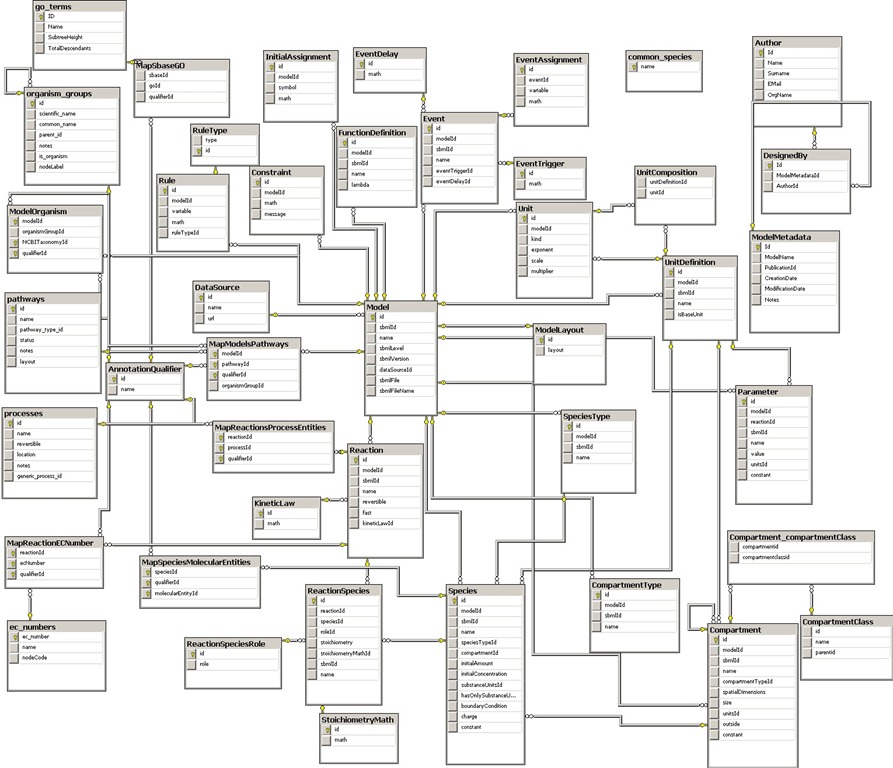
Ah, how beautiful these generic models are, with traceability, access controls and profiles, an orgy of tables and relations (could it be that this business of “foreign relations” awakens some unspeakable fantasy in systems analysts?)
Sometimes this turns into pure onanism, born of an axiom that was drilled into our brains by a group of IBM researchers in 19691: the idea that everything must be modeled in a relational database down to the “twenty-fifth normal form”2.
There’s no denying that the relational model has its advantages; after all, it is the heart of most transactional systems today. To wit: relational databases, when used properly, have many advantages.
The theory behind them is based on first-order logic and set theory, so it’s easy to understand and explain from a theoretical point of view.
Since relational databases let you operate on sets, you can define very efficient operations for “crossing” the data; this is known as “relational algebra”. An equivalent language is “relational calculus”
\[3\]. These two theoretical languages made it possible to create the structured query language SQL, a simple and very powerful language for extracting information from the relational model.
When relational databases are well modeled they use space efficiently.
A good model lets you run queries that weren’t foreseen, and cross information in new ways, though at a cost. If the indexes don’t exist, queries can take quadratic time, or worse.
All these benefits come from the fact that relational databases promote a solid, fault-tolerant structure that lets the engine itself catch semantic or structural errors. Given these advantages, database management systems later incorporated other concepts, such as transactions, the famous ACID (Atomicity, Consistency, Isolation, Durability), which is what makes these databases so widely used in enterprise applications (accounting, banking, retail, etc.).
The other day I heard an important executive say that everybody uses Oracle or SQL Server because they’re good for solving big, enterprise-level problems. I told him that Facebook stores 135 billion messages a month in a non-relational database, but even then he didn’t get it. It’s a textbook case of motivated reasoning.
While almost any problem can be modeled with a relational database, solving a problem with a relational database isn’t always the right call. I already showed you an example where a C program can be more efficient than processing a simple SQL statement. Sure, it takes more development work, but that’s where the art and the science come in: knowing and using the right tool for each kind of problem.
Consider this model:
 class Book {
     String title
     String author
     Integer year
     Integer pages
     Set keywords
     Set ratings
}
Versus this other one
class Book {
    Integer id
    String title
    String author
    Integer year
    Integer pages
}

class Keyword {
    Integer id
    String keyword
    Integer bookId
}


class Ratings {
    Integer id
    String rating
    Integer bookId
}
If you run an online bookstore, it’s far more convenient from a semantic point of view to use the first model, with a single Book class that holds all the relevant information in one place. Since the user will normally interact with one book at a time, this model is simpler and more direct.
If you’re going to do statistics or grouped operations over the books, the second model suits you better. But keep in mind that you can also run those operations through some MapReduce-style mechanism at another time of day, or on an offline database.
Non-relational databases let you tackle the same problem, but sometimes from a simpler, and often more agile, perspective. We’ll see some examples soon. What matters is keeping an open mind and considering that there are simpler ways to scratch your ear.

Edgar F. Codd, a British researcher working at IBM in 1969, proposed the theory of relational databases in a series of papers in the early 1970s, and received the Turing Award in 1981. ↩︎
To date 6 normal forms are known, but an academic’s imagination knows no bounds. ↩︎
Comments
comments powered by Disqus