$ cat posts/circular-reasoning.md
Circular reasoning
The Mona Lisa, the most famous and important portrait in the history of world art. The perfect painting, the greatest work of art, the fruit of the brilliant Leonardo. And yet for centuries it was an obscure piece of art hanging in the private residences of the French kings. Even after the French Revolution, once it had moved to the Louvre, it didn’t draw much attention from art critics.
It was the famous theft of 1911, carried out by Vincenzo Perugia at the urging of the art dealer Eduardo Valfierno, that cemented this painting’s universal fame. Even Apollinaire and Picasso were accused of the theft. For weeks people started visiting the Louvre to gaze at the empty space the theft had left. Slowly the Mona Lisa began to turn into the most valuable object in Western art.
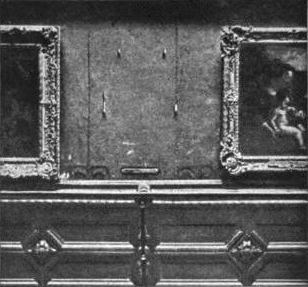
The empty space left after the theft of the Mona Lisa at the Louvre in 1911
Two years and one hundred eleven days later, Vincenzo Peruggia was arrested and the painting recovered. The thief claimed he had done it out of patriotism, to return the work to Italy, and that he was a victim of the con man Valfierno. The painting was exhibited in Florence, Rome and Milan before being returned to France.
This turned it into a cultural icon. Plagiarized thousands of times, it has been parodied, paid homage to, quoted, over and over. It has been insured for more than 700 million dollars; it is the most valuable work of art in the world, irreplaceable. Every time someone quotes, remixes, parodies or uses the Mona Lisa, its fame grows.
And yet, for all the admiration he commanded, Leonardo da Vinci was considered, until the 20th century, a good painter, but inferior to Titian or Raphael. The Mona Lisa was not considered a work of higher quality than others. But today this work is the standard of quality in art.
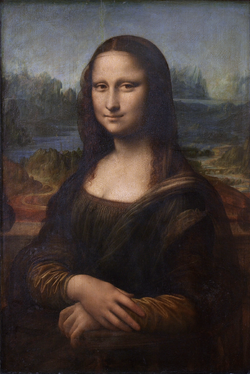
“It is impossible now to imagine the history of Western art without the Mona Lisa, and in that sense it truly is the greatest of all paintings. But it is also impossible to attribute its unique status to anything about the painting itself. This last point presents a problem, though, because when we try to explain the success of the Mona Lisa, we focus our attention precisely on its attributes.”
“
\[\...\]To oversimplify slightly
\[the art critics' argument\], the Mona Lisa is the most famous painting in the world because it is the best, and although it may have taken us a while
\[as a society\]to realize this, it was inevitable that we would. And that is why so many people are puzzled when they see the Mona Lisa with their own eyes. They are expecting these intrinsic qualities to be apparent, and they aren’t. Of course, most of us, when faced with this moment of dissonance, simply shrug our shoulders and assume that someone wiser than us has seen something we cannot see.”1
And even if an art critic lays out the evidence that “proves” the Mona Lisa is the best work of art there is, it is possible to find those same attributes in other works, which might seem just as good, or even better. Of course, this problem is avoided by pointing out that it isn’t any single attribute of the Mona Lisa that makes it special, but the combination of all its attributes (the smile, the use of light, the fantastic background, etc.) There is no way to refute this argument, because the Mona Lisa is a unique object. It looks as if the quality of this work of art is being praised in terms of its attributes, but what is actually being done is the opposite. It has been decided which is the best work of art, and only then, from its attributes, is the metric of quality defined. “We say that the Mona Lisa is the most famous painting in the world because it has attributes X, Y, and Z. But what we are really saying is that the Mona Lisa is famous because it is more like the Mona Lisa than anything else.”1
And this can be applied to any work of art, or to define genius. Shakespeare is great because he resembles Shakespeare, or Cervantes because he is just like Cervantes. We have been taught that Cervantes, da Vinci, Shakespeare or Mozart are geniuses, and genius is given by the similarity one bears to those who have been established as geniuses. I know it’s a hard argument to accept, that it may annoy us, but that’s how it is: many standards of cultural quality come from this kind of circular reasoning:
X is successful, or brilliant, because X has the attributes of X
This kind of reasoning pervades many of the common-sense explanations of why some things succeed and others fail.
“When Facebook first became popular, its success was explained as being due to the exclusivity associated with students of certain universities. In 2009, when Facebook had already opened up to anyone, a Nielsen report attributed its success to its broad appeal, along with its simple design and its focus on connecting. Facebook, in other words, was successful because it had exactly the attributes of Facebook, even though those attributes themselves had changed completely.”1
Another form this circular reasoning takes is: “People do X because X is the norm, and it’s normal to follow the norm”. And how do we know when something is the norm? Once we start paying attention, we’re surprised by the number of explanations that are circular.
When society asks for same-sex marriage, or a woman is elected president, we say that society is now “ready for it”. But the only way to know that society is ready for something is for that something to happen. In other words, what we are saying is: “X happened because that’s what people wanted, and we know that X is what people wanted because X is what happened”.
It is important to highlight this whole problem of circular reasoning because it has to do with one of the central intellectual problems in sociology, the one sociologists call the micro-macro problem. Sociologists want to explain things that are intrinsically macro in nature, because they involve large numbers of people. But these outcomes are the sum of micro actions carried out by individuals.
Cultural institutions such as marriage, social norms, even legal principles, are only relevant to the extent that a large number of people think they are. But for that to happen, society’s decisions have to be driven by a huge number of individual micro actions. Where do families, cultures and societies come from? Why do they exhibit the particular characteristics they exhibit? That is the micro-macro problem.
It turns out this problem shows up in other sciences, where it is often called “emergence” (as in, for example, emergent behavior). And all of this has to do with something we have talked about before on this blog: complexity. Sociology sits at the top of the pyramid of complexity that begins with subatomic particles and ends with global society.
Emergence is a hard problem, because the behavior of the whole cannot be explained just by describing the parts; the interactions are the key. Sociology studies a great variety of interactions, so in this science emergence, in the form of the micro-macro problem, turns out to be more complex and intractable than in other disciplines. The bad part is that common sense tends to hide this complexity.
Consider economics. In order to simplify their explanations, economists talk about the consumer, the market, idealized entities that ignore the interactions of the thousands or millions of individuals that make them up. A so-called “representative agent” is chosen, and the reasoning starts from that entity. The same happens in other social sciences. The complexity of the interactions between individuals is systematically ignored.
In our next articles we’ll see how modern researchers have tried to steer away from this kind of reasoning and, taking advantage of the power computers give us, have begun to explore the complexity of the interactions between individuals. It is possible to build more complex models and observe the emergent behaviors, which is an interesting contribution of computing to the study of society.
Taken from the book Everything Is Obvious: *Once You Know the Answer
by Duncan Watts. ↩︎ ↩︎ ↩︎
Comments
comments powered by Disqus