$ cat posts/irrational-decisions.md
Irrational decisions

In the United States, taxis offer in their payment system the option of leaving a tip of 15%, 20% or 25%. I don’t have confirmation, but I suspect that with the introduction of this system the average tip has gone up to 20%. The reason this happens is a phenomenon that has to do with what we talked about in the previous article.
At the end of Dan Ariely’s video we are shown several cases of this manipulation of preferences. This kind of manipulation can happen when there is asymmetric dominance of attributes. Let’s look at an example. Suppose we have to choose between 2 products. Product A is a high-quality but expensive camera. Product B is a low-quality but cheaper camera. Under these conditions the decision is hard. But if we introduce a third camera, C1, that is clearly more expensive than camera A, then the decision gets easier, and people tend to choose camera A. On the other hand, if a third camera C1 is introduced that has the same price as B but lower quality, then people tend to choose camera B. The diagram below shows this situation:
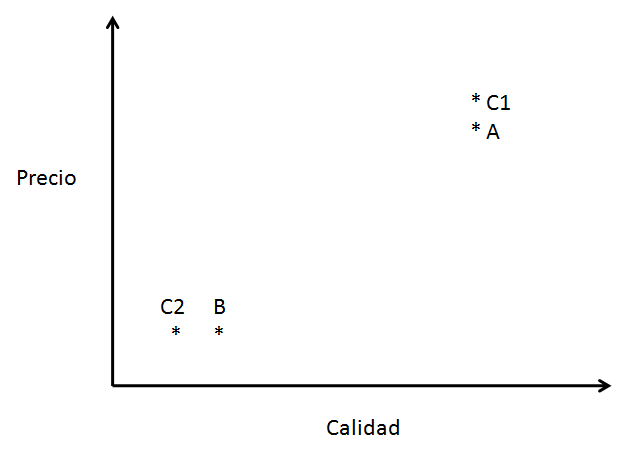
The strange thing is that in the experiments carried out, the third option introduced is never the one people choose. This phenomenon is known as anchoring. In one experiment, for example, people taking part in a wine auction were asked to write down the last two digits of their Social Security number. Even though these numbers were random, and had nothing to do with the auction that followed, it turned out that the higher the number written down, the higher the bid those people were willing to make. This is the phenomenon exploited by the American taxis that use this payment system, since they get people to pay a 20% tip almost every time.
We are irrational when it comes to choosing, and very easy to manipulate. It has been found that human judgments are affected most readily by the ease with which information is accessed or recalled. People are more willing to believe a written statement if the typeface is easier to read, or if they have read it before, even if it was explicitly marked as false. In general, people tend to digest new information in a way that reinforces what they already think. We tend to notice the information that confirms our own beliefs more than the information that doesn’t. This is known as confirmation bias. On the other hand, we are more subjective with information that goes against our beliefs, and we are more skeptical of it and tend to subject it to greater scrutiny. This is called motivated reasoning.
If you believe the dams in Patagonia are a bad thing, you will tend to give more credit to the arguments that support that view, and you will doubt and be skeptical of any argument against it, no matter how objective it tries to be. The same goes for the opposite position.
Both confirmation bias and motivated reasoning largely prevent us from resolving disputes, because the parties look at the same set of “facts” and draw different impressions of reality from them. This happens even in science, where scientists tend to question the evidence that contradicts their preexisting beliefs. On this, Max Planck remarked:
“A new scientific truth does not triumph by convincing its opponents and making them see the light, but rather because its opponents eventually die”
So there is a large number of relevant factors that affect our behavior, and our decisions, in a really tangible and probably unsuspected way. Psychologists have discovered many of these, such as priming, framing, anchoring, the availability heuristic, and several other forms of cognitive biases. We are irrational, and that is something we have to accept. Knowing this can help us understand our peers better, and it can even help us in our work. Like everything, this knowledge has two possible uses: it can be used to manipulate behavior, or it can be used to notice when we are being manipulated. But that decision is yours.
As a complement, I leave you with this video of Dan Gilbert explaining some of the topics touched on in this article:
Comments
comments powered by Disqus