$ cat posts/defaults.md
Defaults
The chart below shows the consent rate for organ donation in 11 European countries:
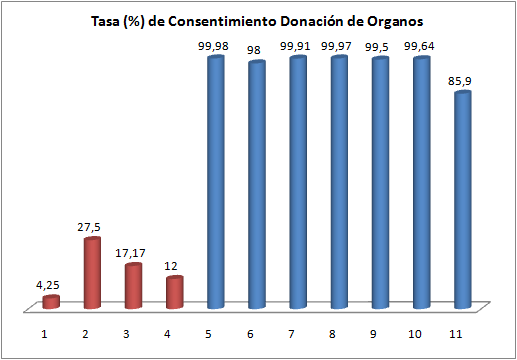
What stands out is that we have practically two sharply defined groups, two clear extremes: the first 4 countries with very low rates, and the other extreme where practically the entire population has consented to donate their organs when they die.
But what explains the difference between one extreme and the other?
Consider countries 4 and 5. Here they are in more detail:
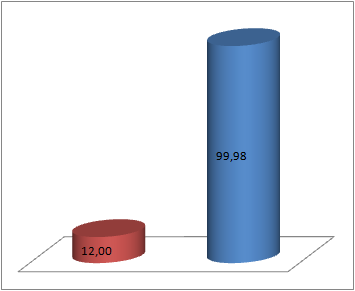
Let’s try to come up with some common-sense theory that explains why one country has a consent rate of 12% and the other 99.98%.
That is the question Duncan Watts put to his students at Columbia University: formulate a theory that explains this difference between country 4 and country 5 in our chart.
Some of the opinions the students offered were:
Maybe one country is more secular, and the other is highly religious.
Perhaps one country has more advanced medical care and the success rate of organ transplants is higher in one country than in the other.
Maybe the accident rate is higher in one of the countries, which means more organs are available for transplants.
Or perhaps one country has a highly socialist culture, emphasizing the importance of the community over that of individuals, while in the other individual rights come first
The truth is that the explanations are pretty good, until we’re told that country 4 is Germany and country 5 is Austria.
What could make Germany and Austria so different?
Is there some difference in their educational and legal systems that we don’t know about?
Maybe there was a media campaign, or a big event that shook Austrian society?
Does it have something to do with World War II?
None of Watts’s students could venture a convincing explanation, but what was clear is that whatever it was, it had to be something really big. And surely many of you don’t know the real cause of this phenomenon, and the explanation is absurdly simple:
In Austria, the default option is to be an organ donor, while in Germany the default option is **not **to be an organ donor.
This explains the enormous difference among all these countries. The details are in the study “Do defaults save lives?” by Eric Johnson and Daniel Goldstein (available at this address: https://webs.wofford.edu/pechwj/Do%20Defaults%20Save%20Lives.pdf)
“In the case of organ donation, European countries have one of two default policies. In presumed-consent states, people are organ donors unless they register not to be, and in explicit-consent countries, nobody is an organ donor without first registering to be one”. And guess what happens. Every country with an opt-out mechanism for organ donation has a higher donation rate. (*)
Understanding the influence of default options matters, because understanding how we make choices affects virtually all of our explanations of social, economic and political behavior.
One of the problems with many economic models is that, in order to understand market behavior, economists assume that people make rational decisions. In general, theories of rational choice assume that people prefer what is best for them. This view is very attractive, because it implies that all human behavior can be understood in terms of individuals trying to satisfy their preferences: “I vote because I care about taking part in politics, and when I vote I choose the candidate who will best serve my interests.” Although we know that’s not how it is, at least not in Chile ;) But it’s still possible to find a reason why there are people who keep voting.
There are many phenomena that seem irrational, or that escape the rational-choice explanation, in the traditional sense of what we understand by rational. For example, an Israeli school decided that parents who showed up late to pick up their children would be fined. What happened is that once the measure was applied, the number of parents arriving late to pick up their kids went up. Why? Because the fine relieved the parents’ feeling of guilt toward the school staff, since in essence they figured they were paying for the right to arrive later. In a certain sense there is a rational choice here, but it isn’t rational in the sense the school staff had in mind, or rational in the sense a traditional economist would use.
When we study why people make the decisions they make, we have to analyze the incentives they face when deciding. That way we can find a “rational” explanation of why they behave the way they do. The problem is that what we’ve done is precisely to “rationalize” the behavior, and rationalizing something is not the same as understanding it, or explaining it.
“Rationalizing human behavior is an exercise in simulation. In our minds we simulate what it would be like to be the person whose behavior we want to understand. Only when we can imagine this simulated version of ourselves responding in the manner of the individual in question do we really feel that we have understood the behavior under study.” \[1\]
And yet, as in the organ donor example, our mental simulations tend to ignore certain kinds of factors that turn out to be very important. Defaults are part of the environment in which the decision maker operates, and they affect behavior in a way that is invisible to the conscious mind, and so they are absent from common-sense explanations of behavior. And defaults are only the tip of the iceberg, as we’ll see in the next articles of this series.
Update
Thanks to a contribution from Javier Rovegno, here is a video of a talk by Dan Ariely in which he talks precisely about our ability to make decisions:
Notes
(*) We are talking about consent rates for being a donor, not rates of actual donors. In Chile, for example, the opt-out model applies (since 2010), that is, people are organ donors unless they explicitly refuse to have their organs donated. Whether the donation actually happens is another matter: the main cause of non-donation of organs in Chile is refusal by the family (see https://www.trasplante.cl/noticias/2011/img/memoria_corporacion.pdf)
\[1\]Taken from the book Everything Is Obvious: *Once You Know the Answer by Duncan Watts.
Comments
comments powered by Disqus