$ cat posts/two-men-and-a-universal-machine.md
Two men and a universal machine
Turing, von Neumann and the origin of computers
Table of contents
The universal machine
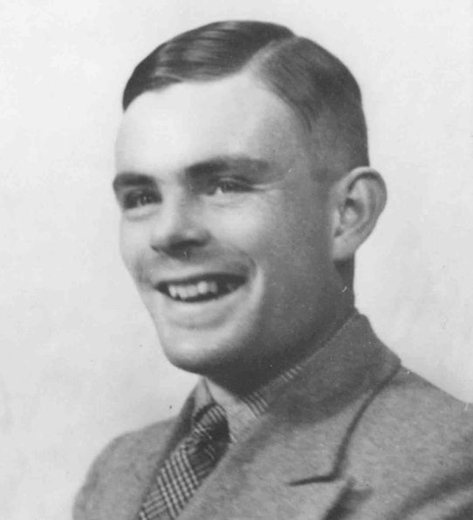
Alan Turing, the father of computing
In 1936 a young man of 24, Alan Turing, decided to reformulate certain results of mathematical logic by expressing the statements of theorems in terms of algorithms that could be interpreted by a theoretical machine. An algorithm is “a prescribed set of well-defined, ordered and finite instructions or rules that makes it possible to carry out an activity through successive steps that leave no doubt for whoever has to carry out that activity.” What Turing wanted was to study the limits of machines that performed automatic calculations. It was a time when the foundations of what computers would be were being laid. The elements needed to build these machines were already available, and Turing wanted to see how powerful these machines were. How far these machines would be able to help us solve complex problems. Turing described a theoretical machine that manipulates the symbols written on a long tape according to a table of rules. The Turing machine consists of a head that can read and/or write on an infinite paper tape. The machine can perform only the following operations: move the head to the right, move the head to the left, read the contents of a cell on the tape, erase the contents of a cell, and write on the tape.
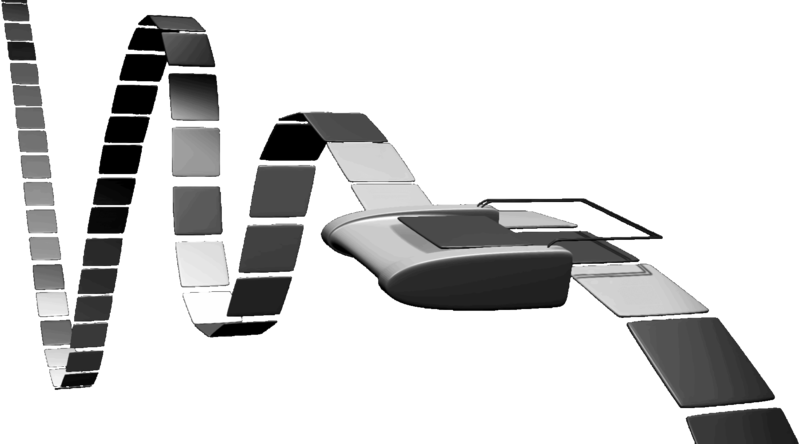
Artist’s rendering of the Turing machine
With such a simple device Turing succeeded in his effort. He not only laid the theoretical foundations for building these machines, he also formalized the concept of the algorithm, which would lead to the development of programming languages, discovered the way to determine the complexity of the problems that a machine of this kind can tackle, and even proposed a kind of test to check operationally whether a machine is intelligent, the famous Turing Test.
It is from Turing’s work that we have the concept of a universal machine, capable of solving any problem. A machine that is able to emulate many of our mental processes. Turing thought that one day it would be possible to discover the algorithms that govern the way we are and think, and that this could be transferred to a machine.
Controversial as it is, this idea has been the engine behind much of the development of artificial intelligence. Personally I think Turing was wrong about it, and probably, as Jaron Lanier argues, the traumas and troubles of Turing’s personal life were what drove this obsession of the great English logician.
This concept of the universal machine became real, and today we have computers everywhere: in the refrigerator, in our televisions, in the car and in our mobile phones. They all have a computer, a universal Turing machine that governs their actions, that decides algorithmically how to react to each new stimulus they pick up from the outside.
Enigma and the war that changed everything
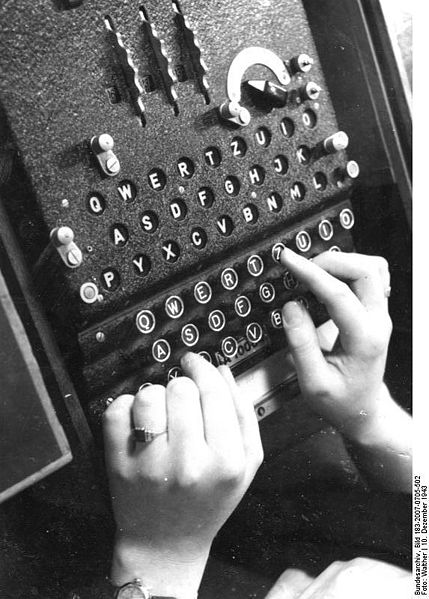
The Enigma machine
During the Second World War Turing became involved in a secret, high-impact project, considered so important that a large part of the outcome of the war, and the final defeat of the Nazis, is said to be owed to the work of this select team of scientists. During that time Turing and the team at Bletchley Park worked on deciphering the secret messages of the German army. In those days the German forces had very powerful encryption machines, such as Enigma and the Lorenz machine. The Enigma machine was used mainly by the navy and the famous German U-boats. The Hut 8 group was in charge of decoding these messages, and Alan Turing was in charge of it.
During that time the Bletchley Park team built a series of machines to help with the automatic deciphering of the messages picked up by the intelligence services.
Among the machines the English built was the Colossus Mark 2, probably the first semi-programmable digital computer.
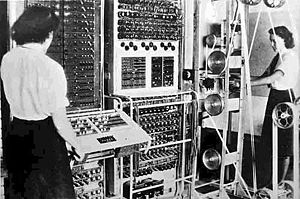
Colossus Mark II
Much of the work of these machines was kept secret for years, and for that reason they were ignored for a long time.
In those days the English developed a series of computers, and Turing himself worked on the development of some of them.
All the computers of that time were programmed by wiring. The revolutionary concept came from the other side of the Atlantic and laid the foundations for the structure of modern computers.
Remember that at the time the Americans were developing the famous Manhattan Project, which would lead to the creation of the first atomic bomb.
Feynman’s human computer
Richard Feynman tells how they needed to do complicated mathematical calculations, and while they had no computer they decided to do them with the help of human staff:
“We worked out the program, but we didn’t have any machine to test it on. So we set up this room with girls in it. Each one had a Marchant
\[a > calculator\]. But she was the multiplier, and she was the adder, and this one cubed, and we had index cards, and all she did was cube this number and send it to the next one. This one played the multiplier, the next one played the adder; we went through the cycle, we got all the bugs out. Well, that’s how we did it. And it turned out we could do it at great speed. Nobody had ever done mass-production calculating before; everyone who had ever done calculations before had done all the steps himself. But Ford1 had a good idea, the damn thing worked a lot faster than the other way, and we got speed with this system that was the predicted speed for the IBM machine: exactly the same.”
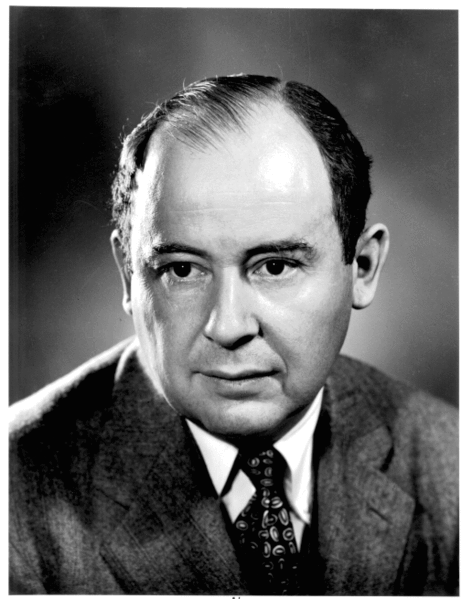
John von Neumann at Los Alamos
Among the men who were at Los Alamos at the time was a brilliant mathematician of Hungarian origin: John von Neumann. Considered a hawk, for his political views and his involvement in the development of atomic weapons (such as the hydrogen bomb), John von Neumann established the first effective architecture for building computers that could be programmed effectively, that is, without so much wiring.
The main idea von Neumann proposed was that data and programs should both be stored in the computer’s main memory.
The von Neumann architecture is described in the paper “The first draft report on the EDVAC” and it is, essentially, the architecture used by most of the computers we use today:
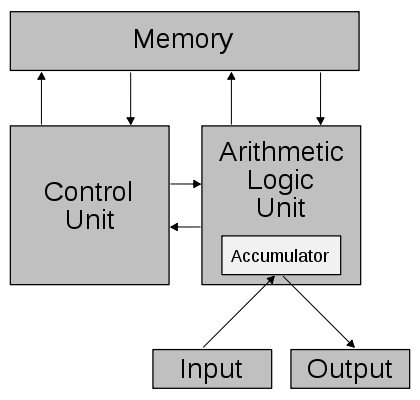
Von Neumann established that memory is a single unit containing the program and the data the computer will act on. There is a module he called the control unit (CU) that reads the instructions from memory and executes them one by one. Another unit, called the arithmetic logic unit (ALU), takes care of the calculations. The ALU reads the data for a calculation and writes the results to memory. Together the control unit (CU) and the arithmetic logic unit (ALU) make up the Central Processing Unit (CPU). To communicate with the outside world the CPU is connected to input devices (INPUT), such as keyboards, sensors, mice, disk drives, etc., and to output devices (OUTPUT) such as screens, printers, speakers, etc.
The different fates of two remarkable men.
Although the contributions of Turing and von Neumann were fundamental to the development of computers, you could not imagine two more different characters.
Von Neumann mainly developed computers to improve the calculations needed to develop the atomic bomb. Although he made remarkable contributions to mathematics and computer science. He helped develop the Monte Carlo method and several simulation techniques with pseudorandom numbers (the random number algorithm we use in our game comes from this mathematician’s work). He is probably the scientist who most influenced the establishment of the concept of mutual assured destruction, which set the nuclear balance between the superpowers during the Cold War. He favored the idea of a preventive nuclear strike on the Soviet Union to keep that power from acquiring the atomic bomb. Von Neumann died of cancer. His biographers have written: “when von Neumann realised he was incurably ill, his logic forced him to realise that he would cease to exist, and hence cease to have thoughts…*His friend Edward Teller said, ‘I think that von Neumann suffered more when his mind would no longer function, than I have ever seen any human being suffer’. Von Neumann’s sense of invulnerability, or simply the desire to live, was struggling with unalterable facts. He seemed to have a great fear of death until the last… No achievements and no amount of influence could save him now, as they always had in the past. Johnny von Neumann, who knew how to live so fully, did not know how to die.”
Alan Turing went on doing research on various subjects. In 1952 he wrote a chess program, but it was impossible to run it on any computer of that era, and he acted as the human CPU. He devoted his last years to mathematical biology, trying to understand why sequences of Fibonacci numbers appear in plant structures. Alan Turing was homosexual, a condition that was condemned in the England of the 1950s. During the investigation of a complaint he himself had filed over a burglary, he had to confess his homosexuality, and the accuser became the accused, charged with “gross indecency and sexual perversion”. The choice was to go to prison or undergo hormone treatment, which included estrogen injections that caused him to grow breasts, along with impotence and other ailments. In 1954 he died of cyanide poisoning after eating an apple. The act is officially considered a suicide, but his mother insisted for many years that it was an accident.
Recommended reading
The Annotated Turing: A Guided Tour Through Alan Turing’s Historic Paper on Computability and the Turing Machine by Charles Petzold, for understanding Alan Turing’s original paper.
A history of the Enigma machine can be found on this site: Kriptópolis, the Enigma machine
This video is a clip from the film Breaking The Code, where Turing explains the concept behind the Turing machine.
A biography of von Neumann can be found on this site, from which we took some quotes.
“El Placer de Descubrir” (The Pleasure of Finding Things Out) by Richard Feynman, Editorial Crítica, Barcelona, 2000.
He is referring to Henry Ford and his idea of mass production. ↩︎
Comments
comments powered by Disqus