$ cat posts/hubris.md
Hubris
Hubris, one of the three virtues of a programmer. But why, if this society considers hubris a sin?
A while back I wrote on akarrú about Areté, pride as the ancients understood it. I am going to transcribe it here:
We live in a mediocre age, but it has always been that way, hasn’t it?
Achilles says:
“The same lot falls to the one who holds back and the one who fights hard. The coward and the brave man are held in the same honor.
The idler dies just the same as the man of many deeds.
I have gained nothing from the pains I have suffered in my heart”.
Discépolo says the same:
¡Hoy resulta que es lo mismo_ _ ser derecho que traidor!..._
_ ¡Ignorante, sabio o chorro,_
_ generoso o estafador!_
_ ¡Todo es igual!_
_ ¡Nada es mejor!_
_ ¡Lo mismo un burro_
_ que un gran profesor!
In other words, humanity has always opted for mediocrity. There is a principle known as the principle of least effort; physicists say that “all systems tend toward states of minimum energy (minimum enthalpy) and maximum disorder (maximum entropy)”.
So there is not much to be done. Entropy is our enemy, it is to blame for the mediocrity of the world; science has explained it at last.
But I resist that explanation, because I aspire to excellence, and I hope my children do too.
There is a spirit that has been lost, an old forgotten goddess the Greeks called Areté, who gets little mention in our day, full as it is of good vibes and minimum enthalpy.
What these times lack is more hubris, something that for the Greeks was a supreme value, and that fell into disrepute in our mediocre society.
I quote my brother:
Superb!
In general, in this mediocre world we live in, we tend to hold hubris in very low esteem. To many it shows up as a sin and not necessarily as a value or a virtue
The explanation is simple: when we are all mediocre, fainthearted and timid, it bothers us to see that there is one who intends to rise out of that condition. Now, it often happens that there are arrogant types who, without any merit, want to present themselves to everyone else as perfect beings. Those need to be taken down a peg right away and left looking ridiculous for their stupidity. Sometimes, however, we have before us someone who truly stands out on his merits. Are we capable of recognizing his worth without falling into envious put-downs?
Envy is not wanting what another has. Envy is refusing to acknowledge it, and above all not rejoicing in another’s good fortune, but trying to harm it or spoil it so that the other cannot enjoy it either.
Sometimes I feel great admiration for the proud, those people who are not only good at what they do, but also know they are capable. How we could use people like that in this country! Not only because it would finally put an end to all those ineffective people in leadership positions who just repeat what was done to them, but also because, faced with someone effective and efficient, all we can do is stop, admire them and learn to be like them!
In Greek thought hubris, that quality of being exceptional, accepting it and making the most of it, is a virtue and can be something that is taught.
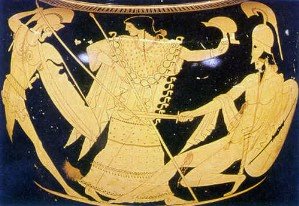
Hubris is not arrogance. Just as Ambition is not Greed. Wanting to be better (aristos), aspiring to something higher, means setting yourself apart from the mediocre, rejecting this state of minimum enthalpy, fighting entropy and wanting to stand out. It means recovering the spirit of those great warriors, Achilles and Hector.
We have to give that pride back to our young people, teach them to pursue excellence, to be the best at what they do, to be proud but not arrogant. To be ambitious, but not greedy.

Areté was a goddess, also known as Virtue, sister of Harmonia, both daughters of Praxidike, an epithet of Persephone, associated with Justice. The three formed a triad, the Praxidikai.
To that divine trio we commend ourselves, Virtue, Harmony and Justice, that it may help us find the path of Areté.
Comments
comments powered by Disqus