$ cat posts/the-media-and-social-control.md
The media and social control
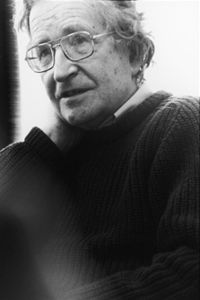
The following text is the “10 Strategies of Media Manipulation” by the celebrated linguist and intellectual Noam Chomsky:
1. The strategy of distraction
The primary element of social control is the strategy of distraction, which consists of diverting the public’s attention from important problems and from the changes decided by the political and economic elites, through the technique of a flood or deluge of continuous distractions and insignificant information. The strategy of distraction is equally indispensable for keeping the public from taking an interest in essential knowledge in the areas of science, economics, psychology, neurobiology and cybernetics. “Keep the public’s attention distracted, away from the real social problems, captivated by matters of no real importance. Keep the public busy, busy, busy, with no time to think; back to the farm like the other animals (quote from the text ‘Silent Weapons for Quiet Wars’)”.
2. Create problems, then offer solutions
This method is also called “problem-reaction-solution”. A problem is created, a “situation” designed to cause a certain reaction in the public, so that the public itself demands the measures you want it to accept. For example: let urban violence develop or intensify, or organize bloody attacks, so that the public is the one demanding security laws and policies at the expense of freedom. Or also: create an economic crisis to get people to accept, as a necessary evil, the rollback of social rights and the dismantling of public services.
3. The strategy of gradualism
To get an unacceptable measure accepted, it is enough to apply it gradually, drop by drop, over consecutive years. That is how radically new socioeconomic conditions (neoliberalism) were imposed during the 1980s and 1990s: the minimal state, privatizations, precariousness, flexibility, mass unemployment, wages that no longer ensure a decent income; so many changes that would have set off a revolution had they been applied all at once.
4. The strategy of deferring
Another way to get an unpopular decision accepted is to present it as “painful and necessary”, winning public acceptance, in the moment, for a future application. It is easier to accept a future sacrifice than an immediate one. First, because the effort is not required right away. Then, because the public, the masses, always tends to hope naively that “everything will be better tomorrow” and that the sacrifice demanded may be avoided. This gives the public more time to get used to the idea of the change and to accept it with resignation when the time comes.
5. Address the public as if they were small children
Most advertising aimed at the general public uses speech, arguments, characters and intonation that are particularly childish, often close to feeble, as if the viewer were a small child or mentally deficient. The harder one tries to deceive the viewer, the more one tends to adopt an infantilizing tone. Why? “If you address a person as if they were 12 years old or younger, then, because of suggestibility, they will tend, with a certain probability, toward a response or reaction as devoid of critical sense as that of a person 12 years old or younger (see “Silent Weapons for Quiet Wars”)”.
6. Use emotion far more than reflection
Appealing to emotion is a classic technique for short-circuiting rational analysis, and ultimately the critical sense of individuals. Moreover, using the emotional register opens the door to the unconscious, to implant or graft ideas, desires, fears and anxieties, compulsions, or to induce behaviors…
7. Keep the public in ignorance and mediocrity
Make the public incapable of understanding the technologies and methods used for its control and enslavement. “The quality of the education given to the lower social classes must be as poor and mediocre as possible, so that the gap of ignorance between the lower classes and the upper social classes is and remains impossible for the lower classes to close (see ‘Silent Weapons for Quiet Wars’)”.
8. Encourage the public to be complacent with mediocrity
Encourage the public to believe that it is fashionable to be stupid, vulgar and uneducated…
9. Reinforce self-blame
Make the individual believe that he alone is to blame for his own misfortune, because of his insufficient intelligence, abilities or effort. So, instead of rebelling against the economic system, the individual devalues and blames himself, which produces a depressive state, one of whose effects is the inhibition of action. And without action, there is no revolution!
10. Know individuals better than they know themselves
Over the last 50 years, the accelerating advances of science have opened a growing gap between the knowledge of the public and the knowledge held and used by the ruling elites. Thanks to biology, neurobiology and applied psychology, the “system” has enjoyed an advanced understanding of the human being, both physically and psychologically. The system has come to know the ordinary individual better than he knows himself. This means that, in most cases, the system exercises greater control and great power over individuals, greater than that of individuals over themselves.
Ten Strategies of Manipulation
Source of this text: Ser Pensador, this entry.
Image from Wikipedia
Comments
comments powered by Disqus