$ cat posts/knuth-answers-all-questions.md
Knuth answers all questions
Table of contents
Another article, this time a translation of a Knuth talk that I published in 2006. By the way, Knuth recently received an award in Spain, according to this story in El País.
Knuth answers all questions
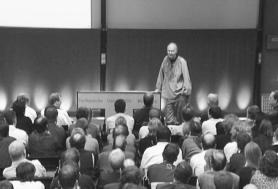
We all have our personal heroes, representative men, especially from the field we work in.
One of my oldest personal heroes is the professor and programmer Donald Knuth.
Author of the famous Art of Computer Programming, and a great programmer. Creator of Metafont and TeX, used by thousands of scientists today to publish their papers.
Donald Knuth is professor emeritus at Stanford University, and probably the oldest geek in existence. For example, the version numbers of TeX approach the transcendental number pi: the first version was 3, the second 3.1, the third 3.14, and so on. He also has the habit of paying 2.56 dollars for every error found in his books (because “256 cents is one hexadecimal dollar”).
Following the example of the famous physicist Richard Feynman, he makes the last class of every course he teaches open to any question on any subject, except those about politics, religion or the final exam.
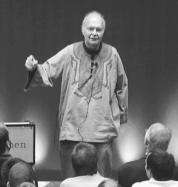
One of these question-and-answer sessions was held as a lecture on October 5, 2001 at the Technische Universität. The session was transcribed in the Notices of the AMS (American Mathematical Society). You can download it from that site. The original post carried my Spanish translation of the questions I found most interesting; here, in English, each section has a short excerpt from the original instead. I invite you to get to know one of the great thinkers of computer science (the headings are my fault).
Computer science
Knuth opens by explaining the format, and the first question asks him to comment on the priorities of the PITAC report to the US president. Another asks about cryptographic algorithms and the efforts of politicians to limit research on them.
Knuth: I think that’s a brilliant solution of the problem of what to present to a president. But in fact what I would like to see is thousands of computer scientists let loose to do whatever they want. That’s what really advances the field.
God and computing
The questions here are about the algorithms that belong in God’s “Book of Algorithms”, and about the relationship between God and computers, which Knuth answers by way of his book 3:16 Bible Texts Illuminated
\[BTI\].
Knuth: The journey is more important than the destination.
The future of computing
He is asked for the five most important problems in computer science, for his thoughts on quantum computing, and whether we will ever have intelligent machines, citing the books by Hans Moravec
\[Mo\]and Ray Kurzweil
\[Ku\]and Christos Papadimitriou’s novel The Smile of Turing [Pa].
Knuth: I don’t like this “top ten” business. It’s the bottom ten that I like. I think you’ve got to go for the little things, the stones that make up the wall.
On software patents
Knuth: I’m against patents on things that any student should be expected to discover. There have been an awful lot of software patents in the U.S. for ideas that are completely trivial, and that bothers me a lot.
The art of programming
The last questions are about the connection between mathematics and computer programming seen as art, and about the checks he writes to people who report errors in his books.
Knuth: I think of programming with beauty in mind, as being something elegant, something that you can be proud of for the way it fits together. Mathematics in the same way has elegance.
The rest is in the original transcript.
Comments
comments powered by Disqus