$ cat posts/beware-the-stylist.md
Beware the stylist
“Don’t ask the barber whether he thinks you need a haircut,” Chato advises us, a reflection that grew out of some conversation with patent lawyers. Well, it’s true that we can regard many practitioners of the law as the cause of most evils, but let’s not get carried away either.
Carlos wrote a nice post, but the ideas he slips in are dangerous.
“El profesor no tiene la cabeza en enseñar, porque el doctor no sale de su casa para sanar” (“The teacher’s mind isn’t on teaching, because the doctor doesn’t leave his house to heal”), sang Jorge González in the 1980s. Governments ask the teachers’ unions what the best way to improve education is. The teachers’ unions answer that raising their salaries is an excellent measure, but that evaluating teachers and demanding excellence from them would be disastrous for the students. That professional associations exist is not the problem. The problem is that you cannot assume they will look after the common good, because they only look after the interests of their own.
Doctors, and even more so the pharmaceutical industry, have been accused of the same thing. Many of them, plain and simple, want us to keep going to the doctor and buying medicine. Medicines are not always sold by prescription only as a matter of public health. Sometimes it is because it suits some people that we need to go to the doctor to get well, that we cannot fend for ourselves. Scientists and artists have not escaped the same accusation either: that they don’t need an environment free of pressure because their search for knowledge and beauty requires it, but simply because anyone would like to have all the time in the world to gaze at their own navel."
(the bold is mine)
It is hard to disagree with these arguments, but they are dangerous, because this is the kind of argument that erodes the power of unions, undermines the legitimacy of professional bodies, gets in the way of democratic debate and, in the end, damages the social fabric. They stay at the accident and never get to the essence of the problems. They are also caricatures, and reasoning from caricatures leads to naive, almost childish solutions.
But the other thing that bothers me about Carlos’s article is that mix of arrogance and naivety:
“For this, for all of this, what the people who promote free software have done is so important. This is a group of people with a very lucrative profession who have decided to reveal a great secret of their trade. That secret is that even when there is little or no money involved, there will still be software. Because programming is a compulsion, because it is extremely satisfying to do, and because there is an extraordinary and wonderful imbalance between the time it takes to write a program and the impact you can have if millions of people use it.”
The images that come to mind when I read this sort of thing range from nuns rescuing prostitutes in Amsterdam’s Red Light District to young environmentalists, settled in a remote village in Sub-Saharan Africa, teaching children how to use energy-saving light bulbs.
Truth is, I don’t know whether I should tell some young programmers I know that, since they practice such a lucrative profession, the right thing would be to donate their time to an open source project, which will then be used by the very company that employs them so it doesn’t have to pay for licenses or maintenance contracts. I can’t bring myself to go that far.
Besides, tell me there is no arrogance in declaring how good we programmers are because we have shown the world the way(*):
Once this secret is revealed, what is left for the rest of society is not to ignore what it has heard, but to take advantage of it. And so you can see there is no trick behind it, free software is not only free, its code is open and it is provided under a legal agreement that gives every possible guarantee. Obviously there are people in my profession who would prefer things to be otherwise, but there is enough critical mass for there to be as many voluntary waivers of our guild’s monopoly rights as are needed. Maybe someday other professions will do the same.
(again, the bold is mine)
(It seems Chato hasn’t read the part that says “This program is distributed in the hope that it will be useful, but WITHOUT ANY WARRANTY” (GPL v3), it seems ;)
Enough. Let’s not be naive, because in the end, who benefits from these free culture ideas? The *Cloud Computing Lords, as Jaron Lanier would say, like Google, like Yahoo.
What greater benefit for a company that lives off information than for all information to be free, open, accessible? Because that is better for the business model (which boils everything down to selling advertising (**)). And who demands anything in return from these companies? Where is the source code of their essential algorithms, of the core of their business? No, that is hidden away safely in the cloud. And to muddy the waters, they release what has already become a commodity. After all, that’s what we have geniuses for, inventing for us, happily working 20 hours a day, living on candy and soda.
Ideas have value when they are secret. The people who pay those lucrative salaries to these brilliant but naive minds know that very well, while those minds spend their time feeding these pipe dreams of freedom. But besides, the source code doesn’t matter, because it no longer has any value, so it makes no difference whether it is handed over, given away, passed around, do whatever you want with it.
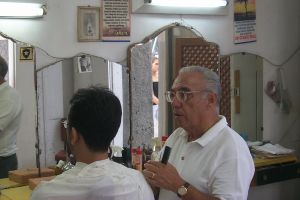
I will keep asking my barber whether I need a haircut, because I like him and he needs the work. The ones I don’t like are those stylists who work at those international fashion style chains and come to tell me what we need.
(*) Yes, we programmers are very arrogant, I know, I know, don’t bug me.
(**) By the way, this post is going to fill up with ads for makeup, hairdressing and styling classes; feel free to take the chance to get a little touch-up.
Comments
comments powered by Disqus