$ cat posts/perspective.md
Perspective
“Perspective is worth 80 IQ points”
– Alan Kay
Alan Kay originally meant to go into biology; it was almost by accident that he ended up in computing. In one of his talks a few years ago, Kay admitted that if he wanted to go back to microbiology it would take him a long time to catch up, given the incredible progress that discipline has made over the years. The same, he says, is not true of computer science, which strikes him as stagnant.
“Much of what is wrong about our field is that many of the ideas that happened before 1975 are still the current paradigm.”
And Alan Kay has been saying it for a while. This 1997 video from OOPSLA shows what could be done with computers in 1972 (the demo starts at 3 minutes 40 seconds):
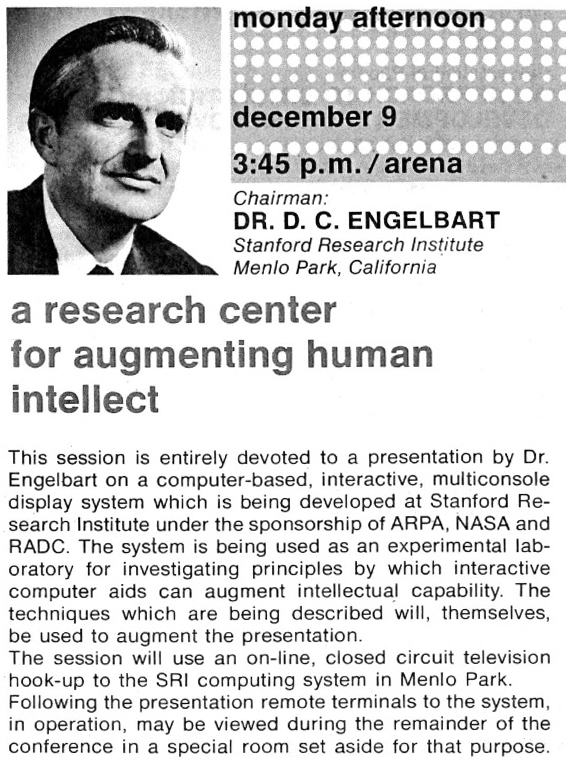
The mouse, one of the great innovations of the 1980s, was first presented by Douglas Engelbart in The Mother of All Demos, in 1968. That legendary demonstration showed, besides the mouse and for the first time, data networks, teleconferencing (with video), email, hypertext and real-time collaborative text editing (did somebody say Google Buzz Wave?).
All the inspiration for Engelbart’s work came from Vannevar Bush’s 1945 article “As We May Think”. Many of you have probably never read it; here it is.
That long article introduces the concept of the Memex, a device that anticipates the idea of our computers using hypertext to navigate information, concepts that became the foundation of Tim Berners-Lee’s World Wide Web.
In 1992 Michael Buckland criticized Vannevar Bush’s vision as incomplete and as failing to understand “information science”, given his low opinion of indexes and classification schemes: “Bush thought that the creation of arbitrary associations between individual records was the basis of memory, so he wanted a 'mem(ory-)ex', or 'Memex instead of index'. The result was a personalized, but superficial and inherently self-defeating design.”
If you look at the first attempts to classify the information on the web, they all clung to the idea that information had to be indexed. Nobody seemed to consider the intrinsic value of hyperlinks, the thing Vannevar Bush championed. Buckland had managed to impose “the correct view of information science”.
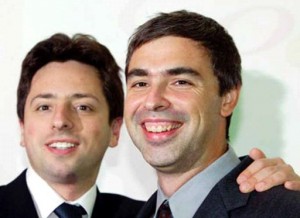
The revolution in search, the real innovation of that era, came from the work of Larry Page and Sergey Brin and their concept of PageRank, which places intrinsic value on Vannevar Bush’s ideas and defies the conventional wisdom of Buckland’s “information science”. Page and Brin took a different perspective from their competitors, and that is how they won.
The great advances in computing have come about that way. Everyone else just keeps improving and optimizing problems already solved. Few people in computing bother to study their past, so they repeat the same mistakes over and over, or simply reinvent the wheel.
We keep stagnating. Once we take one small step, we get stuck in a loop of micro-optimizations, without making any significant quantum leaps. That is Alan Kay’s complaint, and he is largely right.
Today we have plenty of “Bucklands”, especially in academia, telling us that this or that is the correct paradigm and shutting down any attempt to approach problems from another perspective.
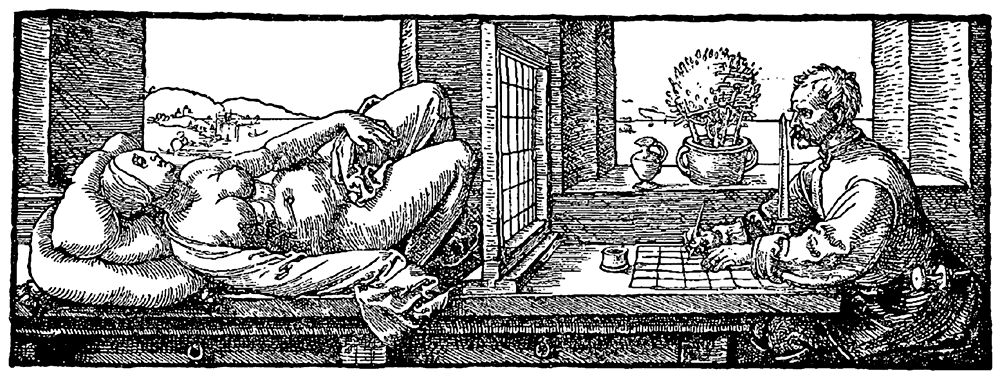
Every advance has to break with the established order. We need to look back, and understand and take ownership of what has been handed down to us. We need to step off the narrow paths our teachers laid out for us. In short, we always need to take up new perspectives; only then are we in a position to innovate.
Comments
comments powered by Disqus