$ cat posts/and-yet-we-failed.md
And yet, we failed
Amid all the celebration over the rescue of the 33 Atacama miners, a historical image comes to mind. When a victorious Roman general entered Rome in triumph, leading the victory parade, he was accompanied in his chariot by a loyal slave, who held a laurel wreath over his head and kept whispering in his ear: “Look behind you. Remember that you are only a mortal” (Respice pos te! Hominem te memento!)
\[1\]And it’s good to remember our limitations, especially now that our engineering is being showered with praise, which it deserves, by the way. But there is a technological lesson in this rescue that we shouldn’t let slip by, and Juan Carlos Barroux explains it on his excellent blog Tecnología e Innovación.
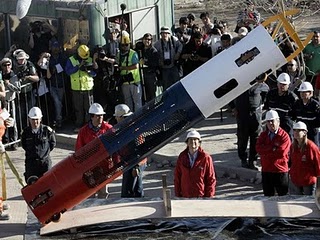
After analyzing the technology of the famous Fénix capsule, Juan Carlos offers the following reflection:
The Fénix capsule is without a doubt an incremental advance, driven by the need to modify the earlier design in the face of requirements an order of magnitude harder. Chilean engineering showed its great strength in process management, following a meticulous testing protocol. The country showed itself for what it is: an orderly country where procedures work. A complete success in the eyes of the world. Good for the miners and good for Chile.
And yet, to me, we failed.
I’ll be called a killjoy, maybe with some reason, but it’s when everything is going perfectly that the seeds of defeat are sown. Let me argue my case. Who owns the design? Who holds the IP (i.e. Intellectual Property) of the Fénix capsule? Who started the process to obtain the patent? I searched the patent database, and quite simply nobody has started that process yet. Without reading the agreements and contracts between the Government of Chile, via Codelco, ASMAR or whoever, and NASA, it isn’t possible to know whether it was spelled out in some clause. I suspect that, the goal being to rescue the miners alive, any secondary goal of developing the mining cluster ended up, once again, in the bottom drawer.
On the other hand, which Chilean university took part in the design process?
As far as I know, none. None. I find it very hard to believe that the mechanical engineering departments of the Universidad de Chile, the UTFSM, the PUC, the Universidad de Concepción, to name just a few, aren’t capable of taking the requirements and, building on similar solutions such as those described in patent 4,254,994, designing, building, testing, validating, patenting and generating value with a solution similar to the Fénix capsules, for whose design we had to call in none other than NASA.
Why? What happened? Do our politicians and leaders not trust homegrown designs? If that’s the case, then the ghost of Transantiago still haunts us and we are condemned to perennial underdevelopment. Are we excellent engineers of production processes who, when it comes to designing something new, don’t know where to start? It’s possible, and that would explain why it took a foreign systems engineer to tackle a new and not clearly structured problem. I’m talking about systems in general, the systems of General Systems Theory (GST), and not just the ones made of bits.
In Chile, systems engineering is not offered as a degree at the local universities, when that is precisely the specialty required to tackle problems that are new and, above all, unstructured, that is, incompletely specified. “Let’s take advantage of this accident to make a leap forward,” President Sebastián Piñera said today. So let’s take advantage of it.
(the bold is mine).
Juan Carlos left me thinking, because he’s right. Why do we always have to turn to foreign technology for help to solve our problems? It’s true, we seem to be good at following procedures, using technology, and solving and confronting problems when they show up.
We caused the drama of the San José mine, and we were capable of solving it. We are reactive, not proactive.
Maybe that’s why we’re such a mess, and so bad at planning: because we’re confident that if a problem comes up we’ll be able to solve it. “Let’s just push ahead, and we’ll fix whatever screw-ups are left along the way.”
Comments
comments powered by Disqus