$ cat posts/state-of-open-source-in-chile-chileforge.md
The state of open source in Chile: the ChileForge community
“Talk is cheap, show me the code,” says Linus Torvalds.
Marco Zúñiga recently threw down a challenge, an acid test for the Chilean open source community. The idea is to put what Linus Torvalds says to the test: whether these communities actually move from talk to action.
As it happens, a few weeks ago I decided to look into the open source repositories we have in this country, mainly prompted by a curious incident involving the ChileForge site (more background here). So I decided to check what had become of this community, and set about analyzing the ChileForge repository. Below I share the result with you. I think it is a good piece of evidence to bring to the debate on the viability of open source in Chile, or at least, for those interested in collecting that dinner from Marco, now you’ll know where not to look ;)

Description of the site, taken from its home page:
“ChileForge is a project driven by the Computer Science Department of the Pontificia Universidad Católica de Chile, which seeks to contribute to the spread and development of software in Chile, under the Open Source model.”
Cutoff date for this analysis: September 16, 2010
Summary: 52% of the projects have released some product, which doesn’t guarantee it is anything usable. The average number of developers per project is 2.2. There has been no activity on the site for 6 months. Only 1 project shows activity in the last year, and only 2 projects show activity in the last two years.
Background:
Registered users: 1,096
Registered projects: 193
Cataloged projects: 106
The analysis went on using the 106 cataloged projects as its base.
Developers: the idea is to look at participation per project, to determine how community-driven the projects are.
Total developers: 235
Average team size: 2.22
\[developers / project\]58% of the projects have only 1 member
22% of the projects have only 2 members
The distribution of developers per project is as follows:
This chart shows the distribution:
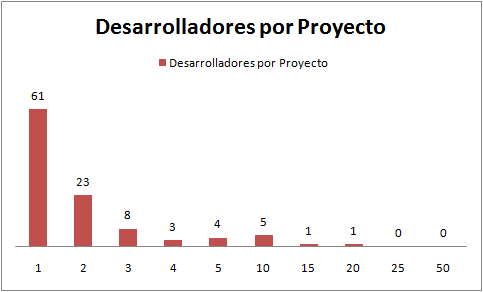
The vertical axis is the number of projects; the horizontal one is the number of developers (members) signed up to each project.
The two projects with the most users are:
Sistema Centro Médico 2005 (http://chileforge.cl/projects/tec) with 16 members, created on April 7, 2005, whose only released file is a PHP class for sending messages using SMTP (imported from an earlier version of the PHPMailer project on sourceforge).
Rizoma (http://chileforge.cl/projects/rizoma/) has 15 registered members, but it is a project that decided to migrate to Savannah, apparently because of support problems with ChileForge. This project seems to be still alive (they have a blog where they report that version 1.0 was released for FLISoL Santiago 2009).
Project maturity
The site lets projects be cataloged by their degree of maturity. The possible states are: Planning, pre-alpha (I suppose in this state there will be some prototype), alpha (a first version without much debugging), beta (with some bugs; users are already starting to use it), production/stable (the project is already in production), and mature (that is, the product now stands on its own and gets maintenance, or new versions are being planned). The distribution is summarized in the following chart:
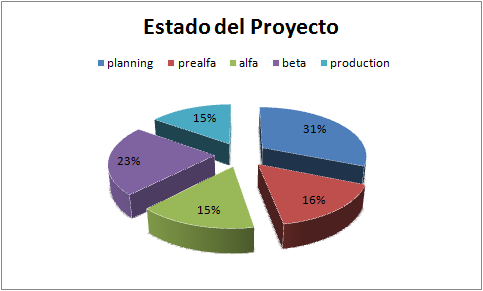
The classification is dubious. For example, there are projects that have released code that looks quite usable, yet they show up as being in the planning stage. In one case (xanubis), the project is cataloged as Production/Stable, yet it has not released a single file, and has only a message that says “We’re just about to start the Xanubis Project”.
The interesting part is seeing how many projects have released some product (downloadable files). For this we counted the projects that had some file available for download. Only 52% have released some product. But, I insist, the quality of these deliverables is dubious; you would have to download the files and analyze them to give a more precise diagnosis of the projects’ maturity. From the little I looked at, I can say they were almost always files in their first version, or just some ancillary files (like the case mentioned above).
Version control: 7 projects (7%) have no version control of any kind; 86 projects (81%) have CVS set up, but the repositories are gathering cobwebs, since they have never been used. Of those left (13), usage is minimal, with no more than 2 or 3 commits per project. This is where the technical immaturity of the ChileForge community shows the most.
Activity
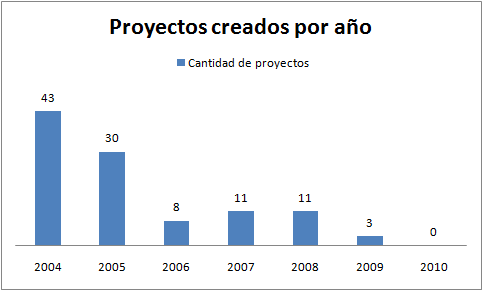
41% (43) of the projects were created in 2004, 28% in 2005. This is the distribution:
To measure a project’s lifetime we counted the number of days from when the project was created until the most recent version of any of the project’s deliverables was released. For example, the longest-lived project (reqadmin) was registered on May 30, 2005 and has released 6 files; the last one is version 0.4 beta, dated June 8, 2008. Between the registration date and the last beta, 1,105 days (37 months) went by.
By this criterion, the average lifetime is 7.6 months, and the median is 4.5 months. The distribution of project lifetimes is shown in this chart (expressed in months):
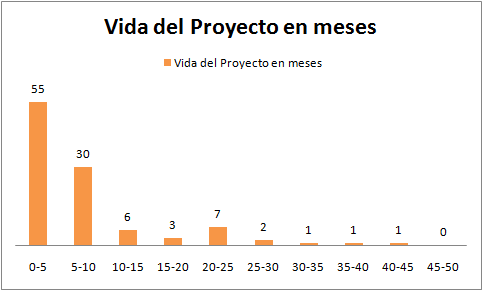
The height of the bars represents the number of projects that fall in the range. The ranges are 5 months wide. For example, the first bar indicates that 55 projects have a life of between 0 and 5 months.
The other parameter is how much activity the project has had in recent months. In this case what we measure is the date of the last product released (the same parameter used to measure the project’s “life”). Here the data is discouraging:
Activity in the last 6 months: no project shows any activity.
Activity in the last year: 1 project
Activity in the last 2 years: 2 projects
If we count the news items published on the front page, we have:
1 news item from 2010, reporting that the Chileforge.cl domain has been recovered
One news item in 2009
28 messages in 2008
Conclusions
ChileForge is a community with very little activity in recent years. Although in its early days (2004) it showed great momentum, its use declined over time, to the point that this year it was inactive for several months.
For a 6-year-old community, this degree of inactivity is a bad indicator. Consider that open source communities have a high degree of participation and activity (Sourceforge, GitHub, even CodePlex, Microsoft’s open source repository).
What is going on with ChileForge? Could it be that users prefer to host their projects on the international repositories? Lack of publicity? Or are there other, deeper causes that explain this lack of activity? I invite you to debate this case.
In any case, I promise that next year I will repeat this exercise, and we will review the state of this community once again.
Comments
comments powered by Disqus