$ cat posts/isnt-it-funny.md
Isn't it funny?
Over at Manzana Mecánica they mention a report on the international landscape of open source software in 2010. Nice study, a bit long. When I started leafing through it, a series of charts like this one caught my eye:
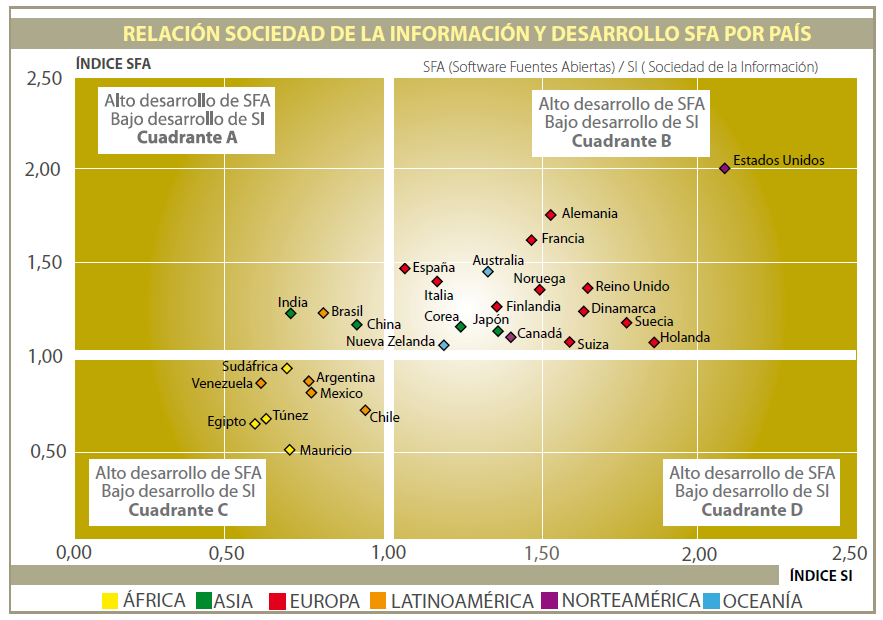
What do those charts mean? (there are several in the report)
The horizontal axis is the information society development index, and the vertical axis is the open source software (OSS) development index. The quadrants are marked off too; the idea is to show us the magic quadrant (top right), which is supposedly the best.
Aha!, says the OSS Taliban, the more open source code there is, the better societies do on their information society development index. But that’s not it(*)!
Well, the report’s authors refrain from saying anything that crude. After all it’s only a landscape, a glance at how things stand, so there are no hard conclusions of that kind. Still, I read the executive summary, which says, in its last paragraph (where the conclusions normally go, right?):
The open source software development model is a globalizing model in which the actors take part over the Internet in different projects in an environment of cooperation, regardless of the nationality of the actor or of the project, with no differences by geographic area either in how the communities operate or in the associated business models.
Ha!, I say. And why am I laughing? Because of this:
The cloud computing model is a globalizing model in which the actors take part over the Internet in different projects in an environment of cooperation, regardless of the nationality of the actor or of the project, with no differences by geographic area either in how the communities operate or in the associated business models.
Not long ago, reading an article on the opportunities of cloud computing for developing countries (or emerging ones, as they are called now), I read a conclusion almost identical to that paragraph above, so I couldn’t resist the experiment of swapping cloud computing for open source software development and seeing what happened, and apart from a couple of details that would need adjusting, it says basically the same thing.
Isn’t it funny?
(*) For the clueless: there are many ways to interpret this correlation, but the simplest and most logical one (what was it Ockham said?) is that OSS will always be correlated with the level of development of the information society; this is tautological. A more developed information society means more programmers and more universities, which will obviously produce more open source software! These indicators don’t actually prove anything.
Comments
comments powered by Disqus