$ cat posts/we-are-doing-it-wrong.md
We're doing it wrong
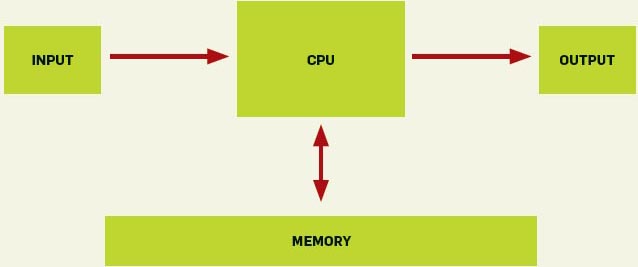
The following diagram is the model of a computer taught to every student of computer engineering or computer science:
 ]
]
The problem is that this model was fine some 40 years ago, but it has nothing to do with modern computer architectures.
In an interesting analysis Poul-Henning Kamp shows how an algorithm that has been considered efficient for 47 years, and has even been analyzed by great luminaries like Donald Knuth, can be optimized by an order of magnitude if you take into account the effects of the architecture it runs on.
Consider this: 30 or 40 years ago, when a virtual memory access caused a “page fault”, a disk access was required, which took about 2 milliseconds. Back then a CPU executed an instruction in 2 microseconds, so in the 2 milliseconds the disk access took, 1,000 instructions were lost.
On a modern computer, where clock frequency is measured in GHz, the worst case means losing 10 million instructions on a page fault (assuming solid-state disks, SSDs; with a regular disk the number is close to 100 million).
What good is an O(log2(n)) algorithm if those operations cause page faults and slow disk operations? For many datasets an O(n) or even an O(n^2) algorithm that avoids page faults would run much faster.
Performance analysis of algorithms will always be a cornerstone achievement of computer science. But the results coming out of the computer science department would be more interesting and useful if they applied to real computers, and not toy ones.
– Poul-Henning Kamp You’re doing it wrong._
Comments
comments powered by Disqus