$ cat posts/bill-gates-pancakes.md
Bill Gates's pancakes
The sorting problem is one of the basic topics in every programmer’s training. But perhaps this well-known problem holds the key to understanding how the evolution of life works. How? That is a story involving none other than Bill Gates, but before telling it let’s review this classic computing problem.
How do we sort a series of data? It is such a basic task that we almost take it for granted. It even comes built into our languages and operating systems, or as a standard function in every spreadsheet program.
One exercise that has become popular is: what is the most efficient way to sort a million 32-bit integers? It is even used as a hiring test. The answer of course depends on many assumptions. At least Barack Obama knows that bubble sort is not the best algorithm, but is an “efficient” algorithm, like quicksort or heapsort, the best way to solve this problem?
How do you measure the efficiency of an algorithm? By the time it takes to run, or by the memory it uses? That is why there are variants of this problem, like a fairly popular one that goes: how do you sort a million 32-bit integers in 2 megabytes of memory? A trick question, because a million 32-bit integers take up 4 megabytes. Believe it or not, even the greats struggle with this question, like the great Guido van Rossum (creator of Python), as you can see in this article.
Another classic form of this problem appears in the first chapter of
that wonderful book every developer should have in their
library: Programming Pearls (2nd Edition)
Bentley’s problem is to sort a file of numbers in the range 0 to 999,999, with only 1 megabyte of memory. The interesting thing about Bentley’s column is that it teaches the importance of pinning down the specification in order to reach a suitable solution. In Bentley’s case he not only gets a solution that works in a small amount of memory, he also gets an efficient O(n) algorithm, using a very efficient data structure.

But let’s get to the surprising story about sorting, which involves a millionaire and some pancakes.
Bill Gates sorts pancakes
What many of you may not know is that Bill Gates made a scientific contribution to the sorting problem by writing a paper (the only known mathematical article that bears his name) describing the obscure pancake sorting algorithm. If you don’t believe me, here is the link to the paper, published in Discrete Mathematics in 1979.
The idea is to sort a stack of pancakes by size, using a spatula. The only operations allowed are inserting the spatula and flipping the pancakes.
To give you an idea of the operation, this is the drawing that accompanies the explanation of the algorithm on Wikipedia:
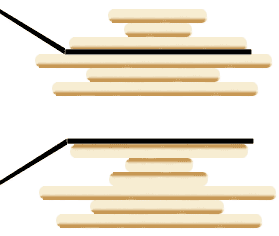
At the top we see how the spatula has been inserted in the middle, and then it is turned, flipping the first three pancakes.
The problem is to find the algorithm that sorts the pancakes, leaving the largest at the bottom and the smallest on top, using the fewest operations (flips of the spatula).
The interesting part is that a variation of this algorithm, known as the burnt pancake problem (Burnt Pancake Problem), was developed by one of the creators of Futurama, David X. Cohen, and was implemented in 2008 with a “computer” made of E. coli bacteria that flipped segments of DNA. The problem was solved when the bacteria developed resistance to antibiotics (?).
The truth is that it’s complicated, but here is another link for when you decide to look into bioinformatics and play with bacteria that shuffle segments of DNA.
What matters is that DNA evolves through small mutations. In trying to understand these mutations, biologists found that this obscure mathematical problem can shed light on the way life evolves through mutation.
Who knows, maybe one day Bill Gates will go down in history not as the aggressive super businessman, but as the accidental discoverer of a fundamental mechanism for understanding how life works.

Comments
comments powered by Disqus