$ cat posts/distributed-version-control.md
Distributed version control
My previous note on version control was well received, and I got comments from people who are not software developers, which is good. I insist that version control is a tool with applications outside the programming world.
But last time we talked about centralized systems, like Subversion (SVN) or CVS, the most popular ones. This time I want to invite you to try distributed version control systems, or DVCS.
If your mind has not been damaged by systems like Subversion or CVS, you will have no trouble adopting these systems, and I suggest you explore the two most popular ones today, Mercurial (hg) and Git.http://git-scm.com/.
When you first face a DVCS coming from the world of centralized systems, the model is hard to adopt. You have to relearn a few things.
I suggest reading this tutorial by Joel Spolsky, where he explains very well the changes we have to make when we move from a centralized system like Subversion to a DVCS, Mercurial in his case.
The main thing is the freedom we gain as developers.
Subversion keeps us from getting the benefits of version control because it always forces us to commit only when the code is fully tested and bug-free, or else we are wrecking everyone else’s work.
This Geek and Poke cartoon lays out the problem:
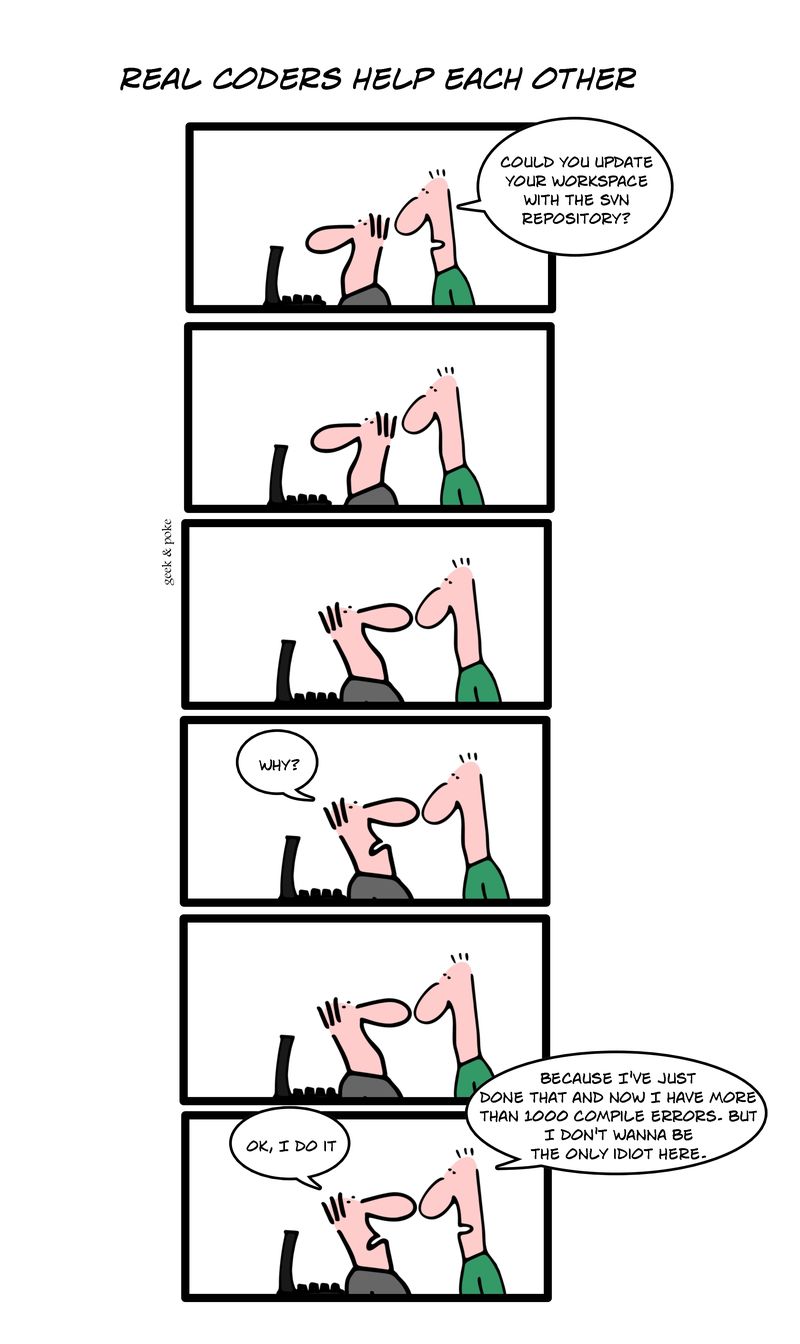
With a DVCS programmers work on their own private copies of the repository without interfering with the central code.
DVCSs have very good mechanisms for merging code that comes from different branches.
Git is an outstanding example here, since Linus Torvalds himself is able to merge from 12 different branches with almost no trouble.
I have evaluated 4 tools, using each of them for quite a while in my personal work.
The first tool I used was Bazaar, about 3 years ago. Bzr is the tool used by Canonical in the development of Ubuntu. It is written in Python, and it is quite simple to use.
The second was Darcs, an interesting tool, developed by a quantum physicist, which has a mathematical model (algebra of patches) and is written in Haskell. Recommended for those with more academic inclinations.
The third and fourth are Mercurial and Git.
As someone out there put it, Git is MacGyver, Mercurial is James Bond. Both have their pros and cons.
I like Git, and it is what I currently use personally. Bringing the change to the corporate environment where I work will take time, I think, but I can keep interoperating with Subversion thanks to Git.
What I like most about Git is that it is a very fast tool. It is probably the fastest version control system I have used, even when I push to a central server on the internet.
But the decision is yours. If you have never used Subversion or CVS, you are better off choosing a DVCS. If you ask me, I recommend Git, or Mercurial. The latter is probably simpler to use, but the former is more flexible and faster.
Comments
comments powered by Disqus