$ cat posts/leibniz-and-the-simplicity-of-the-laws-of-nature.md
Leibniz and the simplicity of the laws of nature
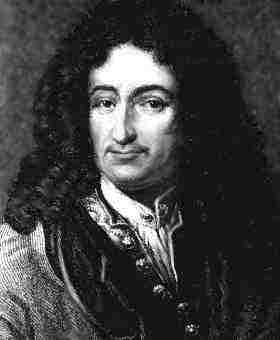
Sans les mathématiques on ne pénètre point au fond de la philosophie. Sans la philosophie on ne pénètre point au fond des mathématiques.
Sans les deux on ne pénètre au fond de rien.
– Leibniz
(Without mathematics we cannot get to the bottom of philosophy. Without philosophy we cannot get to the bottom of mathematics. Without both we cannot get to the bottom of anything.)
Guided by the mathematician Gregory Chaitin, we will venture into the ideas on complexity of the great philosopher and mathematician Gottfried Leibniz. This article is based on Chaitin’s talk titled “Leibniz, Complexity and Incompleteness”.
The first consideration of complexity that Chaitin finds in Leibniz is in the “Discourse on Metaphysics”, where he considers the “experimental data” given by ink spots on a piece of paper, obtained by shaking a quill pen over it. Take the finite set of points obtained this way, and ask whether it obeys a natural law. Well, for Leibniz it is not enough that there is a mathematical equation passing through all the points, because there always is such an equation. The set of points obeys a law only if there is a simple equation that passes through all of them.
The second example of the philosopher’s concern with complexity is when he asks “why is there something rather than nothing, if nothing is simpler than something?”, in 1714, in his “Principles of Nature and Grace.” In modern terms, what the rationalist philosopher wants to know is where the complexity we observe in the world comes from. For Leibniz the answer is God. God has created the best possible world, and all the richness and diversity we observe in the universe is the product of a simple, beautiful and elegant set of ideas. God maximizes the richness of the world while minimizing the complexity of the laws that determine it. In modern scientific terms, the world is understandable, comprehensible, and science is possible, because there is a law that can be understood.
The cosmologist Max Tegmark argues that it is simpler to consider an ensemble of all possible laws and all possible universes than to consider one particular universe. In other words, the multiverse is more fundamental than the question of the laws of our particular universe. To illustrate the idea, the set of all positive integers 1,2,3,... is very simple, even though a particular positive integer, such as 12478329212991232, can be arbitrarily complex.
I want you to think this idea through: it is simpler to think about the multiverse than to try to justify the complexity of our universe. All possible universes exist, and ours has nothing special about it when seen from that perspective. It looks complex, and special, simply because we live in it.
In the Monadology Leibniz discusses the means of carrying out a mathematical proof. There he notes that to prove a complicated statement you break it down into simpler statements, until you reach propositions so simple that they are self-evident and need no proof.
Epistemologists have analyzed Leibniz’s ideas, and have observed that this crucial idea of complexity in Leibniz is something very hard to pin down. How do we measure the complexity of an equation, and therefore the complexity of natural laws?
If we propose the length of the equation as a measure, that is something that changes over time. Besides, what are the basic elements an equation is allowed to have? Do Bessel functions count as part of the standard notation?
If nature is to be governed by simple laws, as Leibniz demands, we need to know how to measure the simplicity of those laws. Well, Chaitin has a proposal, but we will talk about that in the next article.
Comments
comments powered by Disqus