$ cat posts/the-simple-the-complex-and-the-complicated.md
The simple, the complex and the complicated
When we say something is complex we mean to suggest that it is the inevitable result of combining its elements, and that this implies no fault or failure, as when we say “a recipe is complex”.
Complicated, on the other hand, is what we call something that is very hard to understand, solve or explain, for example “a complicated court case”.
Look at this image:
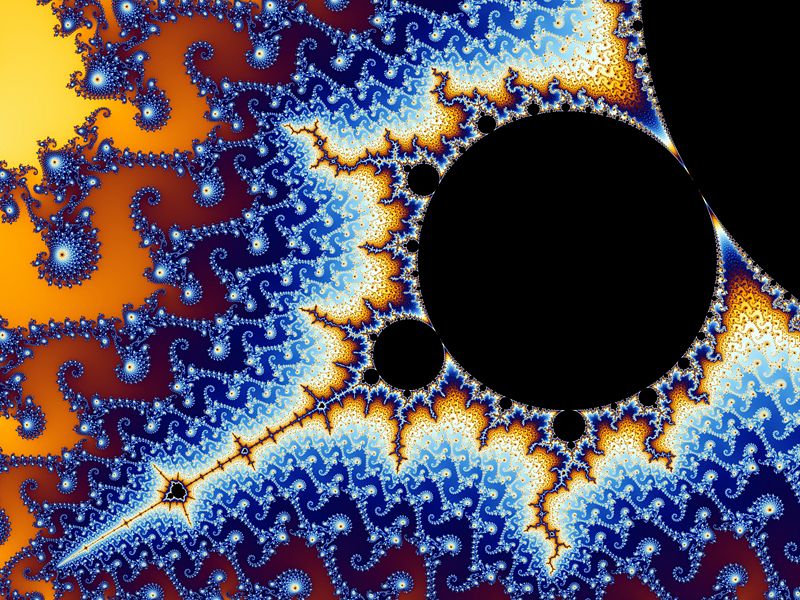
This is undoubtedly a complex image. In case you don’t know it, this is the famous Mandelbrot set, a fractal, a geometric figure with the peculiar property of self-similarity: if we zoomed in on some parts of the image we would get images as beautiful and complex as this one. You can check what I’m saying by watching this video on youtube, which explores the Mandelbrot set.
It is clearly a rather complex image, with infinite detail.
And yet mathematicians tell us that the information contained in the image above is essentially zero.
The Mandelbrot set, which produces the image above and the video I pointed you to, can be expressed in fewer than 140 characters (in a tweet of 48 characters):
M= C**{z: | (z+(z+(z+(...+(z+z2)2...)2)2)2)**2 > 2}
That is a complicated expression for someone who doesn’t know much mathematics. But it isn’t very complex. In fact, a program that computes the Mandelbrot set takes no more than about 50 lines of code (depending on the language)1.
The original image above is 800 x 600 pixels, and each pixel has 24 bits of information, so if we stored the image in a file it would take 11,520,000 bits. Yet the program, written in C, that describes that image could take about 64,000 bits.
The Russian mathematician Kolmogorov invented the concept of Descriptive Complexity, or Algorithmic Entropy, to try to measure the computational resources needed to describe an object.
For example, consider these two strings of letters (taken from wikipedia):
    abababababababababababababababababababababababababababababababab

    4c1j5b2p0cv4w1x8rx2y39umgw5q85s7uraqbjfdppa0q7nieieqe9noc4cvafzf
Both have the same length, 64 characters. However, the first string can be expressed as “ab 32 times”, in just 11 characters. For the second string there seems to be no shorter way than writing it out directly.
Kolmogorov would say the first string is less complex than the second.
Now, back to the Mandelbrot set. It turns out that the program that computes the points of the set has a parameter, which sets the number of iterations needed to determine the next pixel to draw. And if we choose to draw a more detailed segment of the Mandelbrot set, that is, to zoom in, this parameter has to be larger, which means the computer spends more time and resources to generate the detail of a deeper part of the set. Clearly, the definition of algorithmic complexity, taken as the length of the program, doesn’t seem to adequately reflect the actual CPU usage in this problem.
The question is whether this definition of complexity is adequate. Because according to Kolmogorov’s notion the Mandelbrot set is not a complex thing, and we have already seen that in terms of computational cost (energy and processing time) it doesn’t look simple.
On the other hand, a random object such as the string “4c1j5b2p0cv4w1x8rx2y39umgw5q85s7uraqbjfdppa0q7nieieqe9noc4cvafzf” has a very high (or maximal) Kolmogorov complexity, but it is not a very interesting thing to study.
A television showing nothing but static isn’t very interesting. In the end it is just plain noise, but that random noise is complex in information terms, if we follow Kolmogorov’s idea.
This notion of complexity is not satisfactory, and a lot of research effort goes into finding a mathematical definition of complexity that captures our intuitive notions of it.
I want to invite you to explore the study of complexity, something that, as we will see in the coming articles, has been a rather complicated task. :)
Notes:
to complicate things, the z in the expression are complex numbers (I couldn’t help it, sorry ;) ↩︎
Comments
comments powered by Disqus