$ cat posts/when-open-really-means-closed.md
When open really means closed
In 2009 Andreas Constantinou questioned the notion of open source in his article “Open is the new closed”, analyzing in detail a fact we’ve discussed before: releasing the code isn’t enough; control over how an open software product is developed is as important as, or more important than, having the source code.
The word open comes across as something positive. The same thing happens with it as with the word transparency: both are pretty words that signal good intentions. Everyone promises openness, transparency; they even set up commissions and publish a page on their website with transparent information, but deep down what we all expect when people talk about transparency isn’t delivered. The word itself becomes meaningless and we feel cheated.
Something similar happens with open software, open source, and free software: over time we realize they aren’t that free, and they aren’t that open.
Because if we look at the big projects, the successful free software projects, they have behind them the backing of big companies, or conglomerates of companies with very specific interests in controlling these products, so they’re free to the extent that the sponsors allow it.
Consider the case of Java or MySQL, which seem to be under threat right now because they’re under the control of a single big sponsor, like Oracle.
It’s entirely fair to think that the future of these projects is threatened when their control, their governance, has fallen into the hands of a company that operates quite aggressively in the market.
There have been problems with IBM and the patents it promised not to use against the open source community, the moment it saw its mainframe business threatened.
The reason for these problems is that open source licenses only tell half the story, as Constantinou rightly points out.
Licenses govern control of the source code. But in the mobile industry, for example, the source code and the products are two very different things. For example, although you can play with Android’s source code, do you know whether the latest updates to the code are visible? Who decides what goes into the latest release of Symbian? You can create your own browser based on WebKit, but why is it so hard for your contributions to the source code to make it to the top of the tree?
The other half of the open source story is the project’s governance model, which is what Constantinou talks about.
Every open source project must have a governance model. The linux kernel itself has a process for deciding what goes into the main branch of the source.
Constantinou’s company, vision mobile, has mapped this out in this chart:
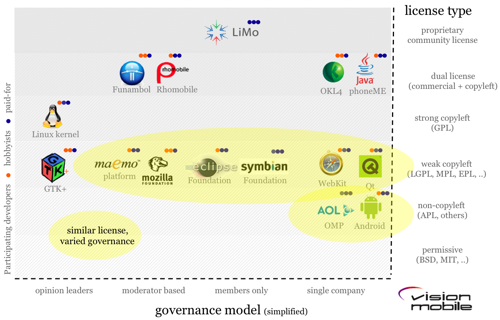
The vertical axis represents the type of license, from the most permissive to the most proprietary (all of them are open source licenses). The horizontal axis shows one variable of the governance model, which has to do with control of the main branch of the code and whether it is controlled by individuals, moderators, a closed club or a specific company. For example, in the case of the linux kernel, control is exercised by a group of opinion leaders (Torvalds and his lieutenants); in the case of Java and Android, there is a single company that decides what finally goes into the main branch of the code.
On the map, next to each project, there are some colored dots that tell us what proportion of these projects’ developers are paid to work on them. For example, in the linux kernel 2/3 are paid (that is, 2/3 of the linux kernel developers receive a salary to devote themselves to contributing to this project).
What an interesting map this is. It’s very revealing.
What Constantinou discovered is that:
Open source licenses (the large print that covers control of the sources) are widely used, converge and are well understood
Governance models (the fine print that controls the product) are proprietary, diverge and are very poorly understood.
This matters, because if we aren’t shown how the development of a product is governed, however open its code may be, most likely its development model, its governance, is totally closed, and deep down we are being fooled. In reality open is closed, and that’s not a paradox.
Comments
comments powered by Disqus