$ cat posts/1-of-5000-or-5000-of-1-batch-and-transactional.md
1 of 5,000 or 5,000 of 1 (batch and transactional)
It’s easy to fool yourself when trying to optimize. What seems logical, and even numerically plausible, can blow up in our faces when we analyze it in detail, especially when we put it to the test in practice.
It’s typical for some expert to advise us to use a certain technique because in theory it’s more optimal. Novices tend to apply these proposals without questioning them much. We older hands tend to trust experience, and experience usually proves us right.
That’s what happened to Jeff Attwood, who in a really brilliant post shows that the expert was wrong, and that what practice was telling him had a basis after all. And the problem Attwood explains is interesting, because I’ve run into the same one several times, even recently.
It goes more or less like this, according to an expert quoted by Attwood
“If you are building an ASP.NET web application that’s going to get thousands of hits per hour, the execution overhead of Linq queries is going to consume too much CPU and make your site slow. There’s a runtime cost associated with each and every Linq Query you write. The queries are parsed and converted to a nice SQL Statement on every hit. It’s not done at compile time because there’s no way to figure out what you might be sending as the parameters in the queries during runtime.”
Although Jeff Attwood is talking about Linq and ASP.Net, the problem can be extrapolated to other environments, like PHP or Java, where we have queries that are interpreted at runtime.
Linq’s mechanism is quite elegant and, in my opinion, more powerful than other ORMs. In the particular case the author presents there is a Linq query more or less like this
    var query = from widget in dc.Widgets
    where widget.ID == id && widget.PageID == pageId
    select widget;
    var widget = query.SingleOrDefault();
The expert states that he was analyzing the problem with this kind of execution and discovered that executing this kind of statement dwarfs the time spent on the roundtrip to the database!!
That is, apparently more time is spent parsing these Linq statements than executing the resulting code in the database. So what you have to do, he recommends, is compile these queries before executing them (something that complicates the code quite a bit, and makes maintaining it a harder task).
You can imagine the face Jeff Attwood made when he read these claims:

Because he simply couldn’t believe it. In fact, the Stack Overflow site, with over 1.6 million page views a day, has many lines of code that depend on Linq statements like the ones questioned by Omar Al Zabir, the MVP expert, author of books on the subject.
And to give his argument more weight, Omar Al Zabir shows data from Rico Mariani, a Microsoft engineer who ran a series of experiments testing the performance of compiled Linq statements versus uncompiled ones.
This is the table Al Zabir shows, taken from the article with Rico Mariani’s experiments:

But there’s a little catch.
To understand why Omar Al Zabir’s claims don’t square with Attwood’s experience, you have to understand how the tests were done, and then we can see that Al Zabir makes a serious mistake, generalizing a solution that is highly dependent on the kind of operation we are going to perform.
Rico Mariani explains that to compare the two kinds of queries he basically ran these two tests:
For the precompiled queries:
start timer
for (j=0;j\<batches;j++)
    compile query

for (i=0;i\<runs;i++)
    create new data context
    run query in new context

stop timer
print number of selects and time etc.
For the interpreted (not precompiled) queries:
start timer

for (j=0;j\<batches;j++)
    for (i=0;i\<runs;i++)
        create new data context
        run query in new context
 stop timer
 print number of selects and time etc.
And what Rico Mariani does is play with the number of runs and the size of the batch, which produces a much longer table of results, one that has at the end some results that are ignored by Al Zabir (we don’t know whether intentionally). These results ignored by the “expert” are:
Testing 2500 batches of 2 selects 5000 selects uncompiled 9165.0ms 25000 records total 545.55 selects/sec
5000 selects compiled 7892.0ms 25000 records total 633.55 selects/sec
Testing 5000 batches of 1 selects
5000 selects uncompiled 9157.0ms 25000 records total 546.03 selects/sec5000 selects compiled 10825.0ms 25000 records total 461.89 selects/sec
You’re surely dizzy by now, but let me sum it up for you:
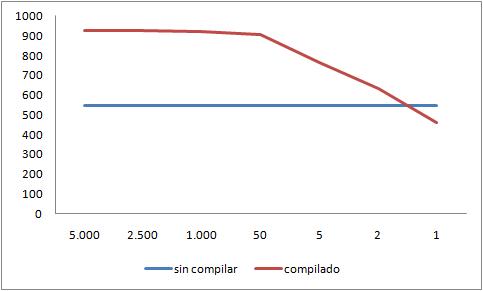
At the start of the experiment, the test is 1 batch of 5,000 selects. In the compiled case you get 925 selects/second, and uncompiled 543 selects per second. Winner: the compiled version.
At the end of the experiment, the test is 5,000 batches of 1 select. In the compiled case you get 461 selects/second and uncompiled you get 546 selects/second.
In fact, if we plot batch size against performance in selects/second, what’s going on becomes clear:
What does this mean?
It turns out we’re looking at the two extremes of possible applications. Attwood’s application is a web application, heavily transactional; that is, it sits at the extreme of 5,000 batches of size 1. On the other hand, Omar Al Zabir’s recommendations are useful when the batch size is large (batches of 5,000 or more selects). Al Zabir’s recommendations are very useful when we’re dealing with batch, offline, non-transactional applications.
That is the particular case of the applications I have to deal with at work: batch applications, processing thousands or millions of records, the exact opposite of transactional web applications. In my case Al Zabir’s advice could apply (if I used Linq).
Does this apply to the debate over compiled languages versus interpreted languages? Or to other cases, like using an ORM versus direct calls to the database with JDBC, for example? I suspect so, but it’s a claim that, as always, needs to be demonstrated, and for that you have to show the code.
References:
Comments
comments powered by Disqus