$ cat posts/computing-as-a-social-science.md
Computing as a social science
In the latest issue of CACM I read the testimony of Michael Buckley, a computer science professor at the University at Buffalo, who, in his article “Computing as Social Science”, wonders how to get young people excited about choosing computer science.
“With each new freshman class I worry that fewer students are choosing a career in computer science, and it’s no stretch of the imagination to think it’s an image problem. Not only are we not getting the word out to high schools, but I believe we’re losing students in the first year of college as well. And it’s because we don’t offer students the idea that computer science is social, relevant, important, and caring, and thus we lose their interest.”
His worries started while he was preparing his curriculum for the last semester:
“I teach Java, which is more than adequate for new programmers to learn everything good and bad about addressing a computer. What they learn is that computers never do what we want, but only what we tell them to do. And what we tell them to do in a freshman programming course is too often dull. Write to the operator, print out the results of a calculation, order some list, and all too often the message, calculation, and list are irrelevant. How can I get them interested?”
Going through textbooks for teaching programming, he realized how bad, and often irrelevant, most of the examples and problems in them were. Practice always beats theory, but the practice offered at the university is, apparently, not very realistic. Not one of the 60 books Buckley consulted made him think computing was socially relevant.
“
\[This matters because\]students’ firsthand experience with computers—their music and their phones—is accepted and reinforced by the image we portray in school—one of unrelenting banality and geekdom—and potential computer science students do not see themselves as having a greater impact.”
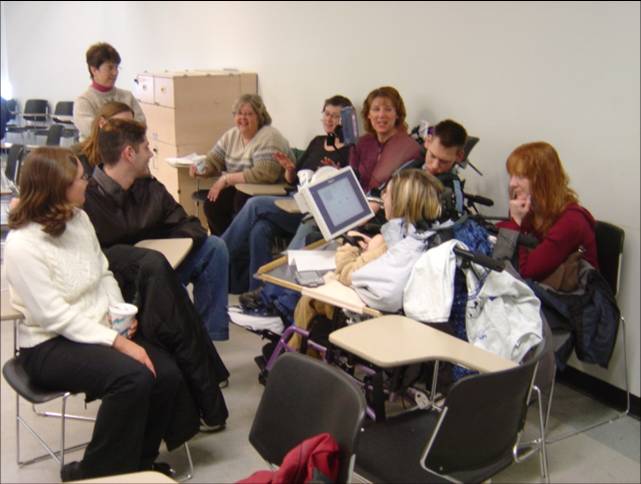
That was when he turned to two senior-level courses at the University at Buffalo that require students to build real systems for real clients. And not just any clients: the community of people with physical disabilities.
The instructions are simple: “Improve the quality of life of someone less able than you. If you can’t figure it out, you fail. So don’t fail.”
This project, developed together with Rice University and with support from Microsoft Research, has become a new paradigm focused on using computing to solve problems students are passionate about.
The program is called Socially Relevant Computing (SRC).
The cases are striking:
“David, who was 43, suffered a stroke at age 27, and hadn’t been able to speak since. He communicated with his nurses by pointing to a sheet of paper that was taped to his wheelchair. It had letters, words, and short phrases, and after much practice, a nurse or therapist could almost decipher what he wanted to say. So our students transferred that sheet of paper to a tablet PC, and when David touches a word, the computer speaks it. How difficult is that? Easier than counting doughnuts. The night they delivered that system, David called me at home with his new voice and thanked me. And said he waited 15 years to speak on the phone. And the pictures I saw later of the event clearly showed students crying.”
The projects include remote-controlled wheelchairs, video conferencing for kids who can’t leave their homes or the hospital, and a light and sound system that teaches autistic children the notions of cause and effect.
Do you teach computing?
Have you thought about making your examples, or your projects, socially relevant? Young people are looking for this, it matters. I invite you to read about this program; there is even a list of resources with supporting material for putting together a curriculum along these lines.
I’ve been lucky enough to take part in many socially relevant projects, and right now my work has a significant impact on my society. But there are plenty of young people who see computing as a nerdy thing, and who think that degrees like sociology, psychology, journalism or (horror) law are better ways to channel their desire to serve their community.
The truth is they aren’t. Computing is, and is destined to be, socially relevant, with an impact even greater than that of the traditional social sciences. It’s just a matter of showing young people this reality, and this beautiful ability our profession has to make a big impact on society.
Comments
comments powered by Disqus